The Energy Mix
Subscribe
Donate
  • Topics
    • Buildings & Infrastructure
    • Climate Equity & Justice
      • Energy Poverty
      • Indigenous Rights & Reconciliation
    • Climate Finance
      • Community Climate Finance
      • Finance & Investment
      • Insurance & Liability
      • Subsidies
    • Climate Impacts & Adaptation
      • Biodiversity & Habitat
      • Drought & Wildfires
      • Forests & Deforestation
      • Health & Safety
      • Heat & Temperature
      • Ice Loss & Sea Level Rise
      • Severe Storms & Flooding
    • Emissions
      • Carbon Levels & Measurement
      • CCS & Negative Emissions
      • Methane
    • Energy
      • Renewables
      • Fossil Fuels
      • Hydrogen
      • Nuclear
      • Batteries & Storage
      • Energy Efficiency
      • Power Grids
    • Food & Agriculture
    • Industry
      • Data Centres & Tech
      • Critical Minerals & Mining
      • Petrochemicals & Plastics
    • Policy & Politics
      • Carbon Pricing
      • COP Conferences
      • Elections
      • Energy Politics
      • International Security & War
      • Legal & Regulatory
    • Research & Innovation
      • International Agencies & Studies
      • Research & Development
    • Society & Culture
      • Climate Action
      • Mis/Disinformation & Greenwashing
      • Jobs & Training
      • Leisure & Recreation
      • Media, Messaging, & Public Opinion
    • Transportation & Mobility
      • Electric Vehicles
      • Shipping & Aviation
      • Transit
      • Walking, Biking & Micromobility
  • Regions
    • Africa
    • Arctic & Antarctica
    • Asia
    • Australia
    • Canada
    • International
    • Mexico & the Caribbean
    • Middle East
    • Oceans
    • Small Island States
    • South & Central America
    • Subnational
    • United States
    • UK & Europe
  • Special Coverage
    • The Weekender
    • IEA2026
    • Canada’s Major Projects Office
    • Hidden Wonder Valley
    • COP30
    • Cities & Communities
    • Heat & Power
    • Community Climate Finance
  • More Resources
    • Climate Glossary
    • What If We Changed the Conversation on Climate Change?
    • Eco-Anxiety
  • About
  • Contact
No Result
View All Result
The Energy Mix
  • Topics
    • Buildings & Infrastructure
    • Climate Equity & Justice
      • Energy Poverty
      • Indigenous Rights & Reconciliation
    • Climate Finance
      • Community Climate Finance
      • Finance & Investment
      • Insurance & Liability
      • Subsidies
    • Climate Impacts & Adaptation
      • Biodiversity & Habitat
      • Drought & Wildfires
      • Forests & Deforestation
      • Health & Safety
      • Heat & Temperature
      • Ice Loss & Sea Level Rise
      • Severe Storms & Flooding
    • Emissions
      • Carbon Levels & Measurement
      • CCS & Negative Emissions
      • Methane
    • Energy
      • Renewables
      • Fossil Fuels
      • Hydrogen
      • Nuclear
      • Batteries & Storage
      • Energy Efficiency
      • Power Grids
    • Food & Agriculture
    • Industry
      • Data Centres & Tech
      • Critical Minerals & Mining
      • Petrochemicals & Plastics
    • Policy & Politics
      • Carbon Pricing
      • COP Conferences
      • Elections
      • Energy Politics
      • International Security & War
      • Legal & Regulatory
    • Research & Innovation
      • International Agencies & Studies
      • Research & Development
    • Society & Culture
      • Climate Action
      • Mis/Disinformation & Greenwashing
      • Jobs & Training
      • Leisure & Recreation
      • Media, Messaging, & Public Opinion
    • Transportation & Mobility
      • Electric Vehicles
      • Shipping & Aviation
      • Transit
      • Walking, Biking & Micromobility
  • Regions
    • Africa
    • Arctic & Antarctica
    • Asia
    • Australia
    • Canada
    • International
    • Mexico & the Caribbean
    • Middle East
    • Oceans
    • Small Island States
    • South & Central America
    • Subnational
    • United States
    • UK & Europe
  • Special Coverage
    • The Weekender
    • IEA2026
    • Canada’s Major Projects Office
    • Hidden Wonder Valley
    • COP30
    • Cities & Communities
    • Heat & Power
    • Community Climate Finance
  • More Resources
    • Climate Glossary
    • What If We Changed the Conversation on Climate Change?
    • Eco-Anxiety
  • About
  • Contact
Subscribe
Donate
The Energy Mix
Subscribe

Extreme Fire Weather Days Triple Globally, Driven Largely by Climate Change

February 23, 2026
Reading time: 3 minutes
Full Story: The Associated Press
Author: Seth Borenstein

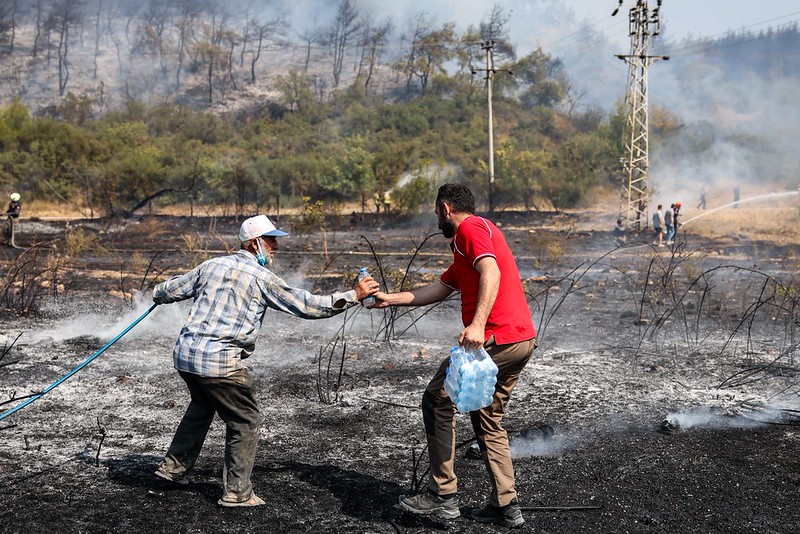
Turkish Red Crescent volunteers assist in fighting wildfires that swept across the country, July 2025. (Turkish Red Crescent/Climate Centre/Flickr)

Turkish Red Crescent volunteers assist in fighting wildfires that swept across the country, July 2025. (Turkish Red Crescent/Climate Centre/Flickr)

The number of days when the weather gets hot, dry and windy—ideal to spark extreme wildfires—has nearly tripled in the past 45 years across the globe, with the trend increasing even higher in the Americas, a new study shows.

And more than half of that increase is caused by human-caused climate change, researchers calculated.

What this means is that as the world warms, more places across the globe are prone to go up in flames at the same time because of increasingly synchronous fire weather, which is when multiple places have the right conditions to go up in smoke. Countries may not have enough resources to put out all the fires popping up and help won’t be as likely to come from neighbours busy with their own flames, according to the authors of a study in Science Advances.

In 1979 and for the next 15 years, the world averaged 22 synchronous fire weather days a year for flames that stayed within large global regions, the study found. In 2023 and 2024, it was up to more than 60 days a year.

Get the latest climate news and analysis, direct to your inbox.

Subscribe Today

View our latest digests

“These sorts of changes that we have seen increase the likelihood in a lot of areas that there will be fires that are going to be very challenging to suppress,” said study co-author John Abatzoglou, a fire scientist at the University of California, Merced.

The researchers didn’t look at actual fires, but the weather conditions: warm, with strong winds and dry air and ground.

“It increases the likelihood of widespread fire outbreaks, but the weather is one dimension,” said study lead author Cong Yin, a fire researcher at University of California, Merced. The other big ingredients to fires are oxygen, fuel such as trees and brush, and ignition such as lightning or arson or human accidents.

This study is important because extreme fire weather is the primary—but not only—factor in increasing fire impacts across the globe, said fire scientist Mike Flannigan of Thompson Rivers University in Canada, who wasn’t part of the study. And it’s also important because regions that used to have fire seasons at different times and could share resources are now overlapping, he said.

Abatzoglou said: “And that’s where things begin to break.”

More than 60% of the global increase in synchronous fire weather days can be attributed to climate change from the burning of coal, oil and natural gas, Yin said. He and his colleagues know this because they used computer simulations to compare what’s happened in the last 45 years to a fictional world without the increased greenhouse gases from burning fossil fuels.

The continental United States, from 1979 to 1988, averaged 7.7 synchronous fire weather days a year. But in the last 10 years that average was up to 38 days a year, according to Yin.

But that is nothing compared to the southern half of South America. That region averaged 5.5 synchronous fire weather days a year from 1979 to 1988; over the last decade, that’s risen to 70.6 days a year, including 118 days in 2023.

Of 14 global regions, only Southeast Asia saw a decrease in synchronous fire weather, probably because it is getting more humid there, Yin said.

This Associated Press story was published Feb. 23, 2026, by The Canadian Press.


in Climate Impacts & Adaptation, Drought & Wildfires

Trending Stories

Facebook
Severe Storms & Flooding

540+ Dead, Hundreds Missing as Towering Flash Flood in Nepal Points to Extreme Heat, Heavy Rainfalls

August 28, 2026
997
Sarah Yurchevich
Data Centres & Tech

Alberta Woman Maps Out the Facts About Power-Hungry Data Centres

August 25, 2026
749
picryl
Canadian Sovereignty

Trump Trade War Could Be a Catalyst to Speed Canada’s Energy Transition, Experts Say

August 25, 2026
711

Leave a Reply Cancel reply

Your email address will not be published. Required fields are marked *

I agree to the Terms & Conditions and Privacy Policy.

Get the latest climate news and analysis, direct to your inbox.

Subscribe Today

Related Articles

‘Piercing Cold’ Produces Power Outages Across Canada and U.S., Methane Leaks in Texas

‘Piercing Cold’ Produces Power Outages Across Canada and U.S., Methane Leaks in Texas

January 26, 2026
Wildfires, Flooding Hit Communities on 3 Continents

Wildfires, Flooding Hit Communities on 3 Continents

January 21, 2026
Cloud Seeding Brings Floods as Iran’s Drought Deepens

Cloud Seeding Brings Floods as Iran’s Drought Deepens

November 18, 2025

The End of the World vs. the End of the Week: Carney’s Pushback on Trump’s Bullying Could Point to the Next Energy Transition Moment

by Mitchell Beer
August 23, 2026

…

Follow Us

Extreme Fire Weather Days Triple Globally, Driven Largely by Climate Change

February 23, 2026
Reading time: 3 minutes
Full Story: The Associated Press
Author: Seth Borenstein

Turkish Red Crescent volunteers assist in fighting wildfires that swept across the country, July 2025. (Turkish Red Crescent/Climate Centre/Flickr)

Turkish Red Crescent volunteers assist in fighting wildfires that swept across the country, July 2025. (Turkish Red Crescent/Climate Centre/Flickr)

The number of days when the weather gets hot, dry and windy—ideal to spark extreme wildfires—has nearly tripled in the past 45 years across the globe, with the trend increasing even higher in the Americas, a new study shows.

And more than half of that increase is caused by human-caused climate change, researchers calculated.

What this means is that as the world warms, more places across the globe are prone to go up in flames at the same time because of increasingly synchronous fire weather, which is when multiple places have the right conditions to go up in smoke. Countries may not have enough resources to put out all the fires popping up and help won’t be as likely to come from neighbours busy with their own flames, according to the authors of a study in Science Advances.

In 1979 and for the next 15 years, the world averaged 22 synchronous fire weather days a year for flames that stayed within large global regions, the study found. In 2023 and 2024, it was up to more than 60 days a year.

Get the latest climate news and analysis, direct to your inbox.

Subscribe Today

View our latest digests

“These sorts of changes that we have seen increase the likelihood in a lot of areas that there will be fires that are going to be very challenging to suppress,” said study co-author John Abatzoglou, a fire scientist at the University of California, Merced.

The researchers didn’t look at actual fires, but the weather conditions: warm, with strong winds and dry air and ground.

“It increases the likelihood of widespread fire outbreaks, but the weather is one dimension,” said study lead author Cong Yin, a fire researcher at University of California, Merced. The other big ingredients to fires are oxygen, fuel such as trees and brush, and ignition such as lightning or arson or human accidents.

This study is important because extreme fire weather is the primary—but not only—factor in increasing fire impacts across the globe, said fire scientist Mike Flannigan of Thompson Rivers University in Canada, who wasn’t part of the study. And it’s also important because regions that used to have fire seasons at different times and could share resources are now overlapping, he said.

Abatzoglou said: “And that’s where things begin to break.”

More than 60% of the global increase in synchronous fire weather days can be attributed to climate change from the burning of coal, oil and natural gas, Yin said. He and his colleagues know this because they used computer simulations to compare what’s happened in the last 45 years to a fictional world without the increased greenhouse gases from burning fossil fuels.

The continental United States, from 1979 to 1988, averaged 7.7 synchronous fire weather days a year. But in the last 10 years that average was up to 38 days a year, according to Yin.

But that is nothing compared to the southern half of South America. That region averaged 5.5 synchronous fire weather days a year from 1979 to 1988; over the last decade, that’s risen to 70.6 days a year, including 118 days in 2023.

Of 14 global regions, only Southeast Asia saw a decrease in synchronous fire weather, probably because it is getting more humid there, Yin said.

This Associated Press story was published Feb. 23, 2026, by The Canadian Press.


in Climate Impacts & Adaptation, Drought & Wildfires

Leave a Reply Cancel reply

Your email address will not be published. Required fields are marked *

I agree to the Terms & Conditions and Privacy Policy.

Related Articles

‘Piercing Cold’ Produces Power Outages Across Canada and U.S., Methane Leaks in Texas

‘Piercing Cold’ Produces Power Outages Across Canada and U.S., Methane Leaks in Texas

January 26, 2026
Wildfires, Flooding Hit Communities on 3 Continents

Wildfires, Flooding Hit Communities on 3 Continents

January 21, 2026
Cloud Seeding Brings Floods as Iran’s Drought Deepens

Cloud Seeding Brings Floods as Iran’s Drought Deepens

November 18, 2025

Trending Stories

Facebook

540+ Dead, Hundreds Missing as Towering Flash Flood in Nepal Points to Extreme Heat, Heavy Rainfalls

August 28, 2026
997
Sarah Yurchevich

Alberta Woman Maps Out the Facts About Power-Hungry Data Centres

August 25, 2026
749
picryl

Trump Trade War Could Be a Catalyst to Speed Canada’s Energy Transition, Experts Say

August 25, 2026
711

The End of the World vs. the End of the Week: Carney’s Pushback on Trump’s Bullying Could Point to the Next Energy Transition Moment

by Mitchell Beer
August 23, 2026

…

Follow Us

Copyright 2026 © Energy Mix Productions Inc. All rights reserved.

  • About
  • Contact
  • Privacy Policy and Copyright
  • Cookie Policy
No Result
View All Result
  • Topics
    • Buildings & Infrastructure
    • Climate Equity & Justice
      • Energy Poverty
      • Indigenous Rights & Reconciliation
    • Climate Finance
      • Community Climate Finance
      • Finance & Investment
      • Insurance & Liability
      • Subsidies
    • Climate Impacts & Adaptation
      • Biodiversity & Habitat
      • Drought & Wildfires
      • Forests & Deforestation
      • Health & Safety
      • Heat & Temperature
      • Ice Loss & Sea Level Rise
      • Severe Storms & Flooding
    • Emissions
      • Carbon Levels & Measurement
      • CCS & Negative Emissions
      • Methane
    • Energy
      • Renewables
      • Fossil Fuels
      • Hydrogen
      • Nuclear
      • Batteries & Storage
      • Energy Efficiency
      • Power Grids
    • Food & Agriculture
    • Industry
      • Data Centres & Tech
      • Critical Minerals & Mining
      • Petrochemicals & Plastics
    • Policy & Politics
      • Carbon Pricing
      • COP Conferences
      • Elections
      • Energy Politics
      • International Security & War
      • Legal & Regulatory
    • Research & Innovation
      • International Agencies & Studies
      • Research & Development
    • Society & Culture
      • Climate Action
      • Mis/Disinformation & Greenwashing
      • Jobs & Training
      • Leisure & Recreation
      • Media, Messaging, & Public Opinion
    • Transportation & Mobility
      • Electric Vehicles
      • Shipping & Aviation
      • Transit
      • Walking, Biking & Micromobility
  • Regions
    • Africa
    • Arctic & Antarctica
    • Asia
    • Australia
    • Canada
    • International
    • Mexico & the Caribbean
    • Middle East
    • Oceans
    • Small Island States
    • South & Central America
    • Subnational
    • United States
    • UK & Europe
  • Special Coverage
    • The Weekender
    • IEA2026
    • Canada’s Major Projects Office
    • Hidden Wonder Valley
    • COP30
    • Cities & Communities
    • Heat & Power
    • Community Climate Finance
  • More Resources
    • Climate Glossary
    • What If We Changed the Conversation on Climate Change?
    • Eco-Anxiety
  • About
  • Contact

Copyright 2025 © Smarter Shift Inc. and Energy Mix Productions Inc. All rights reserved.

Manage Cookie Consent
To provide the best experiences, we use technologies like cookies to store and/or access device information. Consenting to these technologies will allow us to process data such as browsing behaviour or unique IDs on this site. Not consenting or withdrawing consent, may adversely affect certain features and functions.
Functional Always active
The technical storage or access is strictly necessary for the legitimate purpose of enabling the use of a specific service explicitly requested by the subscriber or user, or for the sole purpose of carrying out the transmission of a communication over an electronic communications network.
Preferences
The technical storage or access is necessary for the legitimate purpose of storing preferences that are not requested by the subscriber or user.
Statistics
The technical storage or access that is used exclusively for statistical purposes. The technical storage or access that is used exclusively for anonymous statistical purposes. Without a subpoena, voluntary compliance on the part of your Internet Service Provider, or additional records from a third party, information stored or retrieved for this purpose alone cannot usually be used to identify you.
Marketing
The technical storage or access is required to create user profiles to send advertising, or to track the user on a website or across several websites for similar marketing purposes.
  • Manage options
  • Manage services
  • Manage {vendor_count} vendors
  • Read more about these purposes
View preferences
  • {title}
  • {title}
  • {title}
No Result
View All Result
  • Topics
    • Buildings & Infrastructure
    • Climate Equity & Justice
      • Energy Poverty
      • Indigenous Rights & Reconciliation
    • Climate Finance
      • Community Climate Finance
      • Finance & Investment
      • Insurance & Liability
      • Subsidies
    • Climate Impacts & Adaptation
      • Biodiversity & Habitat
      • Drought & Wildfires
      • Forests & Deforestation
      • Health & Safety
      • Heat & Temperature
      • Ice Loss & Sea Level Rise
      • Severe Storms & Flooding
    • Emissions
      • Carbon Levels & Measurement
      • CCS & Negative Emissions
      • Methane
    • Energy
      • Renewables
      • Fossil Fuels
      • Hydrogen
      • Nuclear
      • Batteries & Storage
      • Energy Efficiency
      • Power Grids
    • Food & Agriculture
    • Industry
      • Data Centres & Tech
      • Critical Minerals & Mining
      • Petrochemicals & Plastics
    • Policy & Politics
      • Carbon Pricing
      • COP Conferences
      • Elections
      • Energy Politics
      • International Security & War
      • Legal & Regulatory
    • Research & Innovation
      • International Agencies & Studies
      • Research & Development
    • Society & Culture
      • Climate Action
      • Mis/Disinformation & Greenwashing
      • Jobs & Training
      • Leisure & Recreation
      • Media, Messaging, & Public Opinion
    • Transportation & Mobility
      • Electric Vehicles
      • Shipping & Aviation
      • Transit
      • Walking, Biking & Micromobility
  • Regions
    • Africa
    • Arctic & Antarctica
    • Asia
    • Australia
    • Canada
    • International
    • Mexico & the Caribbean
    • Middle East
    • Oceans
    • Small Island States
    • South & Central America
    • Subnational
    • United States
    • UK & Europe
  • Special Coverage
    • The Weekender
    • IEA2026
    • Canada’s Major Projects Office
    • Hidden Wonder Valley
    • COP30
    • Cities & Communities
    • Heat & Power
    • Community Climate Finance
  • More Resources
    • Climate Glossary
    • What If We Changed the Conversation on Climate Change?
    • Eco-Anxiety
  • About
  • Contact

Copyright 2025 © Smarter Shift Inc. and Energy Mix Productions Inc. All rights reserved.