The Energy Mix
Subscribe
Donate
  • Topics
    • Buildings & Infrastructure
    • Climate Equity & Justice
      • Energy Poverty
      • Indigenous Rights & Reconciliation
    • Climate Finance
      • Community Climate Finance
      • Finance & Investment
      • Insurance & Liability
      • Subsidies
    • Climate Impacts & Adaptation
      • Biodiversity & Habitat
      • Drought & Wildfires
      • Forests & Deforestation
      • Health & Safety
      • Heat & Temperature
      • Ice Loss & Sea Level Rise
      • Severe Storms & Flooding
    • Emissions
      • Carbon Levels & Measurement
      • CCS & Negative Emissions
      • Methane
    • Energy
      • Renewables
      • Fossil Fuels
      • Hydrogen
      • Nuclear
      • Batteries & Storage
      • Energy Efficiency
      • Power Grids
    • Food & Agriculture
    • Industry
      • Data Centres & Tech
      • Critical Minerals & Mining
      • Petrochemicals & Plastics
    • Policy & Politics
      • Carbon Pricing
      • COP Conferences
      • Elections
      • Energy Politics
      • International Security & War
      • Legal & Regulatory
    • Research & Innovation
      • International Agencies & Studies
      • Research & Development
    • Society & Culture
      • Climate Action
      • Mis/Disinformation & Greenwashing
      • Jobs & Training
      • Leisure & Recreation
      • Media, Messaging, & Public Opinion
    • Transportation & Mobility
      • Electric Vehicles
      • Shipping & Aviation
      • Transit
      • Walking, Biking & Micromobility
  • Regions
    • Africa
    • Arctic & Antarctica
    • Asia
    • Australia
    • Canada
    • International
    • Mexico & the Caribbean
    • Middle East
    • Oceans
    • Small Island States
    • South & Central America
    • Subnational
    • United States
    • UK & Europe
  • Special Coverage
    • The Weekender
    • IEA2026
    • Canada’s Major Projects Office
    • Hidden Wonder Valley
    • COP30
    • Cities & Communities
    • Heat & Power
    • Community Climate Finance
  • More Resources
    • Climate Glossary
    • What If We Changed the Conversation on Climate Change?
    • Eco-Anxiety
  • About
  • Contact
No Result
View All Result
The Energy Mix
  • Topics
    • Buildings & Infrastructure
    • Climate Equity & Justice
      • Energy Poverty
      • Indigenous Rights & Reconciliation
    • Climate Finance
      • Community Climate Finance
      • Finance & Investment
      • Insurance & Liability
      • Subsidies
    • Climate Impacts & Adaptation
      • Biodiversity & Habitat
      • Drought & Wildfires
      • Forests & Deforestation
      • Health & Safety
      • Heat & Temperature
      • Ice Loss & Sea Level Rise
      • Severe Storms & Flooding
    • Emissions
      • Carbon Levels & Measurement
      • CCS & Negative Emissions
      • Methane
    • Energy
      • Renewables
      • Fossil Fuels
      • Hydrogen
      • Nuclear
      • Batteries & Storage
      • Energy Efficiency
      • Power Grids
    • Food & Agriculture
    • Industry
      • Data Centres & Tech
      • Critical Minerals & Mining
      • Petrochemicals & Plastics
    • Policy & Politics
      • Carbon Pricing
      • COP Conferences
      • Elections
      • Energy Politics
      • International Security & War
      • Legal & Regulatory
    • Research & Innovation
      • International Agencies & Studies
      • Research & Development
    • Society & Culture
      • Climate Action
      • Mis/Disinformation & Greenwashing
      • Jobs & Training
      • Leisure & Recreation
      • Media, Messaging, & Public Opinion
    • Transportation & Mobility
      • Electric Vehicles
      • Shipping & Aviation
      • Transit
      • Walking, Biking & Micromobility
  • Regions
    • Africa
    • Arctic & Antarctica
    • Asia
    • Australia
    • Canada
    • International
    • Mexico & the Caribbean
    • Middle East
    • Oceans
    • Small Island States
    • South & Central America
    • Subnational
    • United States
    • UK & Europe
  • Special Coverage
    • The Weekender
    • IEA2026
    • Canada’s Major Projects Office
    • Hidden Wonder Valley
    • COP30
    • Cities & Communities
    • Heat & Power
    • Community Climate Finance
  • More Resources
    • Climate Glossary
    • What If We Changed the Conversation on Climate Change?
    • Eco-Anxiety
  • About
  • Contact
Subscribe
Donate
The Energy Mix
Subscribe

Growing Evidence Points to Link Between Autism and Wildfire Smoke

February 17, 2026
Reading time: 4 minutes
Full Story: Grist
Author: Zoya Teirstein

(Pexels)

(Pexels)

This story was originally published by Grist. Sign up for Grist’s weekly newsletter here.

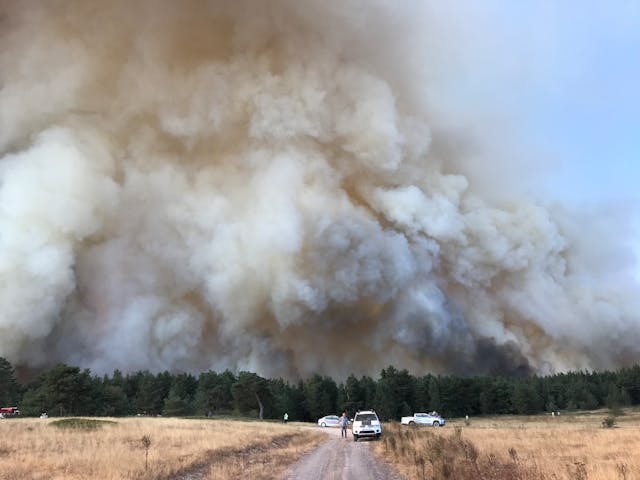
Two new studies have identified an alarming connection between exposure to wildfire smoke during pregnancy and autism in young children. The unprecedented findings suggest the neurological consequences of breathing smoke are more profound than previously thought. 

The research builds on a robust body of evidence that shows wildfire smoke is supremely unhealthy—about 10 times worse than inhaling car exhaust and other pollution emitted by burning fossil fuels. The ultra-fine particles that trees and vegetation release during combustion penetrate deep into the lungs and bloodstream, exacerbating preexisting conditions like asthma and, recent studies suggest, damaging internal organs. 

In recent years, researchers have also begun to suspect that conflagrations like the one that leveled swaths of Los Angeles County last year impact neurological health, but the effects of smoke on brain development are comparatively poorly understood. Two new studies shed light on the complicated web of genetic and environmental factors that contribute to autism spectrum disorder, building on previous research that found connections between the developmental disability and exposure to air pollution in general.  

Get the latest climate news and analysis, direct to your inbox.

Subscribe Today

View our latest digests

The first study, published in the peer-reviewed journal Environmental Science and Technology, analyzed data on more than 200,000 children born in southern California between 2006 and 2014. It found that those born to mothers exposed to 10 or more days of smoke in their third trimester had a 23% greater risk of being diagnosed with autism by age 5. Pregnant women who endured between six and 10 days saw a 12% higher risk of such a diagnosis in their kids.

Notably, the study found that average wildfire smoke concentration across the entire pregnancy or individual trimesters had no material effect on autism diagnoses. What did make a difference was the number of days a person in their third trimester inhaled the pollutant. Even one day of exposure had an effect. 

“The more you get exposed the worse it is,” said David Luglio, a postdoctoral fellow at Tulane University and the lead author of the study. “But we can’t necessarily answer why that is the case.” Luglio said he hopes future research will help untangle why prolonged inhalation made such a big difference. Future studies may also help refine these results by incorporating information on how much time the subjects spent outside during fires and whether they wore masks that help filter particulate matter.

The second study, published in the peer-reviewed journal Environment International, examined a much bigger sample—some 8.5 million births in California between 2001 and 2019. It, too, found a link between wildfire smoke exposure and autism diagnoses, though its different methodology yielded more nuanced results. When researchers looked at average smoke exposure across all births, the association was relatively weak. But among women who experienced intense smoke episodes — particularly those in the top 10th percentile of exposure—the link was substantially stronger. And it was strongest in people who live where population centers meet undeveloped land and who are not exposed to very high levels of general air pollution normally.

For women in the highest percentile of wildfire smoke exposure who otherwise lived in areas with relatively little background air pollution—such as car exhaust and urban smog—the odds of having a child diagnosed with autism were 50% higher than among those with lower wildfire smoke exposure. The researchers adjusted their analyses for non-wildfire related sources of air pollution.

“It’s a really huge study,” said Rebecca Schmidt, a professor of public health at University of California Davis and the paper’s lead author—referring to the many millions of records her team analyzed. The earlier study was also quite large, she said, a sign that both findings are well-founded. “There’s more evidence when there’s replication of similar findings,” she said. 

Autism spectrum disorder affects 1 in 31 8-year-olds in the United States. The extent to which the neurological condition, which researchers widely agree is largely determined by genetics, may also be influenced by environmental factors remains an active area of research. In recent years, as wildfires have burned with more severity and frequency in some parts of the world, researchers have been considering their impact on the disorder. 

At the same time, public interest in autism and its causes has mounted since the late 1990s, when the esteemed British medical journal The Lancet published what was later found to be a fraudulent paper that claimed to find a connection between the MMR vaccine and autism. Robert F. Kennedy Jr., the U.S. secretary of health and human services and one of the world’s most prominent vaccine skeptics, has long championed that theory. Under his leadership, the agency has radically remade the childhood immunization schedule, stacked an expert vaccine safety panel with his skeptics, and wound down mRNA vaccine development, among other moves that public health experts say undermine confidence in vaccines and threaten disease elimination status. 

There is no credible evidence that vaccines cause autism. Even the two studies on autism and wildfire smoke do not indicate that wildfire smoke specifically causes autism. Credible experts who study the disorder, including the authors of these studies, agree that a diagnosis is very likely the result of several factors working in tandem. 

“All we can point out is this association in the third trimester,” Guglio said. “It takes other people down the line to investigate those pathways more directly.”



in Drought & Wildfires, Health & Safety, International Agencies & Studies

Trending Stories

Facebook
Severe Storms & Flooding

540+ Dead, Hundreds Missing as Towering Flash Flood in Nepal Points to Extreme Heat, Heavy Rainfalls

August 28, 2026
997
Sarah Yurchevich
Data Centres & Tech

Alberta Woman Maps Out the Facts About Power-Hungry Data Centres

August 25, 2026
749
picryl
Canadian Sovereignty

Trump Trade War Could Be a Catalyst to Speed Canada’s Energy Transition, Experts Say

August 25, 2026
711

Leave a Reply Cancel reply

Your email address will not be published. Required fields are marked *

I agree to the Terms & Conditions and Privacy Policy.

Get the latest climate news and analysis, direct to your inbox.

Subscribe Today

Related Articles

EVs Are Already Making Your Air Cleaner

EVs Are Already Making Your Air Cleaner

February 2, 2026
EPA to Stop Calculating Health Care Savings from Key Air Pollution Rules

EPA to Stop Calculating Health Care Savings from Key Air Pollution Rules

January 19, 2026
U.S. Proposes Safety Regulations After Tesla Door Handles Trap Drivers in Fatal Crashes

U.S. Proposes Safety Regulations After Tesla Door Handles Trap Drivers in Fatal Crashes

January 12, 2026

The End of the World vs. the End of the Week: Carney’s Pushback on Trump’s Bullying Could Point to the Next Energy Transition Moment

by Mitchell Beer
August 23, 2026

…

Follow Us

Growing Evidence Points to Link Between Autism and Wildfire Smoke

February 17, 2026
Reading time: 4 minutes
Full Story: Grist
Author: Zoya Teirstein

(Pexels)

(Pexels)

This story was originally published by Grist. Sign up for Grist’s weekly newsletter here.

Two new studies have identified an alarming connection between exposure to wildfire smoke during pregnancy and autism in young children. The unprecedented findings suggest the neurological consequences of breathing smoke are more profound than previously thought. 

The research builds on a robust body of evidence that shows wildfire smoke is supremely unhealthy—about 10 times worse than inhaling car exhaust and other pollution emitted by burning fossil fuels. The ultra-fine particles that trees and vegetation release during combustion penetrate deep into the lungs and bloodstream, exacerbating preexisting conditions like asthma and, recent studies suggest, damaging internal organs. 

In recent years, researchers have also begun to suspect that conflagrations like the one that leveled swaths of Los Angeles County last year impact neurological health, but the effects of smoke on brain development are comparatively poorly understood. Two new studies shed light on the complicated web of genetic and environmental factors that contribute to autism spectrum disorder, building on previous research that found connections between the developmental disability and exposure to air pollution in general.  

Get the latest climate news and analysis, direct to your inbox.

Subscribe Today

View our latest digests

The first study, published in the peer-reviewed journal Environmental Science and Technology, analyzed data on more than 200,000 children born in southern California between 2006 and 2014. It found that those born to mothers exposed to 10 or more days of smoke in their third trimester had a 23% greater risk of being diagnosed with autism by age 5. Pregnant women who endured between six and 10 days saw a 12% higher risk of such a diagnosis in their kids.

Notably, the study found that average wildfire smoke concentration across the entire pregnancy or individual trimesters had no material effect on autism diagnoses. What did make a difference was the number of days a person in their third trimester inhaled the pollutant. Even one day of exposure had an effect. 

“The more you get exposed the worse it is,” said David Luglio, a postdoctoral fellow at Tulane University and the lead author of the study. “But we can’t necessarily answer why that is the case.” Luglio said he hopes future research will help untangle why prolonged inhalation made such a big difference. Future studies may also help refine these results by incorporating information on how much time the subjects spent outside during fires and whether they wore masks that help filter particulate matter.

The second study, published in the peer-reviewed journal Environment International, examined a much bigger sample—some 8.5 million births in California between 2001 and 2019. It, too, found a link between wildfire smoke exposure and autism diagnoses, though its different methodology yielded more nuanced results. When researchers looked at average smoke exposure across all births, the association was relatively weak. But among women who experienced intense smoke episodes — particularly those in the top 10th percentile of exposure—the link was substantially stronger. And it was strongest in people who live where population centers meet undeveloped land and who are not exposed to very high levels of general air pollution normally.

For women in the highest percentile of wildfire smoke exposure who otherwise lived in areas with relatively little background air pollution—such as car exhaust and urban smog—the odds of having a child diagnosed with autism were 50% higher than among those with lower wildfire smoke exposure. The researchers adjusted their analyses for non-wildfire related sources of air pollution.

“It’s a really huge study,” said Rebecca Schmidt, a professor of public health at University of California Davis and the paper’s lead author—referring to the many millions of records her team analyzed. The earlier study was also quite large, she said, a sign that both findings are well-founded. “There’s more evidence when there’s replication of similar findings,” she said. 

Autism spectrum disorder affects 1 in 31 8-year-olds in the United States. The extent to which the neurological condition, which researchers widely agree is largely determined by genetics, may also be influenced by environmental factors remains an active area of research. In recent years, as wildfires have burned with more severity and frequency in some parts of the world, researchers have been considering their impact on the disorder. 

At the same time, public interest in autism and its causes has mounted since the late 1990s, when the esteemed British medical journal The Lancet published what was later found to be a fraudulent paper that claimed to find a connection between the MMR vaccine and autism. Robert F. Kennedy Jr., the U.S. secretary of health and human services and one of the world’s most prominent vaccine skeptics, has long championed that theory. Under his leadership, the agency has radically remade the childhood immunization schedule, stacked an expert vaccine safety panel with his skeptics, and wound down mRNA vaccine development, among other moves that public health experts say undermine confidence in vaccines and threaten disease elimination status. 

There is no credible evidence that vaccines cause autism. Even the two studies on autism and wildfire smoke do not indicate that wildfire smoke specifically causes autism. Credible experts who study the disorder, including the authors of these studies, agree that a diagnosis is very likely the result of several factors working in tandem. 

“All we can point out is this association in the third trimester,” Guglio said. “It takes other people down the line to investigate those pathways more directly.”


in Drought & Wildfires, Health & Safety, International Agencies & Studies

Leave a Reply Cancel reply

Your email address will not be published. Required fields are marked *

I agree to the Terms & Conditions and Privacy Policy.

Related Articles

EVs Are Already Making Your Air Cleaner

EVs Are Already Making Your Air Cleaner

February 2, 2026
EPA to Stop Calculating Health Care Savings from Key Air Pollution Rules

EPA to Stop Calculating Health Care Savings from Key Air Pollution Rules

January 19, 2026
U.S. Proposes Safety Regulations After Tesla Door Handles Trap Drivers in Fatal Crashes

U.S. Proposes Safety Regulations After Tesla Door Handles Trap Drivers in Fatal Crashes

January 12, 2026

Trending Stories

Facebook

540+ Dead, Hundreds Missing as Towering Flash Flood in Nepal Points to Extreme Heat, Heavy Rainfalls

August 28, 2026
997
Sarah Yurchevich

Alberta Woman Maps Out the Facts About Power-Hungry Data Centres

August 25, 2026
749
picryl

Trump Trade War Could Be a Catalyst to Speed Canada’s Energy Transition, Experts Say

August 25, 2026
711

The End of the World vs. the End of the Week: Carney’s Pushback on Trump’s Bullying Could Point to the Next Energy Transition Moment

by Mitchell Beer
August 23, 2026

…

Follow Us

Copyright 2026 © Energy Mix Productions Inc. All rights reserved.

  • About
  • Contact
  • Privacy Policy and Copyright
  • Cookie Policy
No Result
View All Result
  • Topics
    • Buildings & Infrastructure
    • Climate Equity & Justice
      • Energy Poverty
      • Indigenous Rights & Reconciliation
    • Climate Finance
      • Community Climate Finance
      • Finance & Investment
      • Insurance & Liability
      • Subsidies
    • Climate Impacts & Adaptation
      • Biodiversity & Habitat
      • Drought & Wildfires
      • Forests & Deforestation
      • Health & Safety
      • Heat & Temperature
      • Ice Loss & Sea Level Rise
      • Severe Storms & Flooding
    • Emissions
      • Carbon Levels & Measurement
      • CCS & Negative Emissions
      • Methane
    • Energy
      • Renewables
      • Fossil Fuels
      • Hydrogen
      • Nuclear
      • Batteries & Storage
      • Energy Efficiency
      • Power Grids
    • Food & Agriculture
    • Industry
      • Data Centres & Tech
      • Critical Minerals & Mining
      • Petrochemicals & Plastics
    • Policy & Politics
      • Carbon Pricing
      • COP Conferences
      • Elections
      • Energy Politics
      • International Security & War
      • Legal & Regulatory
    • Research & Innovation
      • International Agencies & Studies
      • Research & Development
    • Society & Culture
      • Climate Action
      • Mis/Disinformation & Greenwashing
      • Jobs & Training
      • Leisure & Recreation
      • Media, Messaging, & Public Opinion
    • Transportation & Mobility
      • Electric Vehicles
      • Shipping & Aviation
      • Transit
      • Walking, Biking & Micromobility
  • Regions
    • Africa
    • Arctic & Antarctica
    • Asia
    • Australia
    • Canada
    • International
    • Mexico & the Caribbean
    • Middle East
    • Oceans
    • Small Island States
    • South & Central America
    • Subnational
    • United States
    • UK & Europe
  • Special Coverage
    • The Weekender
    • IEA2026
    • Canada’s Major Projects Office
    • Hidden Wonder Valley
    • COP30
    • Cities & Communities
    • Heat & Power
    • Community Climate Finance
  • More Resources
    • Climate Glossary
    • What If We Changed the Conversation on Climate Change?
    • Eco-Anxiety
  • About
  • Contact

Copyright 2025 © Smarter Shift Inc. and Energy Mix Productions Inc. All rights reserved.

Manage Cookie Consent
To provide the best experiences, we use technologies like cookies to store and/or access device information. Consenting to these technologies will allow us to process data such as browsing behaviour or unique IDs on this site. Not consenting or withdrawing consent, may adversely affect certain features and functions.
Functional Always active
The technical storage or access is strictly necessary for the legitimate purpose of enabling the use of a specific service explicitly requested by the subscriber or user, or for the sole purpose of carrying out the transmission of a communication over an electronic communications network.
Preferences
The technical storage or access is necessary for the legitimate purpose of storing preferences that are not requested by the subscriber or user.
Statistics
The technical storage or access that is used exclusively for statistical purposes. The technical storage or access that is used exclusively for anonymous statistical purposes. Without a subpoena, voluntary compliance on the part of your Internet Service Provider, or additional records from a third party, information stored or retrieved for this purpose alone cannot usually be used to identify you.
Marketing
The technical storage or access is required to create user profiles to send advertising, or to track the user on a website or across several websites for similar marketing purposes.
  • Manage options
  • Manage services
  • Manage {vendor_count} vendors
  • Read more about these purposes
View preferences
  • {title}
  • {title}
  • {title}
No Result
View All Result
  • Topics
    • Buildings & Infrastructure
    • Climate Equity & Justice
      • Energy Poverty
      • Indigenous Rights & Reconciliation
    • Climate Finance
      • Community Climate Finance
      • Finance & Investment
      • Insurance & Liability
      • Subsidies
    • Climate Impacts & Adaptation
      • Biodiversity & Habitat
      • Drought & Wildfires
      • Forests & Deforestation
      • Health & Safety
      • Heat & Temperature
      • Ice Loss & Sea Level Rise
      • Severe Storms & Flooding
    • Emissions
      • Carbon Levels & Measurement
      • CCS & Negative Emissions
      • Methane
    • Energy
      • Renewables
      • Fossil Fuels
      • Hydrogen
      • Nuclear
      • Batteries & Storage
      • Energy Efficiency
      • Power Grids
    • Food & Agriculture
    • Industry
      • Data Centres & Tech
      • Critical Minerals & Mining
      • Petrochemicals & Plastics
    • Policy & Politics
      • Carbon Pricing
      • COP Conferences
      • Elections
      • Energy Politics
      • International Security & War
      • Legal & Regulatory
    • Research & Innovation
      • International Agencies & Studies
      • Research & Development
    • Society & Culture
      • Climate Action
      • Mis/Disinformation & Greenwashing
      • Jobs & Training
      • Leisure & Recreation
      • Media, Messaging, & Public Opinion
    • Transportation & Mobility
      • Electric Vehicles
      • Shipping & Aviation
      • Transit
      • Walking, Biking & Micromobility
  • Regions
    • Africa
    • Arctic & Antarctica
    • Asia
    • Australia
    • Canada
    • International
    • Mexico & the Caribbean
    • Middle East
    • Oceans
    • Small Island States
    • South & Central America
    • Subnational
    • United States
    • UK & Europe
  • Special Coverage
    • The Weekender
    • IEA2026
    • Canada’s Major Projects Office
    • Hidden Wonder Valley
    • COP30
    • Cities & Communities
    • Heat & Power
    • Community Climate Finance
  • More Resources
    • Climate Glossary
    • What If We Changed the Conversation on Climate Change?
    • Eco-Anxiety
  • About
  • Contact

Copyright 2025 © Smarter Shift Inc. and Energy Mix Productions Inc. All rights reserved.