The Energy Mix
Subscribe
Donate
  • Topics
    • Buildings & Infrastructure
    • Climate Equity & Justice
      • Energy Poverty
      • Indigenous Rights & Reconciliation
    • Climate Finance
      • Community Climate Finance
      • Finance & Investment
      • Insurance & Liability
      • Subsidies
    • Climate Impacts & Adaptation
      • Biodiversity & Habitat
      • Drought & Wildfires
      • Forests & Deforestation
      • Health & Safety
      • Heat & Temperature
      • Ice Loss & Sea Level Rise
      • Severe Storms & Flooding
    • Emissions
      • Carbon Levels & Measurement
      • CCS & Negative Emissions
      • Methane
    • Energy
      • Renewables
      • Fossil Fuels
      • Hydrogen
      • Nuclear
      • Batteries & Storage
      • Energy Efficiency
      • Power Grids
    • Food & Agriculture
    • Industry
      • Data Centres & Tech
      • Critical Minerals & Mining
      • Petrochemicals & Plastics
    • Policy & Politics
      • Carbon Pricing
      • COP Conferences
      • Elections
      • Energy Politics
      • International Security & War
      • Legal & Regulatory
    • Research & Innovation
      • International Agencies & Studies
      • Research & Development
    • Society & Culture
      • Climate Action
      • Mis/Disinformation & Greenwashing
      • Jobs & Training
      • Leisure & Recreation
      • Media, Messaging, & Public Opinion
    • Transportation & Mobility
      • Electric Vehicles
      • Shipping & Aviation
      • Transit
      • Walking, Biking & Micromobility
  • Regions
    • Africa
    • Arctic & Antarctica
    • Asia
    • Australia
    • Canada
    • International
    • Mexico & the Caribbean
    • Middle East
    • Oceans
    • Small Island States
    • South & Central America
    • Subnational
    • United States
    • UK & Europe
  • Special Coverage
    • The Weekender
    • IEA2026
    • Canada’s Major Projects Office
    • Hidden Wonder Valley
    • COP30
    • Cities & Communities
    • Heat & Power
    • Community Climate Finance
  • More Resources
    • Climate Glossary
    • What If We Changed the Conversation on Climate Change?
    • Eco-Anxiety
  • About
  • Contact
No Result
View All Result
The Energy Mix
  • Topics
    • Buildings & Infrastructure
    • Climate Equity & Justice
      • Energy Poverty
      • Indigenous Rights & Reconciliation
    • Climate Finance
      • Community Climate Finance
      • Finance & Investment
      • Insurance & Liability
      • Subsidies
    • Climate Impacts & Adaptation
      • Biodiversity & Habitat
      • Drought & Wildfires
      • Forests & Deforestation
      • Health & Safety
      • Heat & Temperature
      • Ice Loss & Sea Level Rise
      • Severe Storms & Flooding
    • Emissions
      • Carbon Levels & Measurement
      • CCS & Negative Emissions
      • Methane
    • Energy
      • Renewables
      • Fossil Fuels
      • Hydrogen
      • Nuclear
      • Batteries & Storage
      • Energy Efficiency
      • Power Grids
    • Food & Agriculture
    • Industry
      • Data Centres & Tech
      • Critical Minerals & Mining
      • Petrochemicals & Plastics
    • Policy & Politics
      • Carbon Pricing
      • COP Conferences
      • Elections
      • Energy Politics
      • International Security & War
      • Legal & Regulatory
    • Research & Innovation
      • International Agencies & Studies
      • Research & Development
    • Society & Culture
      • Climate Action
      • Mis/Disinformation & Greenwashing
      • Jobs & Training
      • Leisure & Recreation
      • Media, Messaging, & Public Opinion
    • Transportation & Mobility
      • Electric Vehicles
      • Shipping & Aviation
      • Transit
      • Walking, Biking & Micromobility
  • Regions
    • Africa
    • Arctic & Antarctica
    • Asia
    • Australia
    • Canada
    • International
    • Mexico & the Caribbean
    • Middle East
    • Oceans
    • Small Island States
    • South & Central America
    • Subnational
    • United States
    • UK & Europe
  • Special Coverage
    • The Weekender
    • IEA2026
    • Canada’s Major Projects Office
    • Hidden Wonder Valley
    • COP30
    • Cities & Communities
    • Heat & Power
    • Community Climate Finance
  • More Resources
    • Climate Glossary
    • What If We Changed the Conversation on Climate Change?
    • Eco-Anxiety
  • About
  • Contact
Subscribe
Donate
The Energy Mix
Subscribe

Wildfires No Longer ‘Go to Sleep’ at Night

April 29, 2026
Reading time: 4 minutes
Full Story: The Associated Press
Author: Seth Borenstein

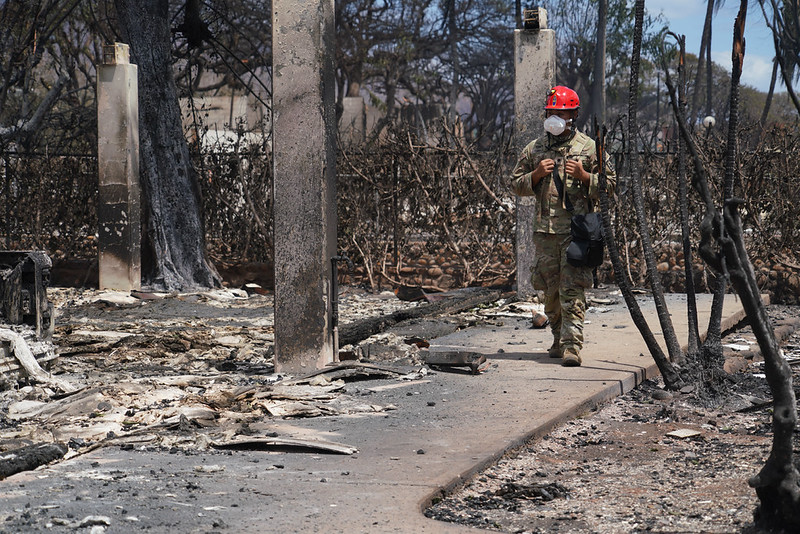
Search and rescue soldiers make recovery efforts in Lahaina, August 10, 2023. (The National Guard/Flickr)

Search and rescue soldiers make recovery efforts in Lahaina, August 10, 2023. (The National Guard/Flickr)

Burning time for North American wildfires is going into overtime. Flames are lasting later into the night and starting earlier in the morning because human-caused climate change is extending the hotter and drier conditions that feed fires, a new study found.

Fires used to die down or even die out at night as temperatures dropped and humidity increased, but that’s happening less often. The number of hours in North America when the weather is favorable for wildfires is 36% higher than 50 years ago, according to a study in Science Advances.

Places such as California have 550 more potential burning hours than the mid-1970s. Parts of southwestern New Mexico and central Arizona are seeing as much as 2,000 more hours a year when the weather is prone to burning fires, the highest increase seen in the study, which looked at Canada and the United States. The research looked at times when conditions were ripe for fire, but that didn’t mean fires occurred during all that time.

Recent Big Fires in LA and Hawaii Burned at Night

Fires that surge at night are tougher to fight and included the Lahaina, Hawaii fire in 2023, the Jasper fire in Alberta in 2024 and the Los Angeles fires in 2025, the study said. Maui’s fire ignited at 12:22 a.m.

It’s not just the clock that is getting extended. The calendar is too. The number of days with fire-prone weather increased by 44%, which effectively added 26 days over the past half century.

It’s mostly from warmer, drier nighttime weather, with a bit of extra wind, the study authors said.

Get the latest climate news and analysis, direct to your inbox.

Subscribe Today

View our latest digests

“Fires normally slow down during the night, or they just stop,” said study co-author Xianli Wang, a fire scientist with the Canadian Forest Service. “But under extreme fire hazard conditions, fire actually burns through the night or later into the night.”

And Wang said Earth’s warming atmosphere means it’s like to get worse.

Tougher to Fight Fires at Night

Fires that don’t “go to sleep” get a running start the next day, making it harder to knock them down, University of California Merced fire scientist John Abatzoglou, who wasn’t part of the study, said in an email.

“Nights aren’t what they used to be — that is, more reliable breaks for wildfire,” he added. “Widespread warming and lack of humidity is keeping fires up at night.”

Wildland firefighter Nicholai Allen, who also founded a firm that makes home fire prevention tools, said it’s very difficult to fight fires at night.

“You have to understand that you have snakes and bears and mountain lions and all the stuff you have in daytime,” Allen said, noting a colleague was bitten by a bear. “But at night, they’re really scared and they’re running away from the fire.”

The Canadian researchers analyzed nearly 9,000 larger fires from 2017 to 2023 using a weather satellite and other tools to get hour-by-hour data on atmospheric conditions during the fires, such as humidity, temperature, wind, rain and fuel moisture levels. They created a computer model that correlated weather conditions and fire status and applied to historical data in Canada and the United States from 1975 to 2106.

Nights Are Warming Faster Than Days

Scientists have long said heat-trapping gases from the burning of coal, oil and natural gas make nights warm faster than days because of increased cloud cover that absorbs and re-emits heat down to Earth at night like a blanket. Since 1975, summers in the contiguous U.S. have seen nighttime lowest temperature warm by 2.6 degrees Fahrenheit (1.4 degrees Celsius), while daytime highest temperatures have gone up 2.2 degrees Fahrenheit (1.2 degrees Celsius), according to the National Oceanic and Atmospheric Administration.

Humidity at night “doesn’t rebound” from its daytime dryness like it used to, said study lead author Kaiwei Luo, a fire science researcher at the University of Alberta.

Wildfires often coincide with drought, especially extreme drought, which means not only drier air, but hotter drier air that sucks up more moisture from the ground and plants, making fuels for fire more flammable, Wang said. In a drought, there’s often a vicious circle of drying and when it is quite dry, a warmer atmosphere has more power to suck moisture out of fuels.

Just as warmer nights especially in heat waves don’t let the body recover, the warmer nights are not allowing forests to recover, Wang said. It can take weeks for dead fuel to recover their lost moisture and be less fire-prone, he said.

“It’s just a stress to the plants,” Wang said. “That also increases fuel load and make fire-burning more easily.”

From 2016 to 2025, wildfires in the United States on average burned an area the size of Massachusetts each year, slightly more than 11,000 square miles (28,500 square kilometers). That’s 2.6 times the average burn area of the 1980s, according to the National Interagency Fire Center. Canada’s land burned on average for the last 10 years is 2.8 times more than during the 1980s, according to the Canadian Interagency Forest Fire Centre.

Syracuse University fire scientist Jacob Bendix, who wasn’t part of the research, called the study a sobering reminder of climate change’s role in driving “increased fire potential across almost all of the fire-prone environments of North America.”

This Associated Press story was published April 17, 2026, by The Canadian Press.


in Drought & Wildfires, International Agencies & Studies

Trending Stories

Facebook
Severe Storms & Flooding

540+ Dead, Hundreds Missing as Towering Flash Flood in Nepal Points to Extreme Heat, Heavy Rainfalls

August 28, 2026
997
Sarah Yurchevich
Data Centres & Tech

Alberta Woman Maps Out the Facts About Power-Hungry Data Centres

August 25, 2026
749
picryl
Canadian Sovereignty

Trump Trade War Could Be a Catalyst to Speed Canada’s Energy Transition, Experts Say

August 25, 2026
711

Leave a Reply Cancel reply

Your email address will not be published. Required fields are marked *

I agree to the Terms & Conditions and Privacy Policy.

Get the latest climate news and analysis, direct to your inbox.

Subscribe Today

Related Articles

Study Ties Particle Pollution From Wildfire Smoke to 24,100 U.S. Deaths per Year

Study Ties Particle Pollution From Wildfire Smoke to 24,100 U.S. Deaths per Year

February 5, 2026
These Numbers Tell the Story of the Los Angeles Wildfires, One Year Later

These Numbers Tell the Story of the Los Angeles Wildfires, One Year Later

January 7, 2026
#Encore: NOT SATIRE: U.S. Politicians Say Wildfire Smoke is Ruining Americans’ Summers, Demand Canada Stop It

#Encore: NOT SATIRE: U.S. Politicians Say Wildfire Smoke is Ruining Americans’ Summers, Demand Canada Stop It

December 24, 2025

The End of the World vs. the End of the Week: Carney’s Pushback on Trump’s Bullying Could Point to the Next Energy Transition Moment

by Mitchell Beer
August 23, 2026

…

Follow Us

Wildfires No Longer ‘Go to Sleep’ at Night

April 29, 2026
Reading time: 4 minutes
Full Story: The Associated Press
Author: Seth Borenstein

Search and rescue soldiers make recovery efforts in Lahaina, August 10, 2023. (The National Guard/Flickr)

Search and rescue soldiers make recovery efforts in Lahaina, August 10, 2023. (The National Guard/Flickr)

Burning time for North American wildfires is going into overtime. Flames are lasting later into the night and starting earlier in the morning because human-caused climate change is extending the hotter and drier conditions that feed fires, a new study found.

Fires used to die down or even die out at night as temperatures dropped and humidity increased, but that’s happening less often. The number of hours in North America when the weather is favorable for wildfires is 36% higher than 50 years ago, according to a study in Science Advances.

Places such as California have 550 more potential burning hours than the mid-1970s. Parts of southwestern New Mexico and central Arizona are seeing as much as 2,000 more hours a year when the weather is prone to burning fires, the highest increase seen in the study, which looked at Canada and the United States. The research looked at times when conditions were ripe for fire, but that didn’t mean fires occurred during all that time.

Recent Big Fires in LA and Hawaii Burned at Night

Fires that surge at night are tougher to fight and included the Lahaina, Hawaii fire in 2023, the Jasper fire in Alberta in 2024 and the Los Angeles fires in 2025, the study said. Maui’s fire ignited at 12:22 a.m.

It’s not just the clock that is getting extended. The calendar is too. The number of days with fire-prone weather increased by 44%, which effectively added 26 days over the past half century.

It’s mostly from warmer, drier nighttime weather, with a bit of extra wind, the study authors said.

Get the latest climate news and analysis, direct to your inbox.

Subscribe Today

View our latest digests

“Fires normally slow down during the night, or they just stop,” said study co-author Xianli Wang, a fire scientist with the Canadian Forest Service. “But under extreme fire hazard conditions, fire actually burns through the night or later into the night.”

And Wang said Earth’s warming atmosphere means it’s like to get worse.

Tougher to Fight Fires at Night

Fires that don’t “go to sleep” get a running start the next day, making it harder to knock them down, University of California Merced fire scientist John Abatzoglou, who wasn’t part of the study, said in an email.

“Nights aren’t what they used to be — that is, more reliable breaks for wildfire,” he added. “Widespread warming and lack of humidity is keeping fires up at night.”

Wildland firefighter Nicholai Allen, who also founded a firm that makes home fire prevention tools, said it’s very difficult to fight fires at night.

“You have to understand that you have snakes and bears and mountain lions and all the stuff you have in daytime,” Allen said, noting a colleague was bitten by a bear. “But at night, they’re really scared and they’re running away from the fire.”

The Canadian researchers analyzed nearly 9,000 larger fires from 2017 to 2023 using a weather satellite and other tools to get hour-by-hour data on atmospheric conditions during the fires, such as humidity, temperature, wind, rain and fuel moisture levels. They created a computer model that correlated weather conditions and fire status and applied to historical data in Canada and the United States from 1975 to 2106.

Nights Are Warming Faster Than Days

Scientists have long said heat-trapping gases from the burning of coal, oil and natural gas make nights warm faster than days because of increased cloud cover that absorbs and re-emits heat down to Earth at night like a blanket. Since 1975, summers in the contiguous U.S. have seen nighttime lowest temperature warm by 2.6 degrees Fahrenheit (1.4 degrees Celsius), while daytime highest temperatures have gone up 2.2 degrees Fahrenheit (1.2 degrees Celsius), according to the National Oceanic and Atmospheric Administration.

Humidity at night “doesn’t rebound” from its daytime dryness like it used to, said study lead author Kaiwei Luo, a fire science researcher at the University of Alberta.

Wildfires often coincide with drought, especially extreme drought, which means not only drier air, but hotter drier air that sucks up more moisture from the ground and plants, making fuels for fire more flammable, Wang said. In a drought, there’s often a vicious circle of drying and when it is quite dry, a warmer atmosphere has more power to suck moisture out of fuels.

Just as warmer nights especially in heat waves don’t let the body recover, the warmer nights are not allowing forests to recover, Wang said. It can take weeks for dead fuel to recover their lost moisture and be less fire-prone, he said.

“It’s just a stress to the plants,” Wang said. “That also increases fuel load and make fire-burning more easily.”

From 2016 to 2025, wildfires in the United States on average burned an area the size of Massachusetts each year, slightly more than 11,000 square miles (28,500 square kilometers). That’s 2.6 times the average burn area of the 1980s, according to the National Interagency Fire Center. Canada’s land burned on average for the last 10 years is 2.8 times more than during the 1980s, according to the Canadian Interagency Forest Fire Centre.

Syracuse University fire scientist Jacob Bendix, who wasn’t part of the research, called the study a sobering reminder of climate change’s role in driving “increased fire potential across almost all of the fire-prone environments of North America.”

This Associated Press story was published April 17, 2026, by The Canadian Press.


in Drought & Wildfires, International Agencies & Studies

Leave a Reply Cancel reply

Your email address will not be published. Required fields are marked *

I agree to the Terms & Conditions and Privacy Policy.

Related Articles

Study Ties Particle Pollution From Wildfire Smoke to 24,100 U.S. Deaths per Year

Study Ties Particle Pollution From Wildfire Smoke to 24,100 U.S. Deaths per Year

February 5, 2026
These Numbers Tell the Story of the Los Angeles Wildfires, One Year Later

These Numbers Tell the Story of the Los Angeles Wildfires, One Year Later

January 7, 2026
#Encore: NOT SATIRE: U.S. Politicians Say Wildfire Smoke is Ruining Americans’ Summers, Demand Canada Stop It

#Encore: NOT SATIRE: U.S. Politicians Say Wildfire Smoke is Ruining Americans’ Summers, Demand Canada Stop It

December 24, 2025

Trending Stories

Facebook

540+ Dead, Hundreds Missing as Towering Flash Flood in Nepal Points to Extreme Heat, Heavy Rainfalls

August 28, 2026
997
Sarah Yurchevich

Alberta Woman Maps Out the Facts About Power-Hungry Data Centres

August 25, 2026
749
picryl

Trump Trade War Could Be a Catalyst to Speed Canada’s Energy Transition, Experts Say

August 25, 2026
711

The End of the World vs. the End of the Week: Carney’s Pushback on Trump’s Bullying Could Point to the Next Energy Transition Moment

by Mitchell Beer
August 23, 2026

…

Follow Us

Copyright 2026 © Energy Mix Productions Inc. All rights reserved.

  • About
  • Contact
  • Privacy Policy and Copyright
  • Cookie Policy
No Result
View All Result
  • Topics
    • Buildings & Infrastructure
    • Climate Equity & Justice
      • Energy Poverty
      • Indigenous Rights & Reconciliation
    • Climate Finance
      • Community Climate Finance
      • Finance & Investment
      • Insurance & Liability
      • Subsidies
    • Climate Impacts & Adaptation
      • Biodiversity & Habitat
      • Drought & Wildfires
      • Forests & Deforestation
      • Health & Safety
      • Heat & Temperature
      • Ice Loss & Sea Level Rise
      • Severe Storms & Flooding
    • Emissions
      • Carbon Levels & Measurement
      • CCS & Negative Emissions
      • Methane
    • Energy
      • Renewables
      • Fossil Fuels
      • Hydrogen
      • Nuclear
      • Batteries & Storage
      • Energy Efficiency
      • Power Grids
    • Food & Agriculture
    • Industry
      • Data Centres & Tech
      • Critical Minerals & Mining
      • Petrochemicals & Plastics
    • Policy & Politics
      • Carbon Pricing
      • COP Conferences
      • Elections
      • Energy Politics
      • International Security & War
      • Legal & Regulatory
    • Research & Innovation
      • International Agencies & Studies
      • Research & Development
    • Society & Culture
      • Climate Action
      • Mis/Disinformation & Greenwashing
      • Jobs & Training
      • Leisure & Recreation
      • Media, Messaging, & Public Opinion
    • Transportation & Mobility
      • Electric Vehicles
      • Shipping & Aviation
      • Transit
      • Walking, Biking & Micromobility
  • Regions
    • Africa
    • Arctic & Antarctica
    • Asia
    • Australia
    • Canada
    • International
    • Mexico & the Caribbean
    • Middle East
    • Oceans
    • Small Island States
    • South & Central America
    • Subnational
    • United States
    • UK & Europe
  • Special Coverage
    • The Weekender
    • IEA2026
    • Canada’s Major Projects Office
    • Hidden Wonder Valley
    • COP30
    • Cities & Communities
    • Heat & Power
    • Community Climate Finance
  • More Resources
    • Climate Glossary
    • What If We Changed the Conversation on Climate Change?
    • Eco-Anxiety
  • About
  • Contact

Copyright 2025 © Smarter Shift Inc. and Energy Mix Productions Inc. All rights reserved.

Manage Cookie Consent
To provide the best experiences, we use technologies like cookies to store and/or access device information. Consenting to these technologies will allow us to process data such as browsing behaviour or unique IDs on this site. Not consenting or withdrawing consent, may adversely affect certain features and functions.
Functional Always active
The technical storage or access is strictly necessary for the legitimate purpose of enabling the use of a specific service explicitly requested by the subscriber or user, or for the sole purpose of carrying out the transmission of a communication over an electronic communications network.
Preferences
The technical storage or access is necessary for the legitimate purpose of storing preferences that are not requested by the subscriber or user.
Statistics
The technical storage or access that is used exclusively for statistical purposes. The technical storage or access that is used exclusively for anonymous statistical purposes. Without a subpoena, voluntary compliance on the part of your Internet Service Provider, or additional records from a third party, information stored or retrieved for this purpose alone cannot usually be used to identify you.
Marketing
The technical storage or access is required to create user profiles to send advertising, or to track the user on a website or across several websites for similar marketing purposes.
  • Manage options
  • Manage services
  • Manage {vendor_count} vendors
  • Read more about these purposes
View preferences
  • {title}
  • {title}
  • {title}
No Result
View All Result
  • Topics
    • Buildings & Infrastructure
    • Climate Equity & Justice
      • Energy Poverty
      • Indigenous Rights & Reconciliation
    • Climate Finance
      • Community Climate Finance
      • Finance & Investment
      • Insurance & Liability
      • Subsidies
    • Climate Impacts & Adaptation
      • Biodiversity & Habitat
      • Drought & Wildfires
      • Forests & Deforestation
      • Health & Safety
      • Heat & Temperature
      • Ice Loss & Sea Level Rise
      • Severe Storms & Flooding
    • Emissions
      • Carbon Levels & Measurement
      • CCS & Negative Emissions
      • Methane
    • Energy
      • Renewables
      • Fossil Fuels
      • Hydrogen
      • Nuclear
      • Batteries & Storage
      • Energy Efficiency
      • Power Grids
    • Food & Agriculture
    • Industry
      • Data Centres & Tech
      • Critical Minerals & Mining
      • Petrochemicals & Plastics
    • Policy & Politics
      • Carbon Pricing
      • COP Conferences
      • Elections
      • Energy Politics
      • International Security & War
      • Legal & Regulatory
    • Research & Innovation
      • International Agencies & Studies
      • Research & Development
    • Society & Culture
      • Climate Action
      • Mis/Disinformation & Greenwashing
      • Jobs & Training
      • Leisure & Recreation
      • Media, Messaging, & Public Opinion
    • Transportation & Mobility
      • Electric Vehicles
      • Shipping & Aviation
      • Transit
      • Walking, Biking & Micromobility
  • Regions
    • Africa
    • Arctic & Antarctica
    • Asia
    • Australia
    • Canada
    • International
    • Mexico & the Caribbean
    • Middle East
    • Oceans
    • Small Island States
    • South & Central America
    • Subnational
    • United States
    • UK & Europe
  • Special Coverage
    • The Weekender
    • IEA2026
    • Canada’s Major Projects Office
    • Hidden Wonder Valley
    • COP30
    • Cities & Communities
    • Heat & Power
    • Community Climate Finance
  • More Resources
    • Climate Glossary
    • What If We Changed the Conversation on Climate Change?
    • Eco-Anxiety
  • About
  • Contact

Copyright 2025 © Smarter Shift Inc. and Energy Mix Productions Inc. All rights reserved.