The Energy Mix
Subscribe
Donate
  • Topics
    • Buildings & Infrastructure
    • Climate Equity & Justice
      • Energy Poverty
      • Indigenous Rights & Reconciliation
    • Climate Finance
      • Community Climate Finance
      • Finance & Investment
      • Insurance & Liability
      • Subsidies
    • Climate Impacts & Adaptation
      • Biodiversity & Habitat
      • Drought & Wildfires
      • Forests & Deforestation
      • Health & Safety
      • Heat & Temperature
      • Ice Loss & Sea Level Rise
      • Severe Storms & Flooding
    • Emissions
      • Carbon Levels & Measurement
      • CCS & Negative Emissions
      • Methane
    • Energy
      • Renewables
      • Fossil Fuels
      • Hydrogen
      • Nuclear
      • Batteries & Storage
      • Energy Efficiency
      • Power Grids
    • Food & Agriculture
    • Industry
      • Data Centres & Tech
      • Critical Minerals & Mining
      • Petrochemicals & Plastics
    • Policy & Politics
      • Carbon Pricing
      • COP Conferences
      • Elections
      • Energy Politics
      • International Security & War
      • Legal & Regulatory
    • Research & Innovation
      • International Agencies & Studies
      • Research & Development
    • Society & Culture
      • Climate Action
      • Mis/Disinformation & Greenwashing
      • Jobs & Training
      • Leisure & Recreation
      • Media, Messaging, & Public Opinion
    • Transportation & Mobility
      • Electric Vehicles
      • Shipping & Aviation
      • Transit
      • Walking, Biking & Micromobility
  • Regions
    • Africa
    • Arctic & Antarctica
    • Asia
    • Australia
    • Canada
    • International
    • Mexico & the Caribbean
    • Middle East
    • Oceans
    • Small Island States
    • South & Central America
    • Subnational
    • United States
    • UK & Europe
  • Special Coverage
    • The Weekender
    • IEA2026
    • Canada’s Major Projects Office
    • Hidden Wonder Valley
    • COP30
    • Cities & Communities
    • Heat & Power
    • Community Climate Finance
  • More Resources
  • About
  • Contact
No Result
View All Result
The Energy Mix
  • Topics
    • Buildings & Infrastructure
    • Climate Equity & Justice
      • Energy Poverty
      • Indigenous Rights & Reconciliation
    • Climate Finance
      • Community Climate Finance
      • Finance & Investment
      • Insurance & Liability
      • Subsidies
    • Climate Impacts & Adaptation
      • Biodiversity & Habitat
      • Drought & Wildfires
      • Forests & Deforestation
      • Health & Safety
      • Heat & Temperature
      • Ice Loss & Sea Level Rise
      • Severe Storms & Flooding
    • Emissions
      • Carbon Levels & Measurement
      • CCS & Negative Emissions
      • Methane
    • Energy
      • Renewables
      • Fossil Fuels
      • Hydrogen
      • Nuclear
      • Batteries & Storage
      • Energy Efficiency
      • Power Grids
    • Food & Agriculture
    • Industry
      • Data Centres & Tech
      • Critical Minerals & Mining
      • Petrochemicals & Plastics
    • Policy & Politics
      • Carbon Pricing
      • COP Conferences
      • Elections
      • Energy Politics
      • International Security & War
      • Legal & Regulatory
    • Research & Innovation
      • International Agencies & Studies
      • Research & Development
    • Society & Culture
      • Climate Action
      • Mis/Disinformation & Greenwashing
      • Jobs & Training
      • Leisure & Recreation
      • Media, Messaging, & Public Opinion
    • Transportation & Mobility
      • Electric Vehicles
      • Shipping & Aviation
      • Transit
      • Walking, Biking & Micromobility
  • Regions
    • Africa
    • Arctic & Antarctica
    • Asia
    • Australia
    • Canada
    • International
    • Mexico & the Caribbean
    • Middle East
    • Oceans
    • Small Island States
    • South & Central America
    • Subnational
    • United States
    • UK & Europe
  • Special Coverage
    • The Weekender
    • IEA2026
    • Canada’s Major Projects Office
    • Hidden Wonder Valley
    • COP30
    • Cities & Communities
    • Heat & Power
    • Community Climate Finance
  • More Resources
  • About
  • Contact
Subscribe
Donate
The Energy Mix
Subscribe

As CO2 Levels Hit Record High, Scientist Warns Canada Against Climate Backsliding

October 16, 2025
Reading time: 5 minutes
Full Story: The Canadian Press, The Associated Press
Author: Jordan Omstead, Jamey Keaten, Seth Borenstein

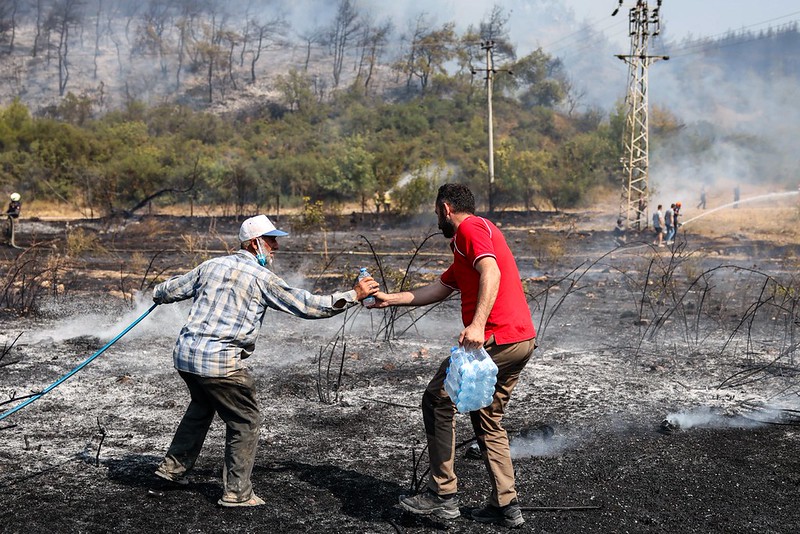
Turkish Red Crescent volunteers assist in fighting wildfires that swept across the country, July 2025. (Turkish Red Crescent/Climate Centre/Flickr)

Turkish Red Crescent volunteers assist in fighting wildfires that swept across the country, July 2025. (Turkish Red Crescent/Climate Centre/Flickr)

A leading Canadian climate scientist says a new report showing planet-warming carbon dioxide levels have soared to record amounts in 2024 is the latest sign Canada must resist pressure to backslide on climate action. 

The World Meteorological Organization (WMO) said in its latest bulletin on greenhouse gases, an annual study released ahead of the U.N.’s annual climate conference, that heat-trapping carbon dioxide’s levels jumped by the highest amount on record last year, with CO2 growth rates tripling since the 1960s, and reaching levels that existed more than 800,000 years ago, The Associated Press reports.

Growth rates of CO2 have accelerated from an annual average increase of 2.4 parts per million per year in the decade from 2011 to 2020, to 3.5 ppm from 2023 to 2024.

Emissions from burning coal, oil and gas, alongside more wildfires, have helped fan a “vicious climate cycle,” and people and industries continue to spew heat-trapping gases while the planet’s oceans and forests lose their ability to absorb them, the WMO report said.

“The heat trapped by CO2 and other greenhouse gases is turbo-charging our climate and leading to more extreme weather,” said WMO Deputy Secretary-General Ko Barrett in a statement. “Reducing emissions is therefore essential not just for our climate but also for our economic security and community well-being.”

What’s disturbing is not just the increase in greenhouse gases, but that it may be signaling a problem in the long-standing and delicate carbon cycle, where humans, industry, cars and animals spew carbon dioxide into the air and forests and oceans pull much of it out of the air, reducing some of the potential warming effect, said WMO senior scientific officer Oksana Tarasova.

Natural land sinks, including the Amazon, remove about one-quarter of the carbon dioxide in the air and the world’s oceans suck up another quarter, she said.

The increase in CO2 levels in the atmosphere “is very important in the sense that probably we started seeing the early indication of the limited capacity of the natural systems to actually absorb everything what we emit,” Tarasova told a news conference. She pointed to the Amazon, which had severe drought and heat, limiting trees ability to suck carbon dioxide out of the atmosphere.

Get the latest climate news and analysis, direct to your inbox.

Subscribe Today

View our latest digests

“The sinks which we which we have, they started failing,” Tarasova said. “The Amazon indeed is emitting CO2, despite the general understanding that if you have a tree, it should absorb.

‘A Wake Up Call’

Damon Matthews, a climate scientist at Concordia University, says it should be a wake-up call for governments in Canada and abroad to rapidly bring down emissions to stabilize the climate, The Canadian Press reports. 

Matthews, a member of an independent federal climate advisory group, says Canada must resist the bullying by U.S. President Donald Trump who has assailed climate change as a “con job,” cancelled major renewable projects, pulled the U.S. out of the United Nations climate accord and urged global leaders to back off clean energy. 

Matthews says the world has yet to hit a so-called “new normal.” 

“We are nowhere near the new normal at the current trend. Things are going to continue getting worse and worse until we actually solve the problem fundamentally,’ said Matthews, an expert on carbon budgeting. 

“We need to, you know, cut our emissions globally in half and then keep decreasing them towards zero in order to keep levels stable.”

The findings in Wednesday’s bulletin are consistent with a June report published by Matthews and more than 60 other scientists who found the world was on pace to produce enough greenhouse gas emissions in the next three years to blow past the international global warming target of 1.5°C, Matthews said. 

United Nations climate chief Simon Stiell has said the Earth is now on track for 3°C. 

‘A Catastrophe Unfolding’

Bill Hare, the founder of research organization Climate Analytics, called the WMO data “alarming and worrying,” reports The Associated Press.

Even though fossil fuel emissions were “relatively flat” last year, he said, the report appeared to show an accelerating increase of CO2 in the atmosphere, “signaling a positive feedback from burning forests and warming oceans driven by record global temperatures.”

“Let there be no mistake, this is a very clear warning sign that the world is heading into an extremely dangerous state—and this is driven by the continued expansion of fossil fuel development, globally,” Hare said. “I’m beginning to feel that this points to a slow-moving climate catastrophe unfolding in front of us.”

WMO called on policymakers to take more steps to help reduce emissions.

While several governments have been pushing for further use of hydrocarbons like coal, oil and gas for energy production, some businesses and local governments have been mobilizing to fight global warming.

Still, Hare said very few countries have made new climate commitments to come “anywhere near dealing with the gravity of the climate crisis.”

Levels Still Rising

The increase in 2024 is setting the planet on track for more long-term temperature increase, WMO said. It noted that concentrations of methane and nitrous oxide—other greenhouse gases caused by human activity—have also hit record levels.

The report was bound to raise new doubts on the world’s ability to hit the goal laid out in the 2015 Paris climate accord of keeping the global average temperature increase to 1.5°C above pre-industrial times.

United Nations climate chief, Simon Stiell, has said the Earth is now on track for 3°C.

Meanwhile, the U.S. National Oceanic and Atmospheric Administration’s global data for this year through June reveals that carbon dioxide levels are still rising at one of the highest rates on record, yet not quite as high as from 2023 to 2024.

The agency’s monthly data for the long-running Hawaii monitoring location for 2025 through August also showed CO2 rates are still increasing, but not as much as between 2023-2024.

This Associated Press story was published Oct. 15, 2025, by The Canadian Press.


in Carbon Levels & Measurement, Drought & Wildfires, Fossil Fuels, International Agencies & Studies, Severe Storms & Flooding

Trending Stories

More than one-third of the Jasper townsite was destroyed by wildfire in 2024  (Laura Durno/Twitter)
Drought & Wildfires

Climate Change Made High Temperatures Twice as Likely Before Jasper Wildfire

August 22, 2024
2.3k
(File photo by Fibonacci Blue/flickr)
Climate Action

Climate Voices See Complications With Blocking New Oil and Gas

November 10, 2026
663
LNG Canada flarestack (supplied image)
Legal & Regulatory

Lawyer’s Letter Warns Pension Funds Over Potential LNG Investments

November 12, 2026
513

Leave a Reply Cancel reply

Your email address will not be published. Required fields are marked *

I agree to the Terms & Conditions and Privacy Policy.

Get the latest climate news and analysis, direct to your inbox.

Subscribe Today

Related Articles

GHG Emissions May Be Set to Peak, 2025 Data Shows

GHG Emissions May Be Set to Peak, 2025 Data Shows

February 2, 2026
17 of World’s 20 Biggest Carbon Polluters Are State-Owned Fossil Companies

17 of World’s 20 Biggest Carbon Polluters Are State-Owned Fossil Companies

January 26, 2026
#Encore: U.S. Emissions Rise, China’s Fall, in Massive Shift Between World’s Biggest Climate Polluters

#Encore: U.S. Emissions Rise, China’s Fall, in Massive Shift Between World’s Biggest Climate Polluters

December 24, 2025

An ‘Extinction-Level Event’ for Trump. A Renewable Energy Surge. A Spiralling Climate Crisis. Is Your Head Spinning Yet?

by Mitchell Beer
November 8, 2026

…

Follow Us

As CO2 Levels Hit Record High, Scientist Warns Canada Against Climate Backsliding

October 16, 2025
Reading time: 5 minutes
Full Story: The Canadian Press, The Associated Press
Author: Jordan Omstead, Jamey Keaten, Seth Borenstein

Turkish Red Crescent volunteers assist in fighting wildfires that swept across the country, July 2025. (Turkish Red Crescent/Climate Centre/Flickr)

Turkish Red Crescent volunteers assist in fighting wildfires that swept across the country, July 2025. (Turkish Red Crescent/Climate Centre/Flickr)

A leading Canadian climate scientist says a new report showing planet-warming carbon dioxide levels have soared to record amounts in 2024 is the latest sign Canada must resist pressure to backslide on climate action. 

The World Meteorological Organization (WMO) said in its latest bulletin on greenhouse gases, an annual study released ahead of the U.N.’s annual climate conference, that heat-trapping carbon dioxide’s levels jumped by the highest amount on record last year, with CO2 growth rates tripling since the 1960s, and reaching levels that existed more than 800,000 years ago, The Associated Press reports.

Growth rates of CO2 have accelerated from an annual average increase of 2.4 parts per million per year in the decade from 2011 to 2020, to 3.5 ppm from 2023 to 2024.

Emissions from burning coal, oil and gas, alongside more wildfires, have helped fan a “vicious climate cycle,” and people and industries continue to spew heat-trapping gases while the planet’s oceans and forests lose their ability to absorb them, the WMO report said.

“The heat trapped by CO2 and other greenhouse gases is turbo-charging our climate and leading to more extreme weather,” said WMO Deputy Secretary-General Ko Barrett in a statement. “Reducing emissions is therefore essential not just for our climate but also for our economic security and community well-being.”

What’s disturbing is not just the increase in greenhouse gases, but that it may be signaling a problem in the long-standing and delicate carbon cycle, where humans, industry, cars and animals spew carbon dioxide into the air and forests and oceans pull much of it out of the air, reducing some of the potential warming effect, said WMO senior scientific officer Oksana Tarasova.

Natural land sinks, including the Amazon, remove about one-quarter of the carbon dioxide in the air and the world’s oceans suck up another quarter, she said.

The increase in CO2 levels in the atmosphere “is very important in the sense that probably we started seeing the early indication of the limited capacity of the natural systems to actually absorb everything what we emit,” Tarasova told a news conference. She pointed to the Amazon, which had severe drought and heat, limiting trees ability to suck carbon dioxide out of the atmosphere.

Get the latest climate news and analysis, direct to your inbox.

Subscribe Today

View our latest digests

“The sinks which we which we have, they started failing,” Tarasova said. “The Amazon indeed is emitting CO2, despite the general understanding that if you have a tree, it should absorb.

‘A Wake Up Call’

Damon Matthews, a climate scientist at Concordia University, says it should be a wake-up call for governments in Canada and abroad to rapidly bring down emissions to stabilize the climate, The Canadian Press reports. 

Matthews, a member of an independent federal climate advisory group, says Canada must resist the bullying by U.S. President Donald Trump who has assailed climate change as a “con job,” cancelled major renewable projects, pulled the U.S. out of the United Nations climate accord and urged global leaders to back off clean energy. 

Matthews says the world has yet to hit a so-called “new normal.” 

“We are nowhere near the new normal at the current trend. Things are going to continue getting worse and worse until we actually solve the problem fundamentally,’ said Matthews, an expert on carbon budgeting. 

“We need to, you know, cut our emissions globally in half and then keep decreasing them towards zero in order to keep levels stable.”

The findings in Wednesday’s bulletin are consistent with a June report published by Matthews and more than 60 other scientists who found the world was on pace to produce enough greenhouse gas emissions in the next three years to blow past the international global warming target of 1.5°C, Matthews said. 

United Nations climate chief Simon Stiell has said the Earth is now on track for 3°C. 

‘A Catastrophe Unfolding’

Bill Hare, the founder of research organization Climate Analytics, called the WMO data “alarming and worrying,” reports The Associated Press.

Even though fossil fuel emissions were “relatively flat” last year, he said, the report appeared to show an accelerating increase of CO2 in the atmosphere, “signaling a positive feedback from burning forests and warming oceans driven by record global temperatures.”

“Let there be no mistake, this is a very clear warning sign that the world is heading into an extremely dangerous state—and this is driven by the continued expansion of fossil fuel development, globally,” Hare said. “I’m beginning to feel that this points to a slow-moving climate catastrophe unfolding in front of us.”

WMO called on policymakers to take more steps to help reduce emissions.

While several governments have been pushing for further use of hydrocarbons like coal, oil and gas for energy production, some businesses and local governments have been mobilizing to fight global warming.

Still, Hare said very few countries have made new climate commitments to come “anywhere near dealing with the gravity of the climate crisis.”

Levels Still Rising

The increase in 2024 is setting the planet on track for more long-term temperature increase, WMO said. It noted that concentrations of methane and nitrous oxide—other greenhouse gases caused by human activity—have also hit record levels.

The report was bound to raise new doubts on the world’s ability to hit the goal laid out in the 2015 Paris climate accord of keeping the global average temperature increase to 1.5°C above pre-industrial times.

United Nations climate chief, Simon Stiell, has said the Earth is now on track for 3°C.

Meanwhile, the U.S. National Oceanic and Atmospheric Administration’s global data for this year through June reveals that carbon dioxide levels are still rising at one of the highest rates on record, yet not quite as high as from 2023 to 2024.

The agency’s monthly data for the long-running Hawaii monitoring location for 2025 through August also showed CO2 rates are still increasing, but not as much as between 2023-2024.

This Associated Press story was published Oct. 15, 2025, by The Canadian Press.


in Carbon Levels & Measurement, Drought & Wildfires, Fossil Fuels, International Agencies & Studies, Severe Storms & Flooding

Leave a Reply Cancel reply

Your email address will not be published. Required fields are marked *

I agree to the Terms & Conditions and Privacy Policy.

Related Articles

GHG Emissions May Be Set to Peak, 2025 Data Shows

GHG Emissions May Be Set to Peak, 2025 Data Shows

February 2, 2026
17 of World’s 20 Biggest Carbon Polluters Are State-Owned Fossil Companies

17 of World’s 20 Biggest Carbon Polluters Are State-Owned Fossil Companies

January 26, 2026
#Encore: U.S. Emissions Rise, China’s Fall, in Massive Shift Between World’s Biggest Climate Polluters

#Encore: U.S. Emissions Rise, China’s Fall, in Massive Shift Between World’s Biggest Climate Polluters

December 24, 2025

Trending Stories

More than one-third of the Jasper townsite was destroyed by wildfire in 2024  (Laura Durno/Twitter)

Climate Change Made High Temperatures Twice as Likely Before Jasper Wildfire

August 22, 2024
2.3k
(File photo by Fibonacci Blue/flickr)

Climate Voices See Complications With Blocking New Oil and Gas

November 10, 2026
663
LNG Canada flarestack (supplied image)

Lawyer’s Letter Warns Pension Funds Over Potential LNG Investments

November 12, 2026
513

An ‘Extinction-Level Event’ for Trump. A Renewable Energy Surge. A Spiralling Climate Crisis. Is Your Head Spinning Yet?

by Mitchell Beer
November 8, 2026

…

Follow Us

Copyright 2026 © Energy Mix Productions Inc. All rights reserved.

  • About
  • Contact
  • Privacy Policy and Copyright
  • Cookie Policy
No Result
View All Result
  • Topics
    • Buildings & Infrastructure
    • Climate Equity & Justice
      • Energy Poverty
      • Indigenous Rights & Reconciliation
    • Climate Finance
      • Community Climate Finance
      • Finance & Investment
      • Insurance & Liability
      • Subsidies
    • Climate Impacts & Adaptation
      • Biodiversity & Habitat
      • Drought & Wildfires
      • Forests & Deforestation
      • Health & Safety
      • Heat & Temperature
      • Ice Loss & Sea Level Rise
      • Severe Storms & Flooding
    • Emissions
      • Carbon Levels & Measurement
      • CCS & Negative Emissions
      • Methane
    • Energy
      • Renewables
      • Fossil Fuels
      • Hydrogen
      • Nuclear
      • Batteries & Storage
      • Energy Efficiency
      • Power Grids
    • Food & Agriculture
    • Industry
      • Data Centres & Tech
      • Critical Minerals & Mining
      • Petrochemicals & Plastics
    • Policy & Politics
      • Carbon Pricing
      • COP Conferences
      • Elections
      • Energy Politics
      • International Security & War
      • Legal & Regulatory
    • Research & Innovation
      • International Agencies & Studies
      • Research & Development
    • Society & Culture
      • Climate Action
      • Mis/Disinformation & Greenwashing
      • Jobs & Training
      • Leisure & Recreation
      • Media, Messaging, & Public Opinion
    • Transportation & Mobility
      • Electric Vehicles
      • Shipping & Aviation
      • Transit
      • Walking, Biking & Micromobility
  • Regions
    • Africa
    • Arctic & Antarctica
    • Asia
    • Australia
    • Canada
    • International
    • Mexico & the Caribbean
    • Middle East
    • Oceans
    • Small Island States
    • South & Central America
    • Subnational
    • United States
    • UK & Europe
  • Special Coverage
    • The Weekender
    • IEA2026
    • Canada’s Major Projects Office
    • Hidden Wonder Valley
    • COP30
    • Cities & Communities
    • Heat & Power
    • Community Climate Finance
  • More Resources
  • About
  • Contact

Copyright 2025 © Smarter Shift Inc. and Energy Mix Productions Inc. All rights reserved.

Manage Cookie Consent
To provide the best experiences, we use technologies like cookies to store and/or access device information. Consenting to these technologies will allow us to process data such as browsing behaviour or unique IDs on this site. Not consenting or withdrawing consent, may adversely affect certain features and functions.
Functional Always active
The technical storage or access is strictly necessary for the legitimate purpose of enabling the use of a specific service explicitly requested by the subscriber or user, or for the sole purpose of carrying out the transmission of a communication over an electronic communications network.
Preferences
The technical storage or access is necessary for the legitimate purpose of storing preferences that are not requested by the subscriber or user.
Statistics
The technical storage or access that is used exclusively for statistical purposes. The technical storage or access that is used exclusively for anonymous statistical purposes. Without a subpoena, voluntary compliance on the part of your Internet Service Provider, or additional records from a third party, information stored or retrieved for this purpose alone cannot usually be used to identify you.
Marketing
The technical storage or access is required to create user profiles to send advertising, or to track the user on a website or across several websites for similar marketing purposes.
  • Manage options
  • Manage services
  • Manage {vendor_count} vendors
  • Read more about these purposes
View preferences
  • {title}
  • {title}
  • {title}
No Result
View All Result
  • Topics
    • Buildings & Infrastructure
    • Climate Equity & Justice
      • Energy Poverty
      • Indigenous Rights & Reconciliation
    • Climate Finance
      • Community Climate Finance
      • Finance & Investment
      • Insurance & Liability
      • Subsidies
    • Climate Impacts & Adaptation
      • Biodiversity & Habitat
      • Drought & Wildfires
      • Forests & Deforestation
      • Health & Safety
      • Heat & Temperature
      • Ice Loss & Sea Level Rise
      • Severe Storms & Flooding
    • Emissions
      • Carbon Levels & Measurement
      • CCS & Negative Emissions
      • Methane
    • Energy
      • Renewables
      • Fossil Fuels
      • Hydrogen
      • Nuclear
      • Batteries & Storage
      • Energy Efficiency
      • Power Grids
    • Food & Agriculture
    • Industry
      • Data Centres & Tech
      • Critical Minerals & Mining
      • Petrochemicals & Plastics
    • Policy & Politics
      • Carbon Pricing
      • COP Conferences
      • Elections
      • Energy Politics
      • International Security & War
      • Legal & Regulatory
    • Research & Innovation
      • International Agencies & Studies
      • Research & Development
    • Society & Culture
      • Climate Action
      • Mis/Disinformation & Greenwashing
      • Jobs & Training
      • Leisure & Recreation
      • Media, Messaging, & Public Opinion
    • Transportation & Mobility
      • Electric Vehicles
      • Shipping & Aviation
      • Transit
      • Walking, Biking & Micromobility
  • Regions
    • Africa
    • Arctic & Antarctica
    • Asia
    • Australia
    • Canada
    • International
    • Mexico & the Caribbean
    • Middle East
    • Oceans
    • Small Island States
    • South & Central America
    • Subnational
    • United States
    • UK & Europe
  • Special Coverage
    • The Weekender
    • IEA2026
    • Canada’s Major Projects Office
    • Hidden Wonder Valley
    • COP30
    • Cities & Communities
    • Heat & Power
    • Community Climate Finance
  • More Resources
  • About
  • Contact

Copyright 2025 © Smarter Shift Inc. and Energy Mix Productions Inc. All rights reserved.




