The Energy Mix
Subscribe
Donate
  • Topics
    • Buildings & Infrastructure
    • Climate Equity & Justice
      • Energy Poverty
      • Indigenous Rights & Reconciliation
    • Climate Finance
      • Community Climate Finance
      • Finance & Investment
      • Insurance & Liability
      • Subsidies
    • Climate Impacts & Adaptation
      • Biodiversity & Habitat
      • Drought & Wildfires
      • Forests & Deforestation
      • Health & Safety
      • Heat & Temperature
      • Ice Loss & Sea Level Rise
      • Severe Storms & Flooding
    • Emissions
      • Carbon Levels & Measurement
      • CCS & Negative Emissions
      • Methane
    • Energy
      • Renewables
      • Fossil Fuels
      • Hydrogen
      • Nuclear
      • Batteries & Storage
      • Energy Efficiency
      • Power Grids
    • Food & Agriculture
    • Industry
      • Data Centres & Tech
      • Critical Minerals & Mining
      • Petrochemicals & Plastics
    • Policy & Politics
      • Carbon Pricing
      • COP Conferences
      • Elections
      • Energy Politics
      • International Security & War
      • Legal & Regulatory
    • Research & Innovation
      • International Agencies & Studies
      • Research & Development
    • Society & Culture
      • Climate Action
      • Mis/Disinformation & Greenwashing
      • Jobs & Training
      • Leisure & Recreation
      • Media, Messaging, & Public Opinion
    • Transportation & Mobility
      • Electric Vehicles
      • Shipping & Aviation
      • Transit
      • Walking, Biking & Micromobility
  • Regions
    • Africa
    • Arctic & Antarctica
    • Asia
    • Australia
    • Canada
    • International
    • Mexico & the Caribbean
    • Middle East
    • Oceans
    • Small Island States
    • South & Central America
    • Subnational
    • United States
    • UK & Europe
  • Special Coverage
    • The Weekender
    • IEA2026
    • Canada’s Major Projects Office
    • Hidden Wonder Valley
    • COP30
    • Cities & Communities
    • Heat & Power
    • Community Climate Finance
  • More Resources
  • About
  • Contact
No Result
View All Result
The Energy Mix
  • Topics
    • Buildings & Infrastructure
    • Climate Equity & Justice
      • Energy Poverty
      • Indigenous Rights & Reconciliation
    • Climate Finance
      • Community Climate Finance
      • Finance & Investment
      • Insurance & Liability
      • Subsidies
    • Climate Impacts & Adaptation
      • Biodiversity & Habitat
      • Drought & Wildfires
      • Forests & Deforestation
      • Health & Safety
      • Heat & Temperature
      • Ice Loss & Sea Level Rise
      • Severe Storms & Flooding
    • Emissions
      • Carbon Levels & Measurement
      • CCS & Negative Emissions
      • Methane
    • Energy
      • Renewables
      • Fossil Fuels
      • Hydrogen
      • Nuclear
      • Batteries & Storage
      • Energy Efficiency
      • Power Grids
    • Food & Agriculture
    • Industry
      • Data Centres & Tech
      • Critical Minerals & Mining
      • Petrochemicals & Plastics
    • Policy & Politics
      • Carbon Pricing
      • COP Conferences
      • Elections
      • Energy Politics
      • International Security & War
      • Legal & Regulatory
    • Research & Innovation
      • International Agencies & Studies
      • Research & Development
    • Society & Culture
      • Climate Action
      • Mis/Disinformation & Greenwashing
      • Jobs & Training
      • Leisure & Recreation
      • Media, Messaging, & Public Opinion
    • Transportation & Mobility
      • Electric Vehicles
      • Shipping & Aviation
      • Transit
      • Walking, Biking & Micromobility
  • Regions
    • Africa
    • Arctic & Antarctica
    • Asia
    • Australia
    • Canada
    • International
    • Mexico & the Caribbean
    • Middle East
    • Oceans
    • Small Island States
    • South & Central America
    • Subnational
    • United States
    • UK & Europe
  • Special Coverage
    • The Weekender
    • IEA2026
    • Canada’s Major Projects Office
    • Hidden Wonder Valley
    • COP30
    • Cities & Communities
    • Heat & Power
    • Community Climate Finance
  • More Resources
  • About
  • Contact
Subscribe
Donate
The Energy Mix
Subscribe

To Keep Climate Science Alive, U.S. Researchers Are Speaking in Code

March 29, 2026
Reading time: 7 minutes
Full Story: Grist
Author: Kate Yoder, Ayurella Horn-Muller, & Clayton Aldern

(Gabriela/Unsplash)

(Gabriela/Unsplash)

This story was originally published by Grist. Sign up for Grist’s weekly newsletter here.

At the United States Department of Agriculture’s research division, everyone knows there’s one word they should never say, according to Ethan Roberts. “The forbidden C-word”—climate.

Roberts, union president at the National Center for Agricultural Utilization Research in Peoria, Illinois, has worked for the federal government for nearly a decade. In that time, the physical science technician has weathered several political administrations, including President Donald Trump’s first term. None compare to what’s happening now. 

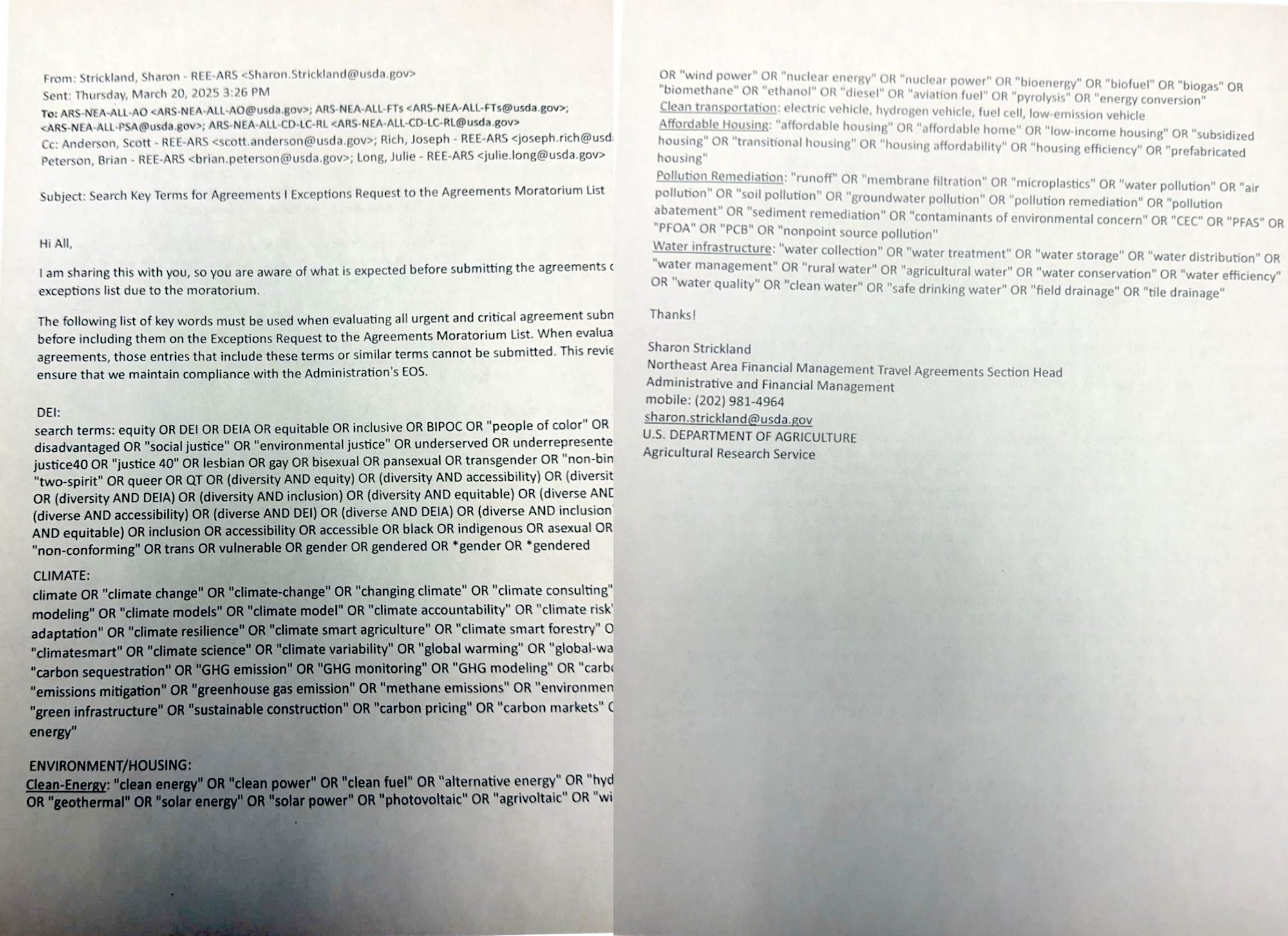
The sweeping transformation became apparent last March, after a memo from upper management at the USDA Agricultural Research Service instructed staffers to avoid submitting agreements and other contracts that used any of 100-plus newly banned words and phrases. Roughly a third directly related to climate change, including “global warming,” “climate science,” and “carbon sequestration.” 

Roberts met with his union to figure out how to respond to the memo. They concluded that the best course of action was just to avoid the terms and try to get their research published by working around them. Throughout the federal agency, “climate change” was swapped for softer synonyms: “elevated temperatures,” “soil health,” and “extreme weather.”

It’s part of a bigger trend. Across federal agencies and academic institutions, scientists are avoiding words they once used without hesitation. When Trump took office last year—calling coal “clean” and “beautiful” while deriding plans to tackle climate change as a “green scam”—a so-called “climate hushing” took hold of the United States, as businesses, politicians, and even the news media got quieter about global warming. There’s a long list of supposedly “woke” words that agencies have been discouraged from using, many tied to climate change or diversity, equity, and inclusion initiatives.

Get the latest climate news and analysis, direct to your inbox.

Subscribe Today

View our latest digests

The language changes were accompanied by larger shifts in how the federal government operates. Elon Musk’s Department of Government Efficiency, known as DOGE, laid off hundreds of thousands of federal workers last year. The Trump administration also slashed spending on science, cutting tens of billions of dollars in grants for projects related to the environment and public lands. Researchers are adapting to the new landscape, with some finding creative ways to continue their climate research, from changing their wording to seeking out different sources of funding.   

For federal researchers studying, say, the interplay between weather patterns and soybean diseases, the key is to reframe studies so they don’t clash with the Trump administration’s politics. “Instead of making it about the climate, you would instead just make it about the disease itself, and be like, ‘This disease does these things under these conditions,’ rather than ‘These conditions cause this disease to do this,’” Roberts added. “It’s just changing the focus.”

You can see how federally funded research has changed by looking at the grants approved by the National Science Foundation, or NSF, an agency that provides roughly a quarter of the U.S. government’s funding to universities. Grist’s analysis found that the number of NSF grants whose titles or abstracts mentioned “climate change” fell from 889 in 2023 to 148 last year, a 77% plunge. Part of that’s a result of NSF staffers approving fewer grants related to climate change under Trump. But researchers self-censoring by omitting the phrase in their proposals also appears to play a role, evidenced by the corresponding rise of “extreme weather”—a synonym that gets around the politicized language.

Trent Ford, the state climatologist for Illinois, said he’s started using terms like “weather extremes” and “weather variability” in framing his proposals for grants. 

“It’s sort of a weird thing, because on principle, if we’re studying climate change, to not name climate change feels dirty,” said Ford, who’s also a research scientist at the Illinois State Water Survey at the University of Illinois Urbana-Champaign. But it’s more of a practical decision than anything else: “We’ve seen where grants that say everything but ‘climate change’ and are obviously studying the impacts of climate change get through with no problem.” He only uses the phrase in grant proposals when he thinks it’s absolutely necessary and when efforts to steer around the term would look too obvious to a reviewer.

Researchers have always had to tailor their framing to align with a funder’s priorities, in this case the federal government. Near the end of President Joe Biden’s term in late 2024, when Ford’s team applied for an NSF grant to study how climate conditions could affect Midwestern agriculture, it made sense to include a line about talking to a diverse group of farmers. But that word became a problem after Trump returned to office.

“By the time the proposal got reviewed by the program manager at NSF, that same language that was required four months ago was now actually a death sentence on it,” Ford said. The NSF liked the proposal, but wanted the researchers to remove the line about reaching a diverse set of agricultural stakeholders and confirm that they would talk to “all American farmers,” Ford said. The team sent it back in, and the NSF approved it last April.

Others weren’t so lucky. Another scientist at the USDA’s Agricultural Research Service, who asked to remain anonymous out of fear of retaliation, said DOGE eliminated major research programs at the agency and, in the process, wiped out hundreds of thousands of dollars in federal funds for an initiative to grow plants without soil that “really didn’t have anything to do with climate change.” The scientist said it had only been labelled as climate research to “satisfy the previous Biden administration.”

“Anything, any project, that had ‘CC’ in front of it, was eliminated. Because ‘CC’ stands for climate change,” the staffer said. “So, unfortunately, that came back to bite them during this administration.”   

Though not to this extreme, researchers have found themselves staying away from politically fraught terms like “climate change” before. During the first Trump administration, Austin Becker, a professor at the University of Rhode Island who studies how ports and maritime infrastructure can be made more resilient to hazards like storms and flooding, started avoiding the phrase, even though it’s what motivated his research. “Everything that was ‘climate’ just became ‘coastal resilience,’” he said. “And we’ve kind of just stuck with that ever since.”

Ford initially resisted pressure to stop using the phrase from colleagues he was writing grants with, but he gave in this time around for financial reasons. “Getting a grant could be the difference between a graduate student getting a paycheck and us having to let a graduate student go, or having to let a full-time employee of the university go,” he said.

Some researchers have been looking for grants in new places as federal money dries up. Dana Fisher, a professor at American University and the director of its Center for Environment, Community, and Equity, has procured private funding to research ways to improve and expand communication about climate change in North America. She’s also looking overseas for funding, where she’s had success during past Republican administrations that were hesitant to approve grants for climate research. When George W. Bush was president, Fisher got a grant to study how climate action in U.S. cities and states could influence federal policymaking, an effort funded by the Norwegian Research Council. That fact raised some eyebrows when she mentioned it to people she was interviewing in Congress. “They’re like, ‘Huh?’” Fisher recalled. “I was like, ‘Well, that’s what happens when there’s a Republican administration.’”

As scarce as funding for anything related to the climate has become under Trump, some topics appear to be even more politically toxic. In Ford’s experience, and from what he’s heard from other researchers, “equity” and “environmental justice” are “actually dirtier words.” The Trump administration has closed the Environmental Protection Agency’s environmental justice offices at its headquarters and in all 10 of its regional offices, and continues to lay off EPA staff who helped communities dealing with pollution. Grist’s analysis of grants reveals a similar pattern: Under Trump, mentions of “DEI,” or diversity, equity, and inclusion, have vanished from NSF grants entirely. Terms like “clean energy” and “pollution” have also declined, but not as sharply as climate change.

You could view the federal government’s pressure on scientists to change their language in different ways. Is it Orwellian-style censorship, silencing dissent and policing language? Or simply the right of a funder, whose politics changes with each administration, to ask for research that reflects its concerns? Does it affect what research gets done, or will applicants simply swap in harmless synonyms to ensure the work can continue? 

The answer is complicated, according to the USDA’s Roberts. Many of the climate projects at the agency’s research division that have so far avoided cancellation are stuck in funding purgatory, awaiting a fate that could hinge on a politically charged word or two. Scientists are adapting their research to better align with White House priorities, hoping to continue equipping farmers with the knowledge of how to adapt to a warming world—and scrubbing any forbidden language in the meantime.

“Clever word usage, and controlling the scope of how the research is presented, allows for scientists to keep doing the work,” Roberts said. ““There’s no one going around hunting these people down, thankfully. Not yet, anyway.”






in International Agencies & Studies, Media, Messaging, & Public Opinion, Policy & Politics, United States

Trending Stories

Uncontrollable wildfire, forest fire. Original public domain image from Flickr
COP Conferences

Ex-Minister, International Think Tanks Scorch Carney Government’s Climate Performance

November 16, 2026
884
Alberta cattle ranch/photo courtesy of Bill Heidecker
Legal & Regulatory

Alberta Landowners Revolt, Won’t Consent to Access Over Oil and Gas Cleanup Concerns

November 16, 2026
786
LNG Canada flarestack (supplied image)
Legal & Regulatory

Lawyer’s Letter Warns Pension Funds Over Potential LNG Investments

November 12, 2026
583

Leave a Reply Cancel reply

Your email address will not be published. Required fields are marked *

I agree to the Terms & Conditions and Privacy Policy.

Get the latest climate news and analysis, direct to your inbox.

Subscribe Today

Related Articles

China Corrects Trump on Wind, Touts Energy Transition in Davos Address

China Corrects Trump on Wind, Touts Energy Transition in Davos Address

January 26, 2026
#Encore: U.S. Threatened to Quit IEA if Analysis Kept Projecting Renewable Energy Future

#Encore: U.S. Threatened to Quit IEA if Analysis Kept Projecting Renewable Energy Future

December 31, 2025
U.S., Other Petrostates ‘Hijack the Process’, Derail Consensus on UN Environment Report

U.S., Other Petrostates ‘Hijack the Process’, Derail Consensus on UN Environment Report

December 17, 2025

Fossil Fuel Phaseout. Cutting Off Demand. Every Strategy Needs to Deliver.

by Mitchell Beer
November 15, 2026

…

Follow Us

To Keep Climate Science Alive, U.S. Researchers Are Speaking in Code

March 29, 2026
Reading time: 7 minutes
Full Story: Grist
Author: Kate Yoder, Ayurella Horn-Muller, & Clayton Aldern

(Gabriela/Unsplash)

(Gabriela/Unsplash)

This story was originally published by Grist. Sign up for Grist’s weekly newsletter here.

At the United States Department of Agriculture’s research division, everyone knows there’s one word they should never say, according to Ethan Roberts. “The forbidden C-word”—climate.

Roberts, union president at the National Center for Agricultural Utilization Research in Peoria, Illinois, has worked for the federal government for nearly a decade. In that time, the physical science technician has weathered several political administrations, including President Donald Trump’s first term. None compare to what’s happening now. 

The sweeping transformation became apparent last March, after a memo from upper management at the USDA Agricultural Research Service instructed staffers to avoid submitting agreements and other contracts that used any of 100-plus newly banned words and phrases. Roughly a third directly related to climate change, including “global warming,” “climate science,” and “carbon sequestration.” 

Roberts met with his union to figure out how to respond to the memo. They concluded that the best course of action was just to avoid the terms and try to get their research published by working around them. Throughout the federal agency, “climate change” was swapped for softer synonyms: “elevated temperatures,” “soil health,” and “extreme weather.”

It’s part of a bigger trend. Across federal agencies and academic institutions, scientists are avoiding words they once used without hesitation. When Trump took office last year—calling coal “clean” and “beautiful” while deriding plans to tackle climate change as a “green scam”—a so-called “climate hushing” took hold of the United States, as businesses, politicians, and even the news media got quieter about global warming. There’s a long list of supposedly “woke” words that agencies have been discouraged from using, many tied to climate change or diversity, equity, and inclusion initiatives.

Get the latest climate news and analysis, direct to your inbox.

Subscribe Today

View our latest digests

The language changes were accompanied by larger shifts in how the federal government operates. Elon Musk’s Department of Government Efficiency, known as DOGE, laid off hundreds of thousands of federal workers last year. The Trump administration also slashed spending on science, cutting tens of billions of dollars in grants for projects related to the environment and public lands. Researchers are adapting to the new landscape, with some finding creative ways to continue their climate research, from changing their wording to seeking out different sources of funding.   

For federal researchers studying, say, the interplay between weather patterns and soybean diseases, the key is to reframe studies so they don’t clash with the Trump administration’s politics. “Instead of making it about the climate, you would instead just make it about the disease itself, and be like, ‘This disease does these things under these conditions,’ rather than ‘These conditions cause this disease to do this,’” Roberts added. “It’s just changing the focus.”

You can see how federally funded research has changed by looking at the grants approved by the National Science Foundation, or NSF, an agency that provides roughly a quarter of the U.S. government’s funding to universities. Grist’s analysis found that the number of NSF grants whose titles or abstracts mentioned “climate change” fell from 889 in 2023 to 148 last year, a 77% plunge. Part of that’s a result of NSF staffers approving fewer grants related to climate change under Trump. But researchers self-censoring by omitting the phrase in their proposals also appears to play a role, evidenced by the corresponding rise of “extreme weather”—a synonym that gets around the politicized language.

Trent Ford, the state climatologist for Illinois, said he’s started using terms like “weather extremes” and “weather variability” in framing his proposals for grants. 

“It’s sort of a weird thing, because on principle, if we’re studying climate change, to not name climate change feels dirty,” said Ford, who’s also a research scientist at the Illinois State Water Survey at the University of Illinois Urbana-Champaign. But it’s more of a practical decision than anything else: “We’ve seen where grants that say everything but ‘climate change’ and are obviously studying the impacts of climate change get through with no problem.” He only uses the phrase in grant proposals when he thinks it’s absolutely necessary and when efforts to steer around the term would look too obvious to a reviewer.

Researchers have always had to tailor their framing to align with a funder’s priorities, in this case the federal government. Near the end of President Joe Biden’s term in late 2024, when Ford’s team applied for an NSF grant to study how climate conditions could affect Midwestern agriculture, it made sense to include a line about talking to a diverse group of farmers. But that word became a problem after Trump returned to office.

“By the time the proposal got reviewed by the program manager at NSF, that same language that was required four months ago was now actually a death sentence on it,” Ford said. The NSF liked the proposal, but wanted the researchers to remove the line about reaching a diverse set of agricultural stakeholders and confirm that they would talk to “all American farmers,” Ford said. The team sent it back in, and the NSF approved it last April.

Others weren’t so lucky. Another scientist at the USDA’s Agricultural Research Service, who asked to remain anonymous out of fear of retaliation, said DOGE eliminated major research programs at the agency and, in the process, wiped out hundreds of thousands of dollars in federal funds for an initiative to grow plants without soil that “really didn’t have anything to do with climate change.” The scientist said it had only been labelled as climate research to “satisfy the previous Biden administration.”

“Anything, any project, that had ‘CC’ in front of it, was eliminated. Because ‘CC’ stands for climate change,” the staffer said. “So, unfortunately, that came back to bite them during this administration.”   

Though not to this extreme, researchers have found themselves staying away from politically fraught terms like “climate change” before. During the first Trump administration, Austin Becker, a professor at the University of Rhode Island who studies how ports and maritime infrastructure can be made more resilient to hazards like storms and flooding, started avoiding the phrase, even though it’s what motivated his research. “Everything that was ‘climate’ just became ‘coastal resilience,’” he said. “And we’ve kind of just stuck with that ever since.”

Ford initially resisted pressure to stop using the phrase from colleagues he was writing grants with, but he gave in this time around for financial reasons. “Getting a grant could be the difference between a graduate student getting a paycheck and us having to let a graduate student go, or having to let a full-time employee of the university go,” he said.

Some researchers have been looking for grants in new places as federal money dries up. Dana Fisher, a professor at American University and the director of its Center for Environment, Community, and Equity, has procured private funding to research ways to improve and expand communication about climate change in North America. She’s also looking overseas for funding, where she’s had success during past Republican administrations that were hesitant to approve grants for climate research. When George W. Bush was president, Fisher got a grant to study how climate action in U.S. cities and states could influence federal policymaking, an effort funded by the Norwegian Research Council. That fact raised some eyebrows when she mentioned it to people she was interviewing in Congress. “They’re like, ‘Huh?’” Fisher recalled. “I was like, ‘Well, that’s what happens when there’s a Republican administration.’”

As scarce as funding for anything related to the climate has become under Trump, some topics appear to be even more politically toxic. In Ford’s experience, and from what he’s heard from other researchers, “equity” and “environmental justice” are “actually dirtier words.” The Trump administration has closed the Environmental Protection Agency’s environmental justice offices at its headquarters and in all 10 of its regional offices, and continues to lay off EPA staff who helped communities dealing with pollution. Grist’s analysis of grants reveals a similar pattern: Under Trump, mentions of “DEI,” or diversity, equity, and inclusion, have vanished from NSF grants entirely. Terms like “clean energy” and “pollution” have also declined, but not as sharply as climate change.

You could view the federal government’s pressure on scientists to change their language in different ways. Is it Orwellian-style censorship, silencing dissent and policing language? Or simply the right of a funder, whose politics changes with each administration, to ask for research that reflects its concerns? Does it affect what research gets done, or will applicants simply swap in harmless synonyms to ensure the work can continue? 

The answer is complicated, according to the USDA’s Roberts. Many of the climate projects at the agency’s research division that have so far avoided cancellation are stuck in funding purgatory, awaiting a fate that could hinge on a politically charged word or two. Scientists are adapting their research to better align with White House priorities, hoping to continue equipping farmers with the knowledge of how to adapt to a warming world—and scrubbing any forbidden language in the meantime.

“Clever word usage, and controlling the scope of how the research is presented, allows for scientists to keep doing the work,” Roberts said. ““There’s no one going around hunting these people down, thankfully. Not yet, anyway.”


in International Agencies & Studies, Media, Messaging, & Public Opinion, Policy & Politics, United States

Leave a Reply Cancel reply

Your email address will not be published. Required fields are marked *

I agree to the Terms & Conditions and Privacy Policy.

Related Articles

China Corrects Trump on Wind, Touts Energy Transition in Davos Address

China Corrects Trump on Wind, Touts Energy Transition in Davos Address

January 26, 2026
#Encore: U.S. Threatened to Quit IEA if Analysis Kept Projecting Renewable Energy Future

#Encore: U.S. Threatened to Quit IEA if Analysis Kept Projecting Renewable Energy Future

December 31, 2025
U.S., Other Petrostates ‘Hijack the Process’, Derail Consensus on UN Environment Report

U.S., Other Petrostates ‘Hijack the Process’, Derail Consensus on UN Environment Report

December 17, 2025

Trending Stories

Uncontrollable wildfire, forest fire. Original public domain image from Flickr

Ex-Minister, International Think Tanks Scorch Carney Government’s Climate Performance

November 16, 2026
884
Alberta cattle ranch/photo courtesy of Bill Heidecker

Alberta Landowners Revolt, Won’t Consent to Access Over Oil and Gas Cleanup Concerns

November 16, 2026
786
LNG Canada flarestack (supplied image)

Lawyer’s Letter Warns Pension Funds Over Potential LNG Investments

November 12, 2026
583

Fossil Fuel Phaseout. Cutting Off Demand. Every Strategy Needs to Deliver.

by Mitchell Beer
November 15, 2026

…

Follow Us

Copyright 2026 © Energy Mix Productions Inc. All rights reserved.

  • About
  • Contact
  • Privacy Policy and Copyright
  • Cookie Policy
No Result
View All Result
  • Topics
    • Buildings & Infrastructure
    • Climate Equity & Justice
      • Energy Poverty
      • Indigenous Rights & Reconciliation
    • Climate Finance
      • Community Climate Finance
      • Finance & Investment
      • Insurance & Liability
      • Subsidies
    • Climate Impacts & Adaptation
      • Biodiversity & Habitat
      • Drought & Wildfires
      • Forests & Deforestation
      • Health & Safety
      • Heat & Temperature
      • Ice Loss & Sea Level Rise
      • Severe Storms & Flooding
    • Emissions
      • Carbon Levels & Measurement
      • CCS & Negative Emissions
      • Methane
    • Energy
      • Renewables
      • Fossil Fuels
      • Hydrogen
      • Nuclear
      • Batteries & Storage
      • Energy Efficiency
      • Power Grids
    • Food & Agriculture
    • Industry
      • Data Centres & Tech
      • Critical Minerals & Mining
      • Petrochemicals & Plastics
    • Policy & Politics
      • Carbon Pricing
      • COP Conferences
      • Elections
      • Energy Politics
      • International Security & War
      • Legal & Regulatory
    • Research & Innovation
      • International Agencies & Studies
      • Research & Development
    • Society & Culture
      • Climate Action
      • Mis/Disinformation & Greenwashing
      • Jobs & Training
      • Leisure & Recreation
      • Media, Messaging, & Public Opinion
    • Transportation & Mobility
      • Electric Vehicles
      • Shipping & Aviation
      • Transit
      • Walking, Biking & Micromobility
  • Regions
    • Africa
    • Arctic & Antarctica
    • Asia
    • Australia
    • Canada
    • International
    • Mexico & the Caribbean
    • Middle East
    • Oceans
    • Small Island States
    • South & Central America
    • Subnational
    • United States
    • UK & Europe
  • Special Coverage
    • The Weekender
    • IEA2026
    • Canada’s Major Projects Office
    • Hidden Wonder Valley
    • COP30
    • Cities & Communities
    • Heat & Power
    • Community Climate Finance
  • More Resources
  • About
  • Contact

Copyright 2025 © Smarter Shift Inc. and Energy Mix Productions Inc. All rights reserved.

Manage Cookie Consent
To provide the best experiences, we use technologies like cookies to store and/or access device information. Consenting to these technologies will allow us to process data such as browsing behaviour or unique IDs on this site. Not consenting or withdrawing consent, may adversely affect certain features and functions.
Functional Always active
The technical storage or access is strictly necessary for the legitimate purpose of enabling the use of a specific service explicitly requested by the subscriber or user, or for the sole purpose of carrying out the transmission of a communication over an electronic communications network.
Preferences
The technical storage or access is necessary for the legitimate purpose of storing preferences that are not requested by the subscriber or user.
Statistics
The technical storage or access that is used exclusively for statistical purposes. The technical storage or access that is used exclusively for anonymous statistical purposes. Without a subpoena, voluntary compliance on the part of your Internet Service Provider, or additional records from a third party, information stored or retrieved for this purpose alone cannot usually be used to identify you.
Marketing
The technical storage or access is required to create user profiles to send advertising, or to track the user on a website or across several websites for similar marketing purposes.
  • Manage options
  • Manage services
  • Manage {vendor_count} vendors
  • Read more about these purposes
View preferences
  • {title}
  • {title}
  • {title}
No Result
View All Result
  • Topics
    • Buildings & Infrastructure
    • Climate Equity & Justice
      • Energy Poverty
      • Indigenous Rights & Reconciliation
    • Climate Finance
      • Community Climate Finance
      • Finance & Investment
      • Insurance & Liability
      • Subsidies
    • Climate Impacts & Adaptation
      • Biodiversity & Habitat
      • Drought & Wildfires
      • Forests & Deforestation
      • Health & Safety
      • Heat & Temperature
      • Ice Loss & Sea Level Rise
      • Severe Storms & Flooding
    • Emissions
      • Carbon Levels & Measurement
      • CCS & Negative Emissions
      • Methane
    • Energy
      • Renewables
      • Fossil Fuels
      • Hydrogen
      • Nuclear
      • Batteries & Storage
      • Energy Efficiency
      • Power Grids
    • Food & Agriculture
    • Industry
      • Data Centres & Tech
      • Critical Minerals & Mining
      • Petrochemicals & Plastics
    • Policy & Politics
      • Carbon Pricing
      • COP Conferences
      • Elections
      • Energy Politics
      • International Security & War
      • Legal & Regulatory
    • Research & Innovation
      • International Agencies & Studies
      • Research & Development
    • Society & Culture
      • Climate Action
      • Mis/Disinformation & Greenwashing
      • Jobs & Training
      • Leisure & Recreation
      • Media, Messaging, & Public Opinion
    • Transportation & Mobility
      • Electric Vehicles
      • Shipping & Aviation
      • Transit
      • Walking, Biking & Micromobility
  • Regions
    • Africa
    • Arctic & Antarctica
    • Asia
    • Australia
    • Canada
    • International
    • Mexico & the Caribbean
    • Middle East
    • Oceans
    • Small Island States
    • South & Central America
    • Subnational
    • United States
    • UK & Europe
  • Special Coverage
    • The Weekender
    • IEA2026
    • Canada’s Major Projects Office
    • Hidden Wonder Valley
    • COP30
    • Cities & Communities
    • Heat & Power
    • Community Climate Finance
  • More Resources
  • About
  • Contact

Copyright 2025 © Smarter Shift Inc. and Energy Mix Productions Inc. All rights reserved.