The Energy Mix
Subscribe
Donate
  • Topics
    • Buildings & Infrastructure
    • Climate Equity & Justice
      • Energy Poverty
      • Indigenous Rights & Reconciliation
    • Climate Finance
      • Community Climate Finance
      • Finance & Investment
      • Insurance & Liability
      • Subsidies
    • Climate Impacts & Adaptation
      • Biodiversity & Habitat
      • Drought & Wildfires
      • Forests & Deforestation
      • Health & Safety
      • Heat & Temperature
      • Ice Loss & Sea Level Rise
      • Severe Storms & Flooding
    • Emissions
      • Carbon Levels & Measurement
      • CCS & Negative Emissions
      • Methane
    • Energy
      • Renewables
      • Fossil Fuels
      • Hydrogen
      • Nuclear
      • Batteries & Storage
      • Energy Efficiency
      • Power Grids
    • Food & Agriculture
    • Industry
      • Data Centres & Tech
      • Critical Minerals & Mining
      • Petrochemicals & Plastics
    • Policy & Politics
      • Carbon Pricing
      • COP Conferences
      • Elections
      • Energy Politics
      • International Security & War
      • Legal & Regulatory
    • Research & Innovation
      • International Agencies & Studies
      • Research & Development
    • Society & Culture
      • Climate Action
      • Mis/Disinformation & Greenwashing
      • Jobs & Training
      • Leisure & Recreation
      • Media, Messaging, & Public Opinion
    • Transportation & Mobility
      • Electric Vehicles
      • Shipping & Aviation
      • Transit
      • Walking, Biking & Micromobility
  • Regions
    • Africa
    • Arctic & Antarctica
    • Asia
    • Australia
    • Canada
    • International
    • Mexico & the Caribbean
    • Middle East
    • Oceans
    • Small Island States
    • South & Central America
    • Subnational
    • United States
    • UK & Europe
  • Special Coverage
    • The Weekender
    • IEA2026
    • Canada’s Major Projects Office
    • Hidden Wonder Valley
    • COP30
    • Cities & Communities
    • Heat & Power
    • Community Climate Finance
  • More Resources
  • About
  • Contact
No Result
View All Result
The Energy Mix
  • Topics
    • Buildings & Infrastructure
    • Climate Equity & Justice
      • Energy Poverty
      • Indigenous Rights & Reconciliation
    • Climate Finance
      • Community Climate Finance
      • Finance & Investment
      • Insurance & Liability
      • Subsidies
    • Climate Impacts & Adaptation
      • Biodiversity & Habitat
      • Drought & Wildfires
      • Forests & Deforestation
      • Health & Safety
      • Heat & Temperature
      • Ice Loss & Sea Level Rise
      • Severe Storms & Flooding
    • Emissions
      • Carbon Levels & Measurement
      • CCS & Negative Emissions
      • Methane
    • Energy
      • Renewables
      • Fossil Fuels
      • Hydrogen
      • Nuclear
      • Batteries & Storage
      • Energy Efficiency
      • Power Grids
    • Food & Agriculture
    • Industry
      • Data Centres & Tech
      • Critical Minerals & Mining
      • Petrochemicals & Plastics
    • Policy & Politics
      • Carbon Pricing
      • COP Conferences
      • Elections
      • Energy Politics
      • International Security & War
      • Legal & Regulatory
    • Research & Innovation
      • International Agencies & Studies
      • Research & Development
    • Society & Culture
      • Climate Action
      • Mis/Disinformation & Greenwashing
      • Jobs & Training
      • Leisure & Recreation
      • Media, Messaging, & Public Opinion
    • Transportation & Mobility
      • Electric Vehicles
      • Shipping & Aviation
      • Transit
      • Walking, Biking & Micromobility
  • Regions
    • Africa
    • Arctic & Antarctica
    • Asia
    • Australia
    • Canada
    • International
    • Mexico & the Caribbean
    • Middle East
    • Oceans
    • Small Island States
    • South & Central America
    • Subnational
    • United States
    • UK & Europe
  • Special Coverage
    • The Weekender
    • IEA2026
    • Canada’s Major Projects Office
    • Hidden Wonder Valley
    • COP30
    • Cities & Communities
    • Heat & Power
    • Community Climate Finance
  • More Resources
  • About
  • Contact
Subscribe
Donate
The Energy Mix
Subscribe
Opinion & Analysis

Threatened Toronto Bike Lane Gets More Rush Hour Traffic than the Car Lane

July 23, 2025
Reading time: 5 minutes
Full Story: Carbon Upfront!
Author: Lloyd Alter

(Canadian Veggie/flickr)

(Canadian Veggie/flickr)

Two studies dropped last month which should give politicians like Ontario Premier Doug Ford something to think about. One is very local: a traffic count in Toronto’s Bloor Street bike lane, which he intends to rip out because he claims it causes traffic congestion and slows his drive to the office.

On June 11, the Toronto Community Bikeways Coalition set up cameras on the second floor of Curbside Cycle and counted every vehicle that passed over an imaginary line in the road during peak travel times. While Doug Ford claims that only 1.2% of Torontonians commute by bike, the study showed that during the afternoon rush hours, bikes, including e-bikes and other micro mobility devices, represented over 50% of all vehicular traffic.
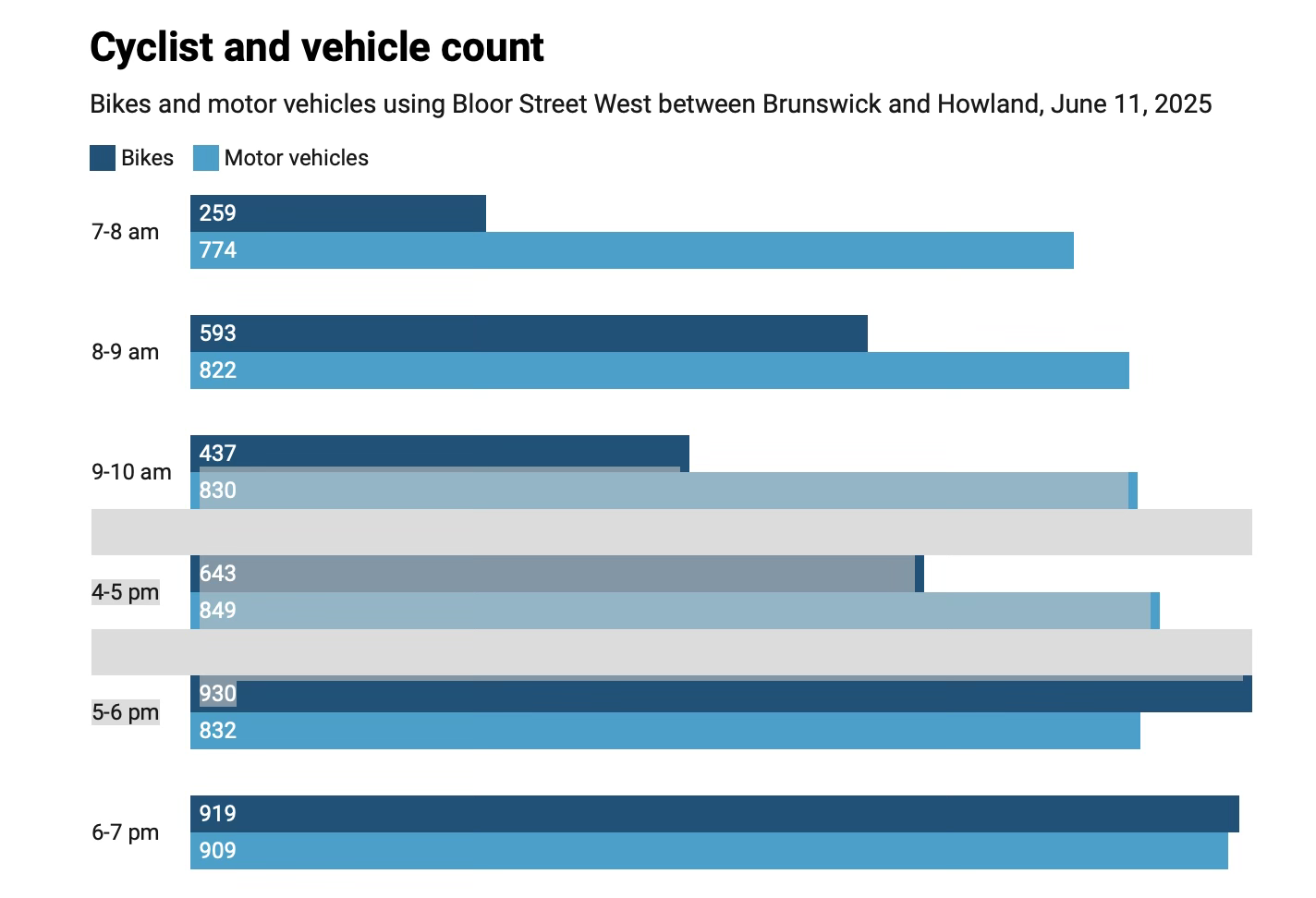
“The upward trend for cycling continues in our city, as it does elsewhere when bike lanes are in place,” said [pdf] Albert Koehl, Coordinator at Community Bikeways in a press release. “What’s especially impressive is that during the 5-7 p.m. rush hours, there were more bikes than cars, even though only a fraction of the roadway is actually set aside for cyclists. We are again seeing the importance of bike lanes for city residents on their way to work or school, to shop, or to go to appointments and meetings.”

The study discusses the problems of e-bike legislation in Ontario, which I have discussed previously, noting that 20% of the traffic in the bike lanes was from big electric scooter/moped type bikes with throttles and decorative pedals.

Get the latest climate news and analysis, direct to your inbox.

Subscribe Today

View our latest digests

“Officially, e-bikes that can be operated without pedalling are not allowed by city by-laws in protected bike lanes, such as on the south side of Bloor, however, our objective was to determine bike lane usage without having to make judgments about who should and should not be in the bike lane.”

I make judgements every day: these scooters are too big and too fast and shouldn’t be in the bike lanes. No doubt, all the bike lane haters are making judgments about this study, yelling TRY COUNTING THE BIKES IN FEBRUARY! However, my daughter and I use this bike lane in February, and when it is properly cleared, it is well-used.

UPDATE: Albert Koehl advises that they staked out the same spot in February and counted over 2,000 cyclists per day.

Bilal Khan, who organized the count, notes, “Our 24-hour study showed more than 9,130 cyclists moved along Bloor St. at the count point. That is over 9,130 people not driving individual cars or on the TTC, helping to reduce pressure on those modes of transport while enjoying an affordable, healthy, noiseless, and climate-friendly way to get around.”

The other very international study reinforces Khan’s point. Titled Global health and climate benefits from walking and cycling infrastructure, the study looked at how urban form and transport infrastructure affect walking and cycling rates in 11,587 cities from 121 countries across six continents.

“We also find positive effects of bicycle lanes (proxying for a wider array of street design practices) on both walking and cycling. In the median city, each new kilometre of bicycle lanes is associated with ~13,400 additional km per year of bicycle travel. If every city increased the extent of its bicycle network to the level of Copenhagen, Denmark, our simulations indicate reductions in private vehicle emissions of ~6% and health benefits of ~US$435 billion per year.”
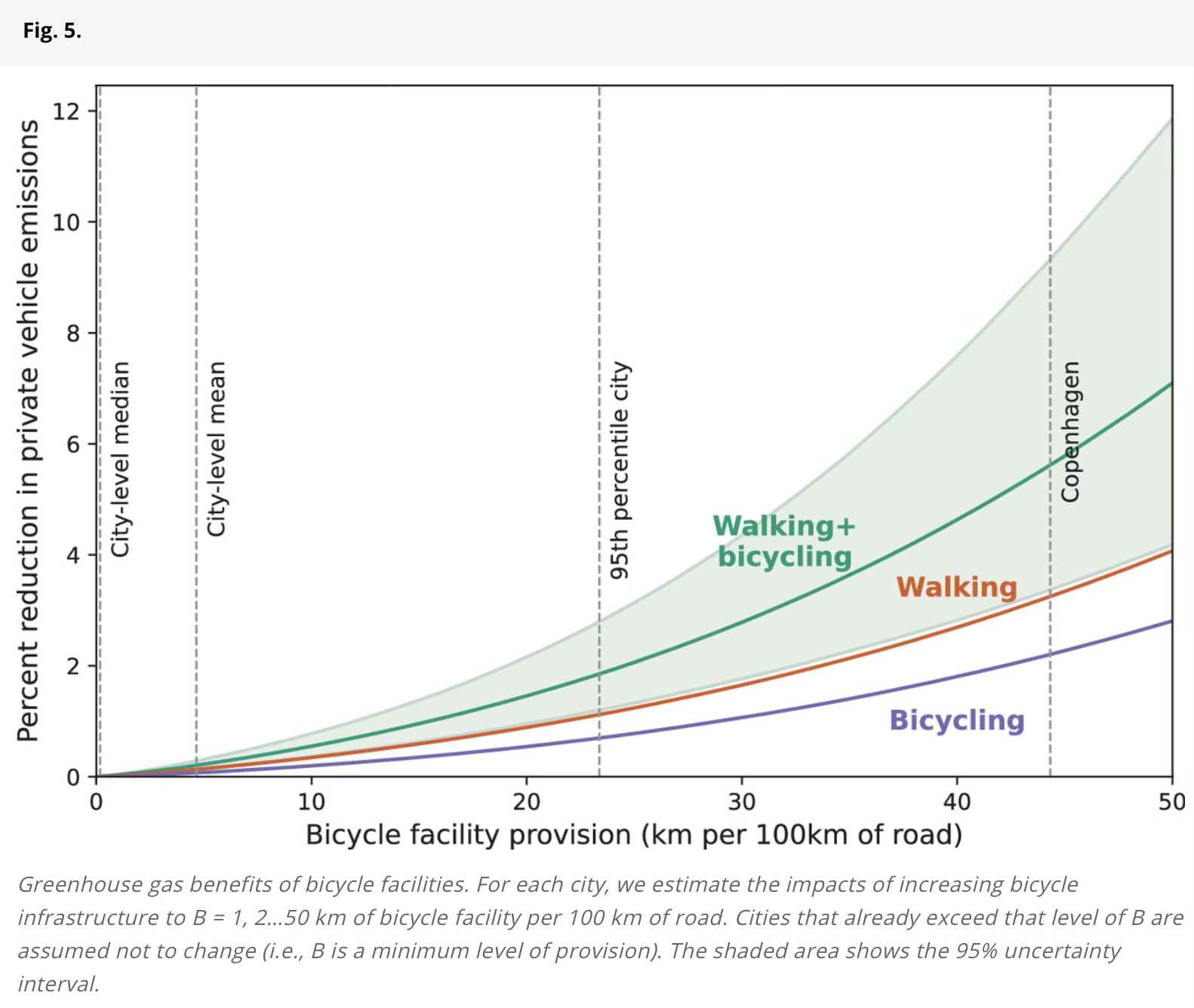
The study unsurprisingly finds that getting people out of cars and onto bikes significantly reduces emissions, and can happen a lot more quickly than switching to electric cars. The authors conclude:

“Our dataset highlights the role of bicycle lanes and paths, but other aspects of street design—sidewalks, safe crossings, and traffic calming measures such as raised intersections—are also important for active travel. The quality of the infrastructure is significant too: bicycle lanes that are protected by curbs or parked cars can attract cyclists of all ages and ability levels, while express bicycle networks such as those in Montreal provide higher design standards on key routes. Globally, 42% of households own a bicycle, and so the question for policymakers is how to encourage more usage rather than increase ownership.”

So here we are in a bizarro world where studies show how bike lanes dramatically increase the number of people riding bikes instead of driving, reducing pollution and fighting climate change, yet politicians all over North America want to tear them out or stop their expansion. They are all in thrall to the fossil fuel economy, which sees bikes as a problem, not a solution. They continue to get elected because there are more car drivers than bike riders, but as a day in June on Toronto’s Bloor Street demonstrates, that can change.

This Substack post by Lloyd Alter is republished at The Energy Mix with his permission.


in Opinion & Analysis, Policy & Politics, Subnational, Walking, Biking & Micromobility

Trending Stories

More than one-third of the Jasper townsite was destroyed by wildfire in 2024  (Laura Durno/Twitter)
Drought & Wildfires

Climate Change Made High Temperatures Twice as Likely Before Jasper Wildfire

August 22, 2024
2.3k
(File photo by Fibonacci Blue/flickr)
Climate Action

Climate Voices See Complications With Blocking New Oil and Gas

November 10, 2026
626
LNG Canada flarestack (supplied image)
Legal & Regulatory

Lawyer’s Letter Warns Pension Funds Over Potential LNG Investments

November 12, 2026
492

Leave a Reply Cancel reply

Your email address will not be published. Required fields are marked *

I agree to the Terms & Conditions and Privacy Policy.

Get the latest climate news and analysis, direct to your inbox.

Subscribe Today

Related Articles

Rethinking Risk in the Age of Climate Chaos

Rethinking Risk in the Age of Climate Chaos

February 11, 2026
Iran’s Major Protest Centres Are Also Battling Extreme Pollution and Water Shortages

Iran’s Major Protest Centres Are Also Battling Extreme Pollution and Water Shortages

February 4, 2026
Federal Environmental Impact Assessments Are in Even More Jeopardy

Federal Environmental Impact Assessments Are in Even More Jeopardy

January 28, 2026

An ‘Extinction-Level Event’ for Trump. A Renewable Energy Surge. A Spiralling Climate Crisis. Is Your Head Spinning Yet?

by Mitchell Beer
November 8, 2026

…

Follow Us

Opinion & Analysis

Threatened Toronto Bike Lane Gets More Rush Hour Traffic than the Car Lane

July 23, 2025
Reading time: 5 minutes
Full Story: Carbon Upfront!
Author: Lloyd Alter

(Canadian Veggie/flickr)

(Canadian Veggie/flickr)

Two studies dropped last month which should give politicians like Ontario Premier Doug Ford something to think about. One is very local: a traffic count in Toronto’s Bloor Street bike lane, which he intends to rip out because he claims it causes traffic congestion and slows his drive to the office.

On June 11, the Toronto Community Bikeways Coalition set up cameras on the second floor of Curbside Cycle and counted every vehicle that passed over an imaginary line in the road during peak travel times. While Doug Ford claims that only 1.2% of Torontonians commute by bike, the study showed that during the afternoon rush hours, bikes, including e-bikes and other micro mobility devices, represented over 50% of all vehicular traffic.

“The upward trend for cycling continues in our city, as it does elsewhere when bike lanes are in place,” said [pdf] Albert Koehl, Coordinator at Community Bikeways in a press release. “What’s especially impressive is that during the 5-7 p.m. rush hours, there were more bikes than cars, even though only a fraction of the roadway is actually set aside for cyclists. We are again seeing the importance of bike lanes for city residents on their way to work or school, to shop, or to go to appointments and meetings.”

The study discusses the problems of e-bike legislation in Ontario, which I have discussed previously, noting that 20% of the traffic in the bike lanes was from big electric scooter/moped type bikes with throttles and decorative pedals.

Get the latest climate news and analysis, direct to your inbox.

Subscribe Today

View our latest digests

“Officially, e-bikes that can be operated without pedalling are not allowed by city by-laws in protected bike lanes, such as on the south side of Bloor, however, our objective was to determine bike lane usage without having to make judgments about who should and should not be in the bike lane.”

I make judgements every day: these scooters are too big and too fast and shouldn’t be in the bike lanes. No doubt, all the bike lane haters are making judgments about this study, yelling TRY COUNTING THE BIKES IN FEBRUARY! However, my daughter and I use this bike lane in February, and when it is properly cleared, it is well-used.

UPDATE: Albert Koehl advises that they staked out the same spot in February and counted over 2,000 cyclists per day.

Bilal Khan, who organized the count, notes, “Our 24-hour study showed more than 9,130 cyclists moved along Bloor St. at the count point. That is over 9,130 people not driving individual cars or on the TTC, helping to reduce pressure on those modes of transport while enjoying an affordable, healthy, noiseless, and climate-friendly way to get around.”

The other very international study reinforces Khan’s point. Titled Global health and climate benefits from walking and cycling infrastructure, the study looked at how urban form and transport infrastructure affect walking and cycling rates in 11,587 cities from 121 countries across six continents.

“We also find positive effects of bicycle lanes (proxying for a wider array of street design practices) on both walking and cycling. In the median city, each new kilometre of bicycle lanes is associated with ~13,400 additional km per year of bicycle travel. If every city increased the extent of its bicycle network to the level of Copenhagen, Denmark, our simulations indicate reductions in private vehicle emissions of ~6% and health benefits of ~US$435 billion per year.”

The study unsurprisingly finds that getting people out of cars and onto bikes significantly reduces emissions, and can happen a lot more quickly than switching to electric cars. The authors conclude:

“Our dataset highlights the role of bicycle lanes and paths, but other aspects of street design—sidewalks, safe crossings, and traffic calming measures such as raised intersections—are also important for active travel. The quality of the infrastructure is significant too: bicycle lanes that are protected by curbs or parked cars can attract cyclists of all ages and ability levels, while express bicycle networks such as those in Montreal provide higher design standards on key routes. Globally, 42% of households own a bicycle, and so the question for policymakers is how to encourage more usage rather than increase ownership.”

So here we are in a bizarro world where studies show how bike lanes dramatically increase the number of people riding bikes instead of driving, reducing pollution and fighting climate change, yet politicians all over North America want to tear them out or stop their expansion. They are all in thrall to the fossil fuel economy, which sees bikes as a problem, not a solution. They continue to get elected because there are more car drivers than bike riders, but as a day in June on Toronto’s Bloor Street demonstrates, that can change.

This Substack post by Lloyd Alter is republished at The Energy Mix with his permission.



in Opinion & Analysis, Policy & Politics, Subnational, Walking, Biking & Micromobility

Leave a Reply Cancel reply

Your email address will not be published. Required fields are marked *

I agree to the Terms & Conditions and Privacy Policy.

Related Articles

Rethinking Risk in the Age of Climate Chaos

Rethinking Risk in the Age of Climate Chaos

February 11, 2026
Iran’s Major Protest Centres Are Also Battling Extreme Pollution and Water Shortages

Iran’s Major Protest Centres Are Also Battling Extreme Pollution and Water Shortages

February 4, 2026
Federal Environmental Impact Assessments Are in Even More Jeopardy

Federal Environmental Impact Assessments Are in Even More Jeopardy

January 28, 2026

Trending Stories

More than one-third of the Jasper townsite was destroyed by wildfire in 2024  (Laura Durno/Twitter)

Climate Change Made High Temperatures Twice as Likely Before Jasper Wildfire

August 22, 2024
2.3k
(File photo by Fibonacci Blue/flickr)

Climate Voices See Complications With Blocking New Oil and Gas

November 10, 2026
626
LNG Canada flarestack (supplied image)

Lawyer’s Letter Warns Pension Funds Over Potential LNG Investments

November 12, 2026
492

An ‘Extinction-Level Event’ for Trump. A Renewable Energy Surge. A Spiralling Climate Crisis. Is Your Head Spinning Yet?

by Mitchell Beer
November 8, 2026

…

Follow Us

Copyright 2026 © Energy Mix Productions Inc. All rights reserved.

  • About
  • Contact
  • Privacy Policy and Copyright
  • Cookie Policy
No Result
View All Result
  • Topics
    • Buildings & Infrastructure
    • Climate Equity & Justice
      • Energy Poverty
      • Indigenous Rights & Reconciliation
    • Climate Finance
      • Community Climate Finance
      • Finance & Investment
      • Insurance & Liability
      • Subsidies
    • Climate Impacts & Adaptation
      • Biodiversity & Habitat
      • Drought & Wildfires
      • Forests & Deforestation
      • Health & Safety
      • Heat & Temperature
      • Ice Loss & Sea Level Rise
      • Severe Storms & Flooding
    • Emissions
      • Carbon Levels & Measurement
      • CCS & Negative Emissions
      • Methane
    • Energy
      • Renewables
      • Fossil Fuels
      • Hydrogen
      • Nuclear
      • Batteries & Storage
      • Energy Efficiency
      • Power Grids
    • Food & Agriculture
    • Industry
      • Data Centres & Tech
      • Critical Minerals & Mining
      • Petrochemicals & Plastics
    • Policy & Politics
      • Carbon Pricing
      • COP Conferences
      • Elections
      • Energy Politics
      • International Security & War
      • Legal & Regulatory
    • Research & Innovation
      • International Agencies & Studies
      • Research & Development
    • Society & Culture
      • Climate Action
      • Mis/Disinformation & Greenwashing
      • Jobs & Training
      • Leisure & Recreation
      • Media, Messaging, & Public Opinion
    • Transportation & Mobility
      • Electric Vehicles
      • Shipping & Aviation
      • Transit
      • Walking, Biking & Micromobility
  • Regions
    • Africa
    • Arctic & Antarctica
    • Asia
    • Australia
    • Canada
    • International
    • Mexico & the Caribbean
    • Middle East
    • Oceans
    • Small Island States
    • South & Central America
    • Subnational
    • United States
    • UK & Europe
  • Special Coverage
    • The Weekender
    • IEA2026
    • Canada’s Major Projects Office
    • Hidden Wonder Valley
    • COP30
    • Cities & Communities
    • Heat & Power
    • Community Climate Finance
  • More Resources
  • About
  • Contact

Copyright 2025 © Smarter Shift Inc. and Energy Mix Productions Inc. All rights reserved.

Manage Cookie Consent
To provide the best experiences, we use technologies like cookies to store and/or access device information. Consenting to these technologies will allow us to process data such as browsing behaviour or unique IDs on this site. Not consenting or withdrawing consent, may adversely affect certain features and functions.
Functional Always active
The technical storage or access is strictly necessary for the legitimate purpose of enabling the use of a specific service explicitly requested by the subscriber or user, or for the sole purpose of carrying out the transmission of a communication over an electronic communications network.
Preferences
The technical storage or access is necessary for the legitimate purpose of storing preferences that are not requested by the subscriber or user.
Statistics
The technical storage or access that is used exclusively for statistical purposes. The technical storage or access that is used exclusively for anonymous statistical purposes. Without a subpoena, voluntary compliance on the part of your Internet Service Provider, or additional records from a third party, information stored or retrieved for this purpose alone cannot usually be used to identify you.
Marketing
The technical storage or access is required to create user profiles to send advertising, or to track the user on a website or across several websites for similar marketing purposes.
  • Manage options
  • Manage services
  • Manage {vendor_count} vendors
  • Read more about these purposes
View preferences
  • {title}
  • {title}
  • {title}
No Result
View All Result
  • Topics
    • Buildings & Infrastructure
    • Climate Equity & Justice
      • Energy Poverty
      • Indigenous Rights & Reconciliation
    • Climate Finance
      • Community Climate Finance
      • Finance & Investment
      • Insurance & Liability
      • Subsidies
    • Climate Impacts & Adaptation
      • Biodiversity & Habitat
      • Drought & Wildfires
      • Forests & Deforestation
      • Health & Safety
      • Heat & Temperature
      • Ice Loss & Sea Level Rise
      • Severe Storms & Flooding
    • Emissions
      • Carbon Levels & Measurement
      • CCS & Negative Emissions
      • Methane
    • Energy
      • Renewables
      • Fossil Fuels
      • Hydrogen
      • Nuclear
      • Batteries & Storage
      • Energy Efficiency
      • Power Grids
    • Food & Agriculture
    • Industry
      • Data Centres & Tech
      • Critical Minerals & Mining
      • Petrochemicals & Plastics
    • Policy & Politics
      • Carbon Pricing
      • COP Conferences
      • Elections
      • Energy Politics
      • International Security & War
      • Legal & Regulatory
    • Research & Innovation
      • International Agencies & Studies
      • Research & Development
    • Society & Culture
      • Climate Action
      • Mis/Disinformation & Greenwashing
      • Jobs & Training
      • Leisure & Recreation
      • Media, Messaging, & Public Opinion
    • Transportation & Mobility
      • Electric Vehicles
      • Shipping & Aviation
      • Transit
      • Walking, Biking & Micromobility
  • Regions
    • Africa
    • Arctic & Antarctica
    • Asia
    • Australia
    • Canada
    • International
    • Mexico & the Caribbean
    • Middle East
    • Oceans
    • Small Island States
    • South & Central America
    • Subnational
    • United States
    • UK & Europe
  • Special Coverage
    • The Weekender
    • IEA2026
    • Canada’s Major Projects Office
    • Hidden Wonder Valley
    • COP30
    • Cities & Communities
    • Heat & Power
    • Community Climate Finance
  • More Resources
  • About
  • Contact

Copyright 2025 © Smarter Shift Inc. and Energy Mix Productions Inc. All rights reserved.



