The Energy Mix
Subscribe
Donate
  • Topics
    • Buildings & Infrastructure
    • Climate Equity & Justice
      • Energy Poverty
      • Indigenous Rights & Reconciliation
    • Climate Finance
      • Community Climate Finance
      • Finance & Investment
      • Insurance & Liability
      • Subsidies
    • Climate Impacts & Adaptation
      • Biodiversity & Habitat
      • Drought & Wildfires
      • Forests & Deforestation
      • Health & Safety
      • Heat & Temperature
      • Ice Loss & Sea Level Rise
      • Severe Storms & Flooding
    • Emissions
      • Carbon Levels & Measurement
      • CCS & Negative Emissions
      • Methane
    • Energy
      • Renewables
      • Fossil Fuels
      • Hydrogen
      • Nuclear
      • Batteries & Storage
      • Energy Efficiency
      • Power Grids
    • Food & Agriculture
    • Industry
      • Data Centres & Tech
      • Critical Minerals & Mining
      • Petrochemicals & Plastics
    • Policy & Politics
      • Carbon Pricing
      • COP Conferences
      • Elections
      • Energy Politics
      • International Security & War
      • Legal & Regulatory
    • Research & Innovation
      • International Agencies & Studies
      • Research & Development
    • Society & Culture
      • Climate Action
      • Mis/Disinformation & Greenwashing
      • Jobs & Training
      • Leisure & Recreation
      • Media, Messaging, & Public Opinion
    • Transportation & Mobility
      • Electric Vehicles
      • Shipping & Aviation
      • Transit
      • Walking, Biking & Micromobility
  • Regions
    • Africa
    • Arctic & Antarctica
    • Asia
    • Australia
    • Canada
    • International
    • Mexico & the Caribbean
    • Middle East
    • Oceans
    • Small Island States
    • South & Central America
    • Subnational
    • United States
    • UK & Europe
  • Special Coverage
    • The Weekender
    • IEA2026
    • Canada’s Major Projects Office
    • Hidden Wonder Valley
    • COP30
    • Cities & Communities
    • Heat & Power
    • Community Climate Finance
  • More Resources
    • Climate Glossary
    • What If We Changed the Conversation on Climate Change?
    • Eco-Anxiety
  • About
  • Contact
No Result
View All Result
The Energy Mix
  • Topics
    • Buildings & Infrastructure
    • Climate Equity & Justice
      • Energy Poverty
      • Indigenous Rights & Reconciliation
    • Climate Finance
      • Community Climate Finance
      • Finance & Investment
      • Insurance & Liability
      • Subsidies
    • Climate Impacts & Adaptation
      • Biodiversity & Habitat
      • Drought & Wildfires
      • Forests & Deforestation
      • Health & Safety
      • Heat & Temperature
      • Ice Loss & Sea Level Rise
      • Severe Storms & Flooding
    • Emissions
      • Carbon Levels & Measurement
      • CCS & Negative Emissions
      • Methane
    • Energy
      • Renewables
      • Fossil Fuels
      • Hydrogen
      • Nuclear
      • Batteries & Storage
      • Energy Efficiency
      • Power Grids
    • Food & Agriculture
    • Industry
      • Data Centres & Tech
      • Critical Minerals & Mining
      • Petrochemicals & Plastics
    • Policy & Politics
      • Carbon Pricing
      • COP Conferences
      • Elections
      • Energy Politics
      • International Security & War
      • Legal & Regulatory
    • Research & Innovation
      • International Agencies & Studies
      • Research & Development
    • Society & Culture
      • Climate Action
      • Mis/Disinformation & Greenwashing
      • Jobs & Training
      • Leisure & Recreation
      • Media, Messaging, & Public Opinion
    • Transportation & Mobility
      • Electric Vehicles
      • Shipping & Aviation
      • Transit
      • Walking, Biking & Micromobility
  • Regions
    • Africa
    • Arctic & Antarctica
    • Asia
    • Australia
    • Canada
    • International
    • Mexico & the Caribbean
    • Middle East
    • Oceans
    • Small Island States
    • South & Central America
    • Subnational
    • United States
    • UK & Europe
  • Special Coverage
    • The Weekender
    • IEA2026
    • Canada’s Major Projects Office
    • Hidden Wonder Valley
    • COP30
    • Cities & Communities
    • Heat & Power
    • Community Climate Finance
  • More Resources
    • Climate Glossary
    • What If We Changed the Conversation on Climate Change?
    • Eco-Anxiety
  • About
  • Contact
Subscribe
Donate
The Energy Mix
Subscribe

This Brooklyn Bagel Shop Is Saving Money With Plug-in Batteries

January 26, 2026
Reading time: 9 minutes
Full Story: Canary Media
Author: Maria Gallucci, Jeff St. John

Noah Bernamoff at Black Seed’s Bushwick shop, which serves as the company’s headquarters (Maria Gallucci/Canary Media)

Noah Bernamoff at Black Seed’s Bushwick shop, which serves as the company’s headquarters (Maria Gallucci/Canary Media)

This story was originally published by Canary Media.

In the back of Black Seed Bagels in northern Brooklyn is a giant catering kitchen filled with industrial-size condiments and freezers full of dough. A tall, silver electric oven, named the Baconator, stands in a far corner, cooking thousands of pounds of meat every week to accompany Black Seed’s hand-rolled, wood-fired bagels.

The Baconator is connected to a battery the size of a carry-on suitcase, which is plugged into the wall. While the morning rush is underway, the 2.8-kilowatt-hour battery can directly power the commercial oven to reduce the company’s reliance on the electric grid, Noah Bernamoff, Black Seed’s co-owner, explained recently at the company’s Bushwick shop. Two more batteries are paired with energy-intensive refrigerators in the front.

Businesses like Black Seed often pay hefty demand charges on their utility bills that reflect the maximum amount of power they use during a month—costs that can represent as much as half their total bill, on average. By shifting to battery power during key times, Black Seed aims to lower its peak grid needs and reduce monthly fees from the utility Con Edison in the process.

Black Seed is part of a battery pilot program run by David Energy, a New York–based retail energy provider. The startup supplied the batteries for free last August and, using its software platform, controls exactly when the three appliances draw on backup power. Vivek Bhagwat, David Energy’s head of engineering, said he expects that tapping batteries for the refrigerators—which are always humming—will be especially helpful during the hottest months, when the shop’s air conditioners run around the clock.

“We’re pretty optimistic about our ability to curtail energy in the summer, when it really matters most, through this machine,” he said while standing beside a doorless fridge holding water, juice, and soda.

For Black Seed, even modest benefits from batteries could make a difference if multiplied across the company’s 10 locations in New York City, Bernamoff said. By way of example, he noted that saving US$80 at every shop every month could add up to almost $10,000 a year in avoided utility costs.

“We’re in the game of nickels and dimes,” he said of the bagel business. ​“So we’re always happy to save the money.”

Get the latest climate news and analysis, direct to your inbox.

Subscribe Today

View our latest digests

James McGinniss, David Energy’s CEO, thinks this ​“do-it-yourself battery” strategy has some serious potential to help small businesses combat rising electricity costs, both in New York City and beyond. Along with Black Seed’s Bushwick shop, his company has installed batteries at fast-food restaurants, a day spa, and a dog grooming store, where the battery is cushioning the power draw of a fur-drying machine. As of mid-January, David Energy has signed deals with customers to put plug-in batteries in about 50 locations, adding up to more than 500 kilowatt-hours of energy storage capacity. 

Black storefront with three large windows, a door, and a sidewalk sign advertising bagels
Outside Black Seed’s shop in Brooklyn’s Williamsburg neighborhood (Stephanie Primavera/Canary Media)

The startup’s plug-in battery pilot is building on the growing interest in DIY energy technologies worldwide. McGinniss cited the example of balcony solar systems that can plug into standard household electrical outlets, which are big in Germany but aren’t yet allowed under most current electrical codes in the U.S.—although state lawmakers in New York and elsewhere are pushing legislation to change that.

Backup batteries, however, are ready for market. Portable batteries from companies like Jackery and EcoFlow are increasingly affordable and popular options for households that are looking for backup power during blackouts but can’t, or don’t want to, install fossil fuel–burning generators. A handful of startups like Pila Energy have plug-in batteries meant to operate around the clock to reduce utility bills as well as to keep refrigerators and other critical appliances running through power outages. 

A plug-in battery helps power a doorless fridge in Black Seed’s Bushwick shop. (Maria Gallucci/Canary Media)

As a retail energy provider, David Energy competes with large utilities and other energy retailers to provide customers with cheaper electricity plans. It does so primarily by purchasing electricity from wholesale markets and then reselling it to businesses and households. But the battery pilot is part of the company’s broader long-term goal to ​“run the grid 24/7 on clean energy,” McGinniss said.

As solar and batteries have become ​“the cheapest electron we can create,” giving customers access to those technologies has become a business priority for David Energy as well—“because people like cheap energy,” he said. Plug-in batteries, in particular, enable the company to ​“rapidly scale our storage under management, even in the existing regulatory construct,” according to McGinniss. 

That last point underscores the challenges that New York City businesses face in installing the type of wired-in and utility-interconnected battery backup systems that are more common in other parts of the country. For years, concerns about fire risks have led the New York City Fire Department to subject stationary lithium-ion battery installations to strict fire-safety regulations that have made them impractical for most building owners. 

Last fall, the New York City Buildings Department issued new rules that industry experts say could make these projects more cost-effective. But that still leaves building owners and battery installers with the task of navigating complex and time-consuming utility interconnection processes—steps that simple plug-in batteries can avoid. 

Can free plug-in batteries pay their way?

Still, how can a retail energy provider recoup the cost of supplying batteries to customers for free? McGinniss didn’t disclose the current financials for David Energy’s no-cost battery program. But he did say that the devices offer money-saving opportunities for customers and money-making ones for his business that can expand over time.

For customers, the fundamental proposition is the opportunity to reduce a big, hard-to-manage portion of their monthly utility bills—the demand charges. Unlike the per-kilowatt-hour ​“volumetric” charges that most households pay, these particular fees are assessed based on the maximum amount of power a business draws from the grid during any 15-minute period within a month. The structure is designed to incentivize customers to reduce peak electricity use, which drives much of the cost for utilities of building and maintaining grid infrastructure.

For New York City businesses, these demand charges can add up to between 15% and 50% of a typical commercial customer’s monthly bill, McGinniss explained. Using stored battery power for big appliances that tend to need a lot of energy during those times can significantly reduce those peaks, he said, as shown in this sample graph from Black Seed’s Bushwick location on Sept. 17, 2025.
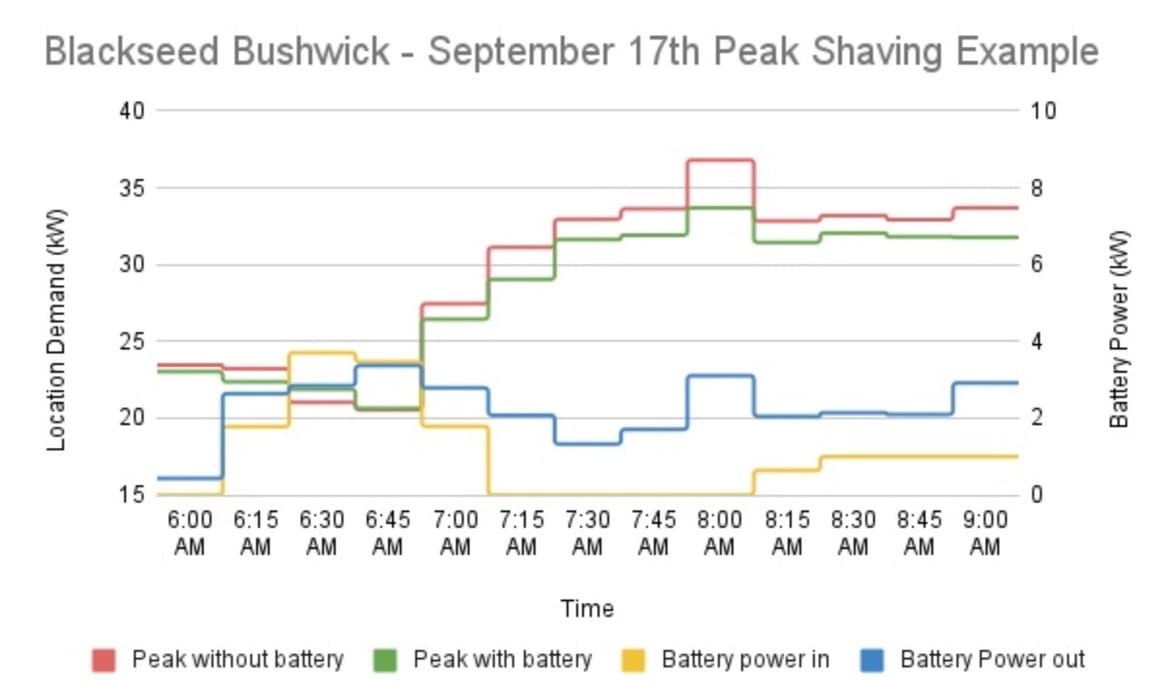
Chart "Blackseed Bushwick—September 17 Peak Shaving Example" with time of day on the x-axis, location demand in kWH as y-axis
(David Energy)

The results can vary greatly from customer to customer, though McGinniss estimated that every kilowatt shaved from that peak could cut about $50 from a monthly bill. That’s a good way for David Energy to entice and retain customers, he said. But the startup can also use the same stored battery power to earn revenues for itself.

One option is participating in so-called demand-response programs, which pay customers to reduce power use during, for instance, hot summer evenings when demand for electricity is putting power plants and grid infrastructure under stress. In New York City, David Energy can participate in programs run by Con Edison and by state grid operator NYISO, McGinniss said.

Retail electricity providers like David Energy can make (or lose) money depending on how cleverly they manage their ever-changing mix of purchases on wholesale energy markets against their commitments to provide their customers with retail power at competitive prices.

In Texas, the country’s most open and competitive electricity market, energy retailers are building gigawatt-scale ​“virtual power plant” platforms, offering customers free smart thermostats,rooftop solar-and-battery systems, and stand-alone backup batteries. In exchange, these programs ask customers for permission to use those systems to pursue arbitrage opportunities—essentially hedging their wholesale energy-market positions by using batteries to store power when it’s cheaper and avoid pulling it from the grid when it’s more expensive. David Energy is pursuing similar opportunities in Texas as well as in its primary markets in New York and elsewhere in the Northeast.

The economics of this customer-facing arbitrage expand as the scale of deployments grows, McGinniss said. ​“As you add these things up, it’s a portfolio effect,” he said. ​“There’s a lot more value to unlock down the road.” 

To be clear, relying on systems installed at customers’ homes and businesses puts a lot of risk on the companies fronting the money to install them. These companies need to have technology to communicate with and control the devices to ensure they’re storing and shifting power at times when that’s valuable. And they need contracts that fairly share the savings and revenues with their customers—and build in options for when customers might want to switch to a different energy retailer that comes along with a more attractive offer.

On that last front, portable batteries are a lot less risky than systems that need to be wired into building electrical panels and interconnected under utility rules, McGinniss noted. ​“If they don’t like the service, we can come pick it up. That’s a remarkable fact about these batteries that changes how you think about financing.”

Even so, Bernamoff at Black Seed Bagels said he’s excited by the longer-term possibility of installing large-scale batteries in the Bushwick store’s basement—particularly as city and state policymakers in New York push to electrify buildings. Today, Black Seed primarily uses fossil-gas appliances and heating systems in its stores. If the company is required to switch to electrified versions, then adding batteries could help it manage its higher electricity bills and limit strain on the local grid, he said.

“The industrial battery side of it all could be really interesting,” Bernamoff said while seated at a café table, beneath a poster advertising the store’s scallion-kimchi cream cheese.

“To the extent that we’d be able to reduce peak power at the service level, instead of piece by piece, now we’re really talking,” he added. ​“Because then every outlet, every light bulb is being better managed and reduced.”


in Batteries & Storage, Buildings & Infrastructure

Trending Stories

(Julie Dabrusin/Facebook)
Carbon Pricing

EXCLUSIVE: Carbon Tax Exemption for Canada Would Break World Trade Rules, EU Law

November 3, 2026
1.6k
Alberta Environment and Protected Areas Minister Grant Hunter, Alberta Newsroom/flickr
Legal & Regulatory

Alberta Accused of Rushing Environmental Law Changes Behind Closed Doors

November 5, 2026
703
Finance Minister François-Philippe Champagne at 2025 Collision Conferencef/flickr
Finance & Investment

Federal Budget Funds Clean Grid and Energy Efficiency, Touts ‘Investment Supercycle’ Built on Major Projects

November 6, 2026
698

Leave a Reply Cancel reply

Your email address will not be published. Required fields are marked *

I agree to the Terms & Conditions and Privacy Policy.

Get the latest climate news and analysis, direct to your inbox.

Subscribe Today

Related Articles

‘Georgia is in Ukraine!’:How a Dead EV Became a Ukrainian DER Freedom Fighter

‘Georgia is in Ukraine!’:How a Dead EV Became a Ukrainian DER Freedom Fighter

January 5, 2026
#Encore: Oneida Battery Project, Canada’s Biggest, Goes Online Ahead of Schedule, Under Budget

#Encore: Oneida Battery Project, Canada’s Biggest, Goes Online Ahead of Schedule, Under Budget

December 28, 2025
‘Unrecognizably’ Cheap Batteries Turn Solar Into an ‘Anytime’ Energy Source

‘Unrecognizably’ Cheap Batteries Turn Solar Into an ‘Anytime’ Energy Source

December 16, 2025

Actions Speak Louder Than Words

by Mitchell Beer
November 2, 2026

…

Follow Us

This Brooklyn Bagel Shop Is Saving Money With Plug-in Batteries

January 26, 2026
Reading time: 9 minutes
Full Story: Canary Media
Author: Maria Gallucci, Jeff St. John

Noah Bernamoff at Black Seed’s Bushwick shop, which serves as the company’s headquarters (Maria Gallucci/Canary Media)

Noah Bernamoff at Black Seed’s Bushwick shop, which serves as the company’s headquarters (Maria Gallucci/Canary Media)

This story was originally published by Canary Media.

In the back of Black Seed Bagels in northern Brooklyn is a giant catering kitchen filled with industrial-size condiments and freezers full of dough. A tall, silver electric oven, named the Baconator, stands in a far corner, cooking thousands of pounds of meat every week to accompany Black Seed’s hand-rolled, wood-fired bagels.

The Baconator is connected to a battery the size of a carry-on suitcase, which is plugged into the wall. While the morning rush is underway, the 2.8-kilowatt-hour battery can directly power the commercial oven to reduce the company’s reliance on the electric grid, Noah Bernamoff, Black Seed’s co-owner, explained recently at the company’s Bushwick shop. Two more batteries are paired with energy-intensive refrigerators in the front.

Businesses like Black Seed often pay hefty demand charges on their utility bills that reflect the maximum amount of power they use during a month—costs that can represent as much as half their total bill, on average. By shifting to battery power during key times, Black Seed aims to lower its peak grid needs and reduce monthly fees from the utility Con Edison in the process.

Black Seed is part of a battery pilot program run by David Energy, a New York–based retail energy provider. The startup supplied the batteries for free last August and, using its software platform, controls exactly when the three appliances draw on backup power. Vivek Bhagwat, David Energy’s head of engineering, said he expects that tapping batteries for the refrigerators—which are always humming—will be especially helpful during the hottest months, when the shop’s air conditioners run around the clock.

“We’re pretty optimistic about our ability to curtail energy in the summer, when it really matters most, through this machine,” he said while standing beside a doorless fridge holding water, juice, and soda.

For Black Seed, even modest benefits from batteries could make a difference if multiplied across the company’s 10 locations in New York City, Bernamoff said. By way of example, he noted that saving US$80 at every shop every month could add up to almost $10,000 a year in avoided utility costs.

“We’re in the game of nickels and dimes,” he said of the bagel business. ​“So we’re always happy to save the money.”

Get the latest climate news and analysis, direct to your inbox.

Subscribe Today

View our latest digests

James McGinniss, David Energy’s CEO, thinks this ​“do-it-yourself battery” strategy has some serious potential to help small businesses combat rising electricity costs, both in New York City and beyond. Along with Black Seed’s Bushwick shop, his company has installed batteries at fast-food restaurants, a day spa, and a dog grooming store, where the battery is cushioning the power draw of a fur-drying machine. As of mid-January, David Energy has signed deals with customers to put plug-in batteries in about 50 locations, adding up to more than 500 kilowatt-hours of energy storage capacity. 

Black storefront with three large windows, a door, and a sidewalk sign advertising bagels
Outside Black Seed’s shop in Brooklyn’s Williamsburg neighborhood (Stephanie Primavera/Canary Media)

The startup’s plug-in battery pilot is building on the growing interest in DIY energy technologies worldwide. McGinniss cited the example of balcony solar systems that can plug into standard household electrical outlets, which are big in Germany but aren’t yet allowed under most current electrical codes in the U.S.—although state lawmakers in New York and elsewhere are pushing legislation to change that.

Backup batteries, however, are ready for market. Portable batteries from companies like Jackery and EcoFlow are increasingly affordable and popular options for households that are looking for backup power during blackouts but can’t, or don’t want to, install fossil fuel–burning generators. A handful of startups like Pila Energy have plug-in batteries meant to operate around the clock to reduce utility bills as well as to keep refrigerators and other critical appliances running through power outages. 

A plug-in battery helps power a doorless fridge in Black Seed’s Bushwick shop. (Maria Gallucci/Canary Media)

As a retail energy provider, David Energy competes with large utilities and other energy retailers to provide customers with cheaper electricity plans. It does so primarily by purchasing electricity from wholesale markets and then reselling it to businesses and households. But the battery pilot is part of the company’s broader long-term goal to ​“run the grid 24/7 on clean energy,” McGinniss said.

As solar and batteries have become ​“the cheapest electron we can create,” giving customers access to those technologies has become a business priority for David Energy as well—“because people like cheap energy,” he said. Plug-in batteries, in particular, enable the company to ​“rapidly scale our storage under management, even in the existing regulatory construct,” according to McGinniss. 

That last point underscores the challenges that New York City businesses face in installing the type of wired-in and utility-interconnected battery backup systems that are more common in other parts of the country. For years, concerns about fire risks have led the New York City Fire Department to subject stationary lithium-ion battery installations to strict fire-safety regulations that have made them impractical for most building owners. 

Last fall, the New York City Buildings Department issued new rules that industry experts say could make these projects more cost-effective. But that still leaves building owners and battery installers with the task of navigating complex and time-consuming utility interconnection processes—steps that simple plug-in batteries can avoid. 

Can free plug-in batteries pay their way?

Still, how can a retail energy provider recoup the cost of supplying batteries to customers for free? McGinniss didn’t disclose the current financials for David Energy’s no-cost battery program. But he did say that the devices offer money-saving opportunities for customers and money-making ones for his business that can expand over time.

For customers, the fundamental proposition is the opportunity to reduce a big, hard-to-manage portion of their monthly utility bills—the demand charges. Unlike the per-kilowatt-hour ​“volumetric” charges that most households pay, these particular fees are assessed based on the maximum amount of power a business draws from the grid during any 15-minute period within a month. The structure is designed to incentivize customers to reduce peak electricity use, which drives much of the cost for utilities of building and maintaining grid infrastructure.

For New York City businesses, these demand charges can add up to between 15% and 50% of a typical commercial customer’s monthly bill, McGinniss explained. Using stored battery power for big appliances that tend to need a lot of energy during those times can significantly reduce those peaks, he said, as shown in this sample graph from Black Seed’s Bushwick location on Sept. 17, 2025.

Chart "Blackseed Bushwick—September 17 Peak Shaving Example" with time of day on the x-axis, location demand in kWH as y-axis
(David Energy)

The results can vary greatly from customer to customer, though McGinniss estimated that every kilowatt shaved from that peak could cut about $50 from a monthly bill. That’s a good way for David Energy to entice and retain customers, he said. But the startup can also use the same stored battery power to earn revenues for itself.

One option is participating in so-called demand-response programs, which pay customers to reduce power use during, for instance, hot summer evenings when demand for electricity is putting power plants and grid infrastructure under stress. In New York City, David Energy can participate in programs run by Con Edison and by state grid operator NYISO, McGinniss said.

Retail electricity providers like David Energy can make (or lose) money depending on how cleverly they manage their ever-changing mix of purchases on wholesale energy markets against their commitments to provide their customers with retail power at competitive prices.

In Texas, the country’s most open and competitive electricity market, energy retailers are building gigawatt-scale ​“virtual power plant” platforms, offering customers free smart thermostats,rooftop solar-and-battery systems, and stand-alone backup batteries. In exchange, these programs ask customers for permission to use those systems to pursue arbitrage opportunities—essentially hedging their wholesale energy-market positions by using batteries to store power when it’s cheaper and avoid pulling it from the grid when it’s more expensive. David Energy is pursuing similar opportunities in Texas as well as in its primary markets in New York and elsewhere in the Northeast.

The economics of this customer-facing arbitrage expand as the scale of deployments grows, McGinniss said. ​“As you add these things up, it’s a portfolio effect,” he said. ​“There’s a lot more value to unlock down the road.” 

To be clear, relying on systems installed at customers’ homes and businesses puts a lot of risk on the companies fronting the money to install them. These companies need to have technology to communicate with and control the devices to ensure they’re storing and shifting power at times when that’s valuable. And they need contracts that fairly share the savings and revenues with their customers—and build in options for when customers might want to switch to a different energy retailer that comes along with a more attractive offer.

On that last front, portable batteries are a lot less risky than systems that need to be wired into building electrical panels and interconnected under utility rules, McGinniss noted. ​“If they don’t like the service, we can come pick it up. That’s a remarkable fact about these batteries that changes how you think about financing.”

Even so, Bernamoff at Black Seed Bagels said he’s excited by the longer-term possibility of installing large-scale batteries in the Bushwick store’s basement—particularly as city and state policymakers in New York push to electrify buildings. Today, Black Seed primarily uses fossil-gas appliances and heating systems in its stores. If the company is required to switch to electrified versions, then adding batteries could help it manage its higher electricity bills and limit strain on the local grid, he said.

“The industrial battery side of it all could be really interesting,” Bernamoff said while seated at a café table, beneath a poster advertising the store’s scallion-kimchi cream cheese.

“To the extent that we’d be able to reduce peak power at the service level, instead of piece by piece, now we’re really talking,” he added. ​“Because then every outlet, every light bulb is being better managed and reduced.”


in Batteries & Storage, Buildings & Infrastructure

Leave a Reply Cancel reply

Your email address will not be published. Required fields are marked *

I agree to the Terms & Conditions and Privacy Policy.

Related Articles

‘Georgia is in Ukraine!’:How a Dead EV Became a Ukrainian DER Freedom Fighter

‘Georgia is in Ukraine!’:How a Dead EV Became a Ukrainian DER Freedom Fighter

January 5, 2026
#Encore: Oneida Battery Project, Canada’s Biggest, Goes Online Ahead of Schedule, Under Budget

#Encore: Oneida Battery Project, Canada’s Biggest, Goes Online Ahead of Schedule, Under Budget

December 28, 2025
‘Unrecognizably’ Cheap Batteries Turn Solar Into an ‘Anytime’ Energy Source

‘Unrecognizably’ Cheap Batteries Turn Solar Into an ‘Anytime’ Energy Source

December 16, 2025

Trending Stories

(Julie Dabrusin/Facebook)

EXCLUSIVE: Carbon Tax Exemption for Canada Would Break World Trade Rules, EU Law

November 3, 2026
1.6k
Alberta Environment and Protected Areas Minister Grant Hunter, Alberta Newsroom/flickr

Alberta Accused of Rushing Environmental Law Changes Behind Closed Doors

November 5, 2026
703
Finance Minister François-Philippe Champagne at 2025 Collision Conferencef/flickr

Federal Budget Funds Clean Grid and Energy Efficiency, Touts ‘Investment Supercycle’ Built on Major Projects

November 6, 2026
698

Actions Speak Louder Than Words

by Mitchell Beer
November 2, 2026

…

Follow Us

Copyright 2026 © Energy Mix Productions Inc. All rights reserved.

  • About
  • Contact
  • Privacy Policy and Copyright
  • Cookie Policy
No Result
View All Result
  • Topics
    • Buildings & Infrastructure
    • Climate Equity & Justice
      • Energy Poverty
      • Indigenous Rights & Reconciliation
    • Climate Finance
      • Community Climate Finance
      • Finance & Investment
      • Insurance & Liability
      • Subsidies
    • Climate Impacts & Adaptation
      • Biodiversity & Habitat
      • Drought & Wildfires
      • Forests & Deforestation
      • Health & Safety
      • Heat & Temperature
      • Ice Loss & Sea Level Rise
      • Severe Storms & Flooding
    • Emissions
      • Carbon Levels & Measurement
      • CCS & Negative Emissions
      • Methane
    • Energy
      • Renewables
      • Fossil Fuels
      • Hydrogen
      • Nuclear
      • Batteries & Storage
      • Energy Efficiency
      • Power Grids
    • Food & Agriculture
    • Industry
      • Data Centres & Tech
      • Critical Minerals & Mining
      • Petrochemicals & Plastics
    • Policy & Politics
      • Carbon Pricing
      • COP Conferences
      • Elections
      • Energy Politics
      • International Security & War
      • Legal & Regulatory
    • Research & Innovation
      • International Agencies & Studies
      • Research & Development
    • Society & Culture
      • Climate Action
      • Mis/Disinformation & Greenwashing
      • Jobs & Training
      • Leisure & Recreation
      • Media, Messaging, & Public Opinion
    • Transportation & Mobility
      • Electric Vehicles
      • Shipping & Aviation
      • Transit
      • Walking, Biking & Micromobility
  • Regions
    • Africa
    • Arctic & Antarctica
    • Asia
    • Australia
    • Canada
    • International
    • Mexico & the Caribbean
    • Middle East
    • Oceans
    • Small Island States
    • South & Central America
    • Subnational
    • United States
    • UK & Europe
  • Special Coverage
    • The Weekender
    • IEA2026
    • Canada’s Major Projects Office
    • Hidden Wonder Valley
    • COP30
    • Cities & Communities
    • Heat & Power
    • Community Climate Finance
  • More Resources
    • Climate Glossary
    • What If We Changed the Conversation on Climate Change?
    • Eco-Anxiety
  • About
  • Contact

Copyright 2025 © Smarter Shift Inc. and Energy Mix Productions Inc. All rights reserved.

Manage Cookie Consent
To provide the best experiences, we use technologies like cookies to store and/or access device information. Consenting to these technologies will allow us to process data such as browsing behaviour or unique IDs on this site. Not consenting or withdrawing consent, may adversely affect certain features and functions.
Functional Always active
The technical storage or access is strictly necessary for the legitimate purpose of enabling the use of a specific service explicitly requested by the subscriber or user, or for the sole purpose of carrying out the transmission of a communication over an electronic communications network.
Preferences
The technical storage or access is necessary for the legitimate purpose of storing preferences that are not requested by the subscriber or user.
Statistics
The technical storage or access that is used exclusively for statistical purposes. The technical storage or access that is used exclusively for anonymous statistical purposes. Without a subpoena, voluntary compliance on the part of your Internet Service Provider, or additional records from a third party, information stored or retrieved for this purpose alone cannot usually be used to identify you.
Marketing
The technical storage or access is required to create user profiles to send advertising, or to track the user on a website or across several websites for similar marketing purposes.
  • Manage options
  • Manage services
  • Manage {vendor_count} vendors
  • Read more about these purposes
View preferences
  • {title}
  • {title}
  • {title}
No Result
View All Result
  • Topics
    • Buildings & Infrastructure
    • Climate Equity & Justice
      • Energy Poverty
      • Indigenous Rights & Reconciliation
    • Climate Finance
      • Community Climate Finance
      • Finance & Investment
      • Insurance & Liability
      • Subsidies
    • Climate Impacts & Adaptation
      • Biodiversity & Habitat
      • Drought & Wildfires
      • Forests & Deforestation
      • Health & Safety
      • Heat & Temperature
      • Ice Loss & Sea Level Rise
      • Severe Storms & Flooding
    • Emissions
      • Carbon Levels & Measurement
      • CCS & Negative Emissions
      • Methane
    • Energy
      • Renewables
      • Fossil Fuels
      • Hydrogen
      • Nuclear
      • Batteries & Storage
      • Energy Efficiency
      • Power Grids
    • Food & Agriculture
    • Industry
      • Data Centres & Tech
      • Critical Minerals & Mining
      • Petrochemicals & Plastics
    • Policy & Politics
      • Carbon Pricing
      • COP Conferences
      • Elections
      • Energy Politics
      • International Security & War
      • Legal & Regulatory
    • Research & Innovation
      • International Agencies & Studies
      • Research & Development
    • Society & Culture
      • Climate Action
      • Mis/Disinformation & Greenwashing
      • Jobs & Training
      • Leisure & Recreation
      • Media, Messaging, & Public Opinion
    • Transportation & Mobility
      • Electric Vehicles
      • Shipping & Aviation
      • Transit
      • Walking, Biking & Micromobility
  • Regions
    • Africa
    • Arctic & Antarctica
    • Asia
    • Australia
    • Canada
    • International
    • Mexico & the Caribbean
    • Middle East
    • Oceans
    • Small Island States
    • South & Central America
    • Subnational
    • United States
    • UK & Europe
  • Special Coverage
    • The Weekender
    • IEA2026
    • Canada’s Major Projects Office
    • Hidden Wonder Valley
    • COP30
    • Cities & Communities
    • Heat & Power
    • Community Climate Finance
  • More Resources
    • Climate Glossary
    • What If We Changed the Conversation on Climate Change?
    • Eco-Anxiety
  • About
  • Contact

Copyright 2025 © Smarter Shift Inc. and Energy Mix Productions Inc. All rights reserved.
