The Energy Mix
Subscribe
Donate
  • Topics
    • Buildings & Infrastructure
    • Climate Equity & Justice
      • Energy Poverty
      • Indigenous Rights & Reconciliation
    • Climate Finance
      • Community Climate Finance
      • Finance & Investment
      • Insurance & Liability
      • Subsidies
    • Climate Impacts & Adaptation
      • Biodiversity & Habitat
      • Drought & Wildfires
      • Forests & Deforestation
      • Health & Safety
      • Heat & Temperature
      • Ice Loss & Sea Level Rise
      • Severe Storms & Flooding
    • Emissions
      • Carbon Levels & Measurement
      • CCS & Negative Emissions
      • Methane
    • Energy
      • Renewables
      • Fossil Fuels
      • Hydrogen
      • Nuclear
      • Batteries & Storage
      • Energy Efficiency
      • Power Grids
    • Food & Agriculture
    • Industry
      • Data Centres & Tech
      • Critical Minerals & Mining
      • Petrochemicals & Plastics
    • Policy & Politics
      • Carbon Pricing
      • COP Conferences
      • Elections
      • Energy Politics
      • International Security & War
      • Legal & Regulatory
    • Research & Innovation
      • International Agencies & Studies
      • Research & Development
    • Society & Culture
      • Climate Action
      • Mis/Disinformation & Greenwashing
      • Jobs & Training
      • Leisure & Recreation
      • Media, Messaging, & Public Opinion
    • Transportation & Mobility
      • Electric Vehicles
      • Shipping & Aviation
      • Transit
      • Walking, Biking & Micromobility
  • Regions
    • Africa
    • Arctic & Antarctica
    • Asia
    • Australia
    • Canada
    • International
    • Mexico & the Caribbean
    • Middle East
    • Oceans
    • Small Island States
    • South & Central America
    • Subnational
    • United States
    • UK & Europe
  • Special Coverage
    • The Weekender
    • IEA2026
    • Canada’s Major Projects Office
    • Hidden Wonder Valley
    • COP30
    • Cities & Communities
    • Heat & Power
    • Community Climate Finance
  • More Resources
    • Climate Glossary
    • What If We Changed the Conversation on Climate Change?
    • Eco-Anxiety
  • About
  • Contact
No Result
View All Result
The Energy Mix
  • Topics
    • Buildings & Infrastructure
    • Climate Equity & Justice
      • Energy Poverty
      • Indigenous Rights & Reconciliation
    • Climate Finance
      • Community Climate Finance
      • Finance & Investment
      • Insurance & Liability
      • Subsidies
    • Climate Impacts & Adaptation
      • Biodiversity & Habitat
      • Drought & Wildfires
      • Forests & Deforestation
      • Health & Safety
      • Heat & Temperature
      • Ice Loss & Sea Level Rise
      • Severe Storms & Flooding
    • Emissions
      • Carbon Levels & Measurement
      • CCS & Negative Emissions
      • Methane
    • Energy
      • Renewables
      • Fossil Fuels
      • Hydrogen
      • Nuclear
      • Batteries & Storage
      • Energy Efficiency
      • Power Grids
    • Food & Agriculture
    • Industry
      • Data Centres & Tech
      • Critical Minerals & Mining
      • Petrochemicals & Plastics
    • Policy & Politics
      • Carbon Pricing
      • COP Conferences
      • Elections
      • Energy Politics
      • International Security & War
      • Legal & Regulatory
    • Research & Innovation
      • International Agencies & Studies
      • Research & Development
    • Society & Culture
      • Climate Action
      • Mis/Disinformation & Greenwashing
      • Jobs & Training
      • Leisure & Recreation
      • Media, Messaging, & Public Opinion
    • Transportation & Mobility
      • Electric Vehicles
      • Shipping & Aviation
      • Transit
      • Walking, Biking & Micromobility
  • Regions
    • Africa
    • Arctic & Antarctica
    • Asia
    • Australia
    • Canada
    • International
    • Mexico & the Caribbean
    • Middle East
    • Oceans
    • Small Island States
    • South & Central America
    • Subnational
    • United States
    • UK & Europe
  • Special Coverage
    • The Weekender
    • IEA2026
    • Canada’s Major Projects Office
    • Hidden Wonder Valley
    • COP30
    • Cities & Communities
    • Heat & Power
    • Community Climate Finance
  • More Resources
    • Climate Glossary
    • What If We Changed the Conversation on Climate Change?
    • Eco-Anxiety
  • About
  • Contact
Subscribe
Donate
The Energy Mix
Subscribe

Next-Gen Geothermal Project Goes Online in Texas

August 21, 2026
Reading time: 4 minutes
Full Story: Canary Media
Author: Maria Gallucci

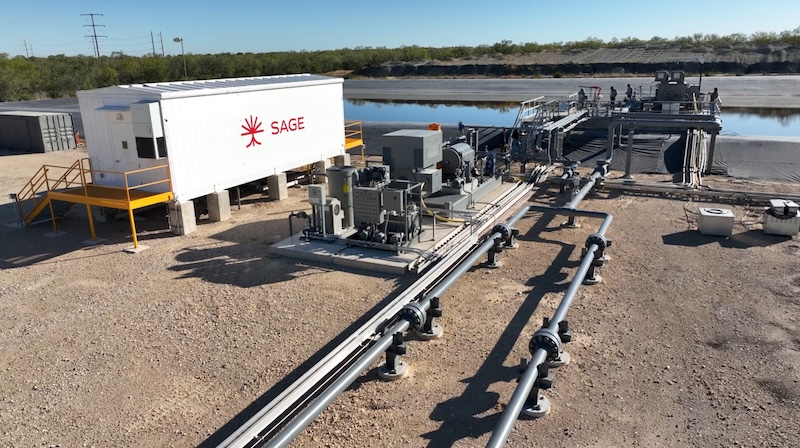
(Sage Geosystems)

(Sage Geosystems)

This story was originally published by Canary Media.

Sage Geosystems has hit a big milestone out on a rugged tract near San Antonio: The startup is producing power from its first next-generation geothermal plant. The system is just the third of its kind to come online in the U.S. as the sector races to commercialize the source of on-demand clean electricity.

The novel geothermal facility in Texas has been running since April, Sage exclusively shared with Canary Media. The Houston-based firm said the 3-megawatt pilot plant has performed reliably and as predicted after more than 120 days of grid-connected operations.

Cindy Taff, Sage’s CEO, said the results will ​“directly inform and de-risk” an upcoming collaboration in Nevada with Ormat Technologies, a conventional geothermal leader that is increasingly dipping its toes into next-generation technology. The Nevada project is a necessary precursor to Sage’s deal with Meta to develop 150 MW of geothermal power.

Sage’s enhanced geothermal system is a type of nascent tech that involves drilling deep into hot rocks and fracturing them to create water pockets, then using the heat to generate power. It’s distinct from the decades-old traditional geothermal plants that rely on what Taff called ​“very unicorn geology” — the few places in the world where a combination of water, heat, and permeable rocks are easily accessible.

Get the latest climate news and analysis, direct to your inbox.

Subscribe Today

View our latest digests

For all the buzz around the technology, just two other enhanced systems have connected to the U.S. grid so far.

In 2013, Reno-based Ormat completed a 1.7-MW demonstration project at its conventional Desert Peak facility in western Nevada, before returning its focus to old-school geothermal for a time. That demo is no longer producing power, Ormat confirmed.

A decade later, Fervo Energy began operating a 3.5-MW geothermal plant in northern Nevada in partnership with Google. Building off that project, Fervo is now constructing a 500-MW facility in Utah, which is set to come partially online in October.

Sage likewise expects its early success in Texas to fuel its commercial-scale ambitions.

The startup has been developing the pilot since 2024, when it reached a deal with San Miguel Electric Cooperative to use land near a coal-fired power plant in the town of Christine. Sage built its own substation there and intermittently sells power to the Texas grid.

Taff said that one of the most promising outcomes has been the relatively limited water loss from the underground system. Sage’s approach involves creating a network of fractures, into which it pumps and stores large volumes of water. As hot water pushes up against the rocks around it, mechanical pressure builds, which is released when the crew opens a valve at the top. This is different from other enhanced projects, which use fractures to flow water between two wells without pressure.

In both cases, water can migrate into surrounding rock formations as it moves through the fractures. The more water a project loses along the way, the less efficient it becomes at producing energy.

Sage lost less than 10% of the water that it cycled through the Texas system on multiple occasions, which Taff said bodes well not just for the company but also for the larger universe of enhanced geothermal, if it adopts similar methods.

“The net power output that you can produce from these technologies is going to go up, she said, noting that curbing water loss will enable enhanced systems to scale commercially at a competitive cost.

Initially, Sage planned to use similar geothermal techniques to develop a long-duration energy storage system near the coal plant. But in recent years, Texas has built one of the largest grid-battery fleets in the world, making the timing less ripe for rolling out a novel storage technology. So Sage is now primarily focused on meeting the nation’s growing demand for around-the-clock clean electricity.

To that end, Taff said Sage expects to begin drilling its first well at one of Ormat’s conventional geothermal plants in Nevada later this year. Sage will provide the hot water it produces to Ormat to generate electricity at the existing facility — allowing Sage to demonstrate its technology without going through the costly, lengthy steps of connecting to the grid or building a power plant.

Sage hasn’t yet specified how large this system will be, but does expect to start producing electricity in 2027 and reach full-scale production in 2028. Once that happens, Sage will begin working with Meta to start developing 150 MW of next-gen geothermal power somewhere east of the Rocky Mountains. All told, Sage has lined up about a gigawatt’s worth of projects on paper.

The Texas pilot enables Sage to ​“actually model and predict how the [reservoir] behavior is going to be going forward,” she said. ​“And that sets us up very nicely for scaling and building commercial facilities with our approach.”


in Geothermal, United States

Trending Stories

Facebook
Severe Storms & Flooding

540+ Dead, Hundreds Missing as Towering Flash Flood in Nepal Points to Extreme Heat, Heavy Rainfalls

August 28, 2026
992
Sarah Yurchevich
Data Centres & Tech

Alberta Woman Maps Out the Facts About Power-Hungry Data Centres

August 25, 2026
739
picryl
Canadian Sovereignty

Trump Trade War Could Be a Catalyst to Speed Canada’s Energy Transition, Experts Say

August 25, 2026
703

Leave a Reply Cancel reply

Your email address will not be published. Required fields are marked *

I agree to the Terms & Conditions and Privacy Policy.

Get the latest climate news and analysis, direct to your inbox.

Subscribe Today

Related Articles

DEEP Earth Energy Unveils Next-Gen Geothermal Plant Near Estevan

DEEP Earth Energy Unveils Next-Gen Geothermal Plant Near Estevan

February 19, 2025
Oil and Gas Industry Positioned to Drive Geothermal Boom, IEA Finds

Oil and Gas Industry Positioned to Drive Geothermal Boom, IEA Finds

December 13, 2024
Iceland’s No-Waste Geothermal Model Ready For Export

Iceland’s No-Waste Geothermal Model Ready For Export

March 21, 2024

The End of the World vs. the End of the Week: Carney’s Pushback on Trump’s Bullying Could Point to the Next Energy Transition Moment

by Mitchell Beer
August 23, 2026

…

Follow Us

Next-Gen Geothermal Project Goes Online in Texas

August 21, 2026
Reading time: 4 minutes
Full Story: Canary Media
Author: Maria Gallucci

(Sage Geosystems)

(Sage Geosystems)

This story was originally published by Canary Media.

Sage Geosystems has hit a big milestone out on a rugged tract near San Antonio: The startup is producing power from its first next-generation geothermal plant. The system is just the third of its kind to come online in the U.S. as the sector races to commercialize the source of on-demand clean electricity.

The novel geothermal facility in Texas has been running since April, Sage exclusively shared with Canary Media. The Houston-based firm said the 3-megawatt pilot plant has performed reliably and as predicted after more than 120 days of grid-connected operations.

Cindy Taff, Sage’s CEO, said the results will ​“directly inform and de-risk” an upcoming collaboration in Nevada with Ormat Technologies, a conventional geothermal leader that is increasingly dipping its toes into next-generation technology. The Nevada project is a necessary precursor to Sage’s deal with Meta to develop 150 MW of geothermal power.

Sage’s enhanced geothermal system is a type of nascent tech that involves drilling deep into hot rocks and fracturing them to create water pockets, then using the heat to generate power. It’s distinct from the decades-old traditional geothermal plants that rely on what Taff called ​“very unicorn geology” — the few places in the world where a combination of water, heat, and permeable rocks are easily accessible.

Get the latest climate news and analysis, direct to your inbox.

Subscribe Today

View our latest digests

For all the buzz around the technology, just two other enhanced systems have connected to the U.S. grid so far.

In 2013, Reno-based Ormat completed a 1.7-MW demonstration project at its conventional Desert Peak facility in western Nevada, before returning its focus to old-school geothermal for a time. That demo is no longer producing power, Ormat confirmed.

A decade later, Fervo Energy began operating a 3.5-MW geothermal plant in northern Nevada in partnership with Google. Building off that project, Fervo is now constructing a 500-MW facility in Utah, which is set to come partially online in October.

Sage likewise expects its early success in Texas to fuel its commercial-scale ambitions.

The startup has been developing the pilot since 2024, when it reached a deal with San Miguel Electric Cooperative to use land near a coal-fired power plant in the town of Christine. Sage built its own substation there and intermittently sells power to the Texas grid.

Taff said that one of the most promising outcomes has been the relatively limited water loss from the underground system. Sage’s approach involves creating a network of fractures, into which it pumps and stores large volumes of water. As hot water pushes up against the rocks around it, mechanical pressure builds, which is released when the crew opens a valve at the top. This is different from other enhanced projects, which use fractures to flow water between two wells without pressure.

In both cases, water can migrate into surrounding rock formations as it moves through the fractures. The more water a project loses along the way, the less efficient it becomes at producing energy.

Sage lost less than 10% of the water that it cycled through the Texas system on multiple occasions, which Taff said bodes well not just for the company but also for the larger universe of enhanced geothermal, if it adopts similar methods.

“The net power output that you can produce from these technologies is going to go up, she said, noting that curbing water loss will enable enhanced systems to scale commercially at a competitive cost.

Initially, Sage planned to use similar geothermal techniques to develop a long-duration energy storage system near the coal plant. But in recent years, Texas has built one of the largest grid-battery fleets in the world, making the timing less ripe for rolling out a novel storage technology. So Sage is now primarily focused on meeting the nation’s growing demand for around-the-clock clean electricity.

To that end, Taff said Sage expects to begin drilling its first well at one of Ormat’s conventional geothermal plants in Nevada later this year. Sage will provide the hot water it produces to Ormat to generate electricity at the existing facility — allowing Sage to demonstrate its technology without going through the costly, lengthy steps of connecting to the grid or building a power plant.

Sage hasn’t yet specified how large this system will be, but does expect to start producing electricity in 2027 and reach full-scale production in 2028. Once that happens, Sage will begin working with Meta to start developing 150 MW of next-gen geothermal power somewhere east of the Rocky Mountains. All told, Sage has lined up about a gigawatt’s worth of projects on paper.

The Texas pilot enables Sage to ​“actually model and predict how the [reservoir] behavior is going to be going forward,” she said. ​“And that sets us up very nicely for scaling and building commercial facilities with our approach.”


in Geothermal, United States

Leave a Reply Cancel reply

Your email address will not be published. Required fields are marked *

I agree to the Terms & Conditions and Privacy Policy.

Related Articles

DEEP Earth Energy Unveils Next-Gen Geothermal Plant Near Estevan

DEEP Earth Energy Unveils Next-Gen Geothermal Plant Near Estevan

February 19, 2025
Oil and Gas Industry Positioned to Drive Geothermal Boom, IEA Finds

Oil and Gas Industry Positioned to Drive Geothermal Boom, IEA Finds

December 13, 2024
Iceland’s No-Waste Geothermal Model Ready For Export

Iceland’s No-Waste Geothermal Model Ready For Export

March 21, 2024

Trending Stories

Facebook

540+ Dead, Hundreds Missing as Towering Flash Flood in Nepal Points to Extreme Heat, Heavy Rainfalls

August 28, 2026
992
Sarah Yurchevich

Alberta Woman Maps Out the Facts About Power-Hungry Data Centres

August 25, 2026
739
picryl

Trump Trade War Could Be a Catalyst to Speed Canada’s Energy Transition, Experts Say

August 25, 2026
703

The End of the World vs. the End of the Week: Carney’s Pushback on Trump’s Bullying Could Point to the Next Energy Transition Moment

by Mitchell Beer
August 23, 2026

…

Follow Us

Copyright 2026 © Energy Mix Productions Inc. All rights reserved.

  • About
  • Contact
  • Privacy Policy and Copyright
  • Cookie Policy
No Result
View All Result
  • Topics
    • Buildings & Infrastructure
    • Climate Equity & Justice
      • Energy Poverty
      • Indigenous Rights & Reconciliation
    • Climate Finance
      • Community Climate Finance
      • Finance & Investment
      • Insurance & Liability
      • Subsidies
    • Climate Impacts & Adaptation
      • Biodiversity & Habitat
      • Drought & Wildfires
      • Forests & Deforestation
      • Health & Safety
      • Heat & Temperature
      • Ice Loss & Sea Level Rise
      • Severe Storms & Flooding
    • Emissions
      • Carbon Levels & Measurement
      • CCS & Negative Emissions
      • Methane
    • Energy
      • Renewables
      • Fossil Fuels
      • Hydrogen
      • Nuclear
      • Batteries & Storage
      • Energy Efficiency
      • Power Grids
    • Food & Agriculture
    • Industry
      • Data Centres & Tech
      • Critical Minerals & Mining
      • Petrochemicals & Plastics
    • Policy & Politics
      • Carbon Pricing
      • COP Conferences
      • Elections
      • Energy Politics
      • International Security & War
      • Legal & Regulatory
    • Research & Innovation
      • International Agencies & Studies
      • Research & Development
    • Society & Culture
      • Climate Action
      • Mis/Disinformation & Greenwashing
      • Jobs & Training
      • Leisure & Recreation
      • Media, Messaging, & Public Opinion
    • Transportation & Mobility
      • Electric Vehicles
      • Shipping & Aviation
      • Transit
      • Walking, Biking & Micromobility
  • Regions
    • Africa
    • Arctic & Antarctica
    • Asia
    • Australia
    • Canada
    • International
    • Mexico & the Caribbean
    • Middle East
    • Oceans
    • Small Island States
    • South & Central America
    • Subnational
    • United States
    • UK & Europe
  • Special Coverage
    • The Weekender
    • IEA2026
    • Canada’s Major Projects Office
    • Hidden Wonder Valley
    • COP30
    • Cities & Communities
    • Heat & Power
    • Community Climate Finance
  • More Resources
    • Climate Glossary
    • What If We Changed the Conversation on Climate Change?
    • Eco-Anxiety
  • About
  • Contact

Copyright 2025 © Smarter Shift Inc. and Energy Mix Productions Inc. All rights reserved.

Manage Cookie Consent
To provide the best experiences, we use technologies like cookies to store and/or access device information. Consenting to these technologies will allow us to process data such as browsing behaviour or unique IDs on this site. Not consenting or withdrawing consent, may adversely affect certain features and functions.
Functional Always active
The technical storage or access is strictly necessary for the legitimate purpose of enabling the use of a specific service explicitly requested by the subscriber or user, or for the sole purpose of carrying out the transmission of a communication over an electronic communications network.
Preferences
The technical storage or access is necessary for the legitimate purpose of storing preferences that are not requested by the subscriber or user.
Statistics
The technical storage or access that is used exclusively for statistical purposes. The technical storage or access that is used exclusively for anonymous statistical purposes. Without a subpoena, voluntary compliance on the part of your Internet Service Provider, or additional records from a third party, information stored or retrieved for this purpose alone cannot usually be used to identify you.
Marketing
The technical storage or access is required to create user profiles to send advertising, or to track the user on a website or across several websites for similar marketing purposes.
  • Manage options
  • Manage services
  • Manage {vendor_count} vendors
  • Read more about these purposes
View preferences
  • {title}
  • {title}
  • {title}
No Result
View All Result
  • Topics
    • Buildings & Infrastructure
    • Climate Equity & Justice
      • Energy Poverty
      • Indigenous Rights & Reconciliation
    • Climate Finance
      • Community Climate Finance
      • Finance & Investment
      • Insurance & Liability
      • Subsidies
    • Climate Impacts & Adaptation
      • Biodiversity & Habitat
      • Drought & Wildfires
      • Forests & Deforestation
      • Health & Safety
      • Heat & Temperature
      • Ice Loss & Sea Level Rise
      • Severe Storms & Flooding
    • Emissions
      • Carbon Levels & Measurement
      • CCS & Negative Emissions
      • Methane
    • Energy
      • Renewables
      • Fossil Fuels
      • Hydrogen
      • Nuclear
      • Batteries & Storage
      • Energy Efficiency
      • Power Grids
    • Food & Agriculture
    • Industry
      • Data Centres & Tech
      • Critical Minerals & Mining
      • Petrochemicals & Plastics
    • Policy & Politics
      • Carbon Pricing
      • COP Conferences
      • Elections
      • Energy Politics
      • International Security & War
      • Legal & Regulatory
    • Research & Innovation
      • International Agencies & Studies
      • Research & Development
    • Society & Culture
      • Climate Action
      • Mis/Disinformation & Greenwashing
      • Jobs & Training
      • Leisure & Recreation
      • Media, Messaging, & Public Opinion
    • Transportation & Mobility
      • Electric Vehicles
      • Shipping & Aviation
      • Transit
      • Walking, Biking & Micromobility
  • Regions
    • Africa
    • Arctic & Antarctica
    • Asia
    • Australia
    • Canada
    • International
    • Mexico & the Caribbean
    • Middle East
    • Oceans
    • Small Island States
    • South & Central America
    • Subnational
    • United States
    • UK & Europe
  • Special Coverage
    • The Weekender
    • IEA2026
    • Canada’s Major Projects Office
    • Hidden Wonder Valley
    • COP30
    • Cities & Communities
    • Heat & Power
    • Community Climate Finance
  • More Resources
    • Climate Glossary
    • What If We Changed the Conversation on Climate Change?
    • Eco-Anxiety
  • About
  • Contact

Copyright 2025 © Smarter Shift Inc. and Energy Mix Productions Inc. All rights reserved.