The Energy Mix
Subscribe
Donate
  • Topics
    • Buildings & Infrastructure
    • Climate Equity & Justice
      • Energy Poverty
      • Indigenous Rights & Reconciliation
    • Climate Finance
      • Community Climate Finance
      • Finance & Investment
      • Insurance & Liability
      • Subsidies
    • Climate Impacts & Adaptation
      • Biodiversity & Habitat
      • Drought & Wildfires
      • Forests & Deforestation
      • Health & Safety
      • Heat & Temperature
      • Ice Loss & Sea Level Rise
      • Severe Storms & Flooding
    • Emissions
      • Carbon Levels & Measurement
      • CCS & Negative Emissions
      • Methane
    • Energy
      • Renewables
      • Fossil Fuels
      • Hydrogen
      • Nuclear
      • Batteries & Storage
      • Energy Efficiency
      • Power Grids
    • Food & Agriculture
    • Industry
      • Data Centres & Tech
      • Critical Minerals & Mining
      • Petrochemicals & Plastics
    • Policy & Politics
      • Carbon Pricing
      • COP Conferences
      • Elections
      • Energy Politics
      • International Security & War
      • Legal & Regulatory
    • Research & Innovation
      • International Agencies & Studies
      • Research & Development
    • Society & Culture
      • Climate Action
      • Mis/Disinformation & Greenwashing
      • Jobs & Training
      • Leisure & Recreation
      • Media, Messaging, & Public Opinion
    • Transportation & Mobility
      • Electric Vehicles
      • Shipping & Aviation
      • Transit
      • Walking, Biking & Micromobility
  • Regions
    • Africa
    • Arctic & Antarctica
    • Asia
    • Australia
    • Canada
    • International
    • Mexico & the Caribbean
    • Middle East
    • Oceans
    • Small Island States
    • South & Central America
    • Subnational
    • United States
    • UK & Europe
  • Special Coverage
    • The Weekender
    • IEA2026
    • Canada’s Major Projects Office
    • Hidden Wonder Valley
    • COP30
    • Cities & Communities
    • Heat & Power
    • Community Climate Finance
  • More Resources
    • Climate Glossary
    • What If We Changed the Conversation on Climate Change?
    • Eco-Anxiety
  • About
  • Contact
No Result
View All Result
The Energy Mix
  • Topics
    • Buildings & Infrastructure
    • Climate Equity & Justice
      • Energy Poverty
      • Indigenous Rights & Reconciliation
    • Climate Finance
      • Community Climate Finance
      • Finance & Investment
      • Insurance & Liability
      • Subsidies
    • Climate Impacts & Adaptation
      • Biodiversity & Habitat
      • Drought & Wildfires
      • Forests & Deforestation
      • Health & Safety
      • Heat & Temperature
      • Ice Loss & Sea Level Rise
      • Severe Storms & Flooding
    • Emissions
      • Carbon Levels & Measurement
      • CCS & Negative Emissions
      • Methane
    • Energy
      • Renewables
      • Fossil Fuels
      • Hydrogen
      • Nuclear
      • Batteries & Storage
      • Energy Efficiency
      • Power Grids
    • Food & Agriculture
    • Industry
      • Data Centres & Tech
      • Critical Minerals & Mining
      • Petrochemicals & Plastics
    • Policy & Politics
      • Carbon Pricing
      • COP Conferences
      • Elections
      • Energy Politics
      • International Security & War
      • Legal & Regulatory
    • Research & Innovation
      • International Agencies & Studies
      • Research & Development
    • Society & Culture
      • Climate Action
      • Mis/Disinformation & Greenwashing
      • Jobs & Training
      • Leisure & Recreation
      • Media, Messaging, & Public Opinion
    • Transportation & Mobility
      • Electric Vehicles
      • Shipping & Aviation
      • Transit
      • Walking, Biking & Micromobility
  • Regions
    • Africa
    • Arctic & Antarctica
    • Asia
    • Australia
    • Canada
    • International
    • Mexico & the Caribbean
    • Middle East
    • Oceans
    • Small Island States
    • South & Central America
    • Subnational
    • United States
    • UK & Europe
  • Special Coverage
    • The Weekender
    • IEA2026
    • Canada’s Major Projects Office
    • Hidden Wonder Valley
    • COP30
    • Cities & Communities
    • Heat & Power
    • Community Climate Finance
  • More Resources
    • Climate Glossary
    • What If We Changed the Conversation on Climate Change?
    • Eco-Anxiety
  • About
  • Contact
Subscribe
Donate
The Energy Mix
Subscribe

Canadians in Every Riding Support Climate Action, New Research Shows

September 8, 2019
Reading time: 7 minutes
Full Story: The Conversation @ConversationEDU
Author: Matto Mildenberger @mmildenberger and Erick Lachapelle @erickUdeM

kelly8843496 / Pixabay

kelly8843496 / Pixabay

Canada is gearing up for a big election this fall and climate policy will likely be at the centre of debate. Prime Minister Justin Trudeau’s Liberals are trumpeting their carbon pricing policy, while Andrew Scheer’s Conservatives want to get rid of it. Meanwhile, Elizabeth May and her newly relevant Greens think Canada must do more to manage the climate crisis.

But where do Canadian voters stand on this issue? Our research team, based at the Université de Montréal and the University of California Santa Barbara, has new public opinion data to answer this question. Using recent statistical and political science advances, we can estimate Canadian opinion in every single riding across the country (except for the less densely populated territories, where data collection is sparse). And we’ve released on online tool so anyone can see how their local riding compares to others across the country.

Canadians are Concerned About Climate Change

Our results reinforce what is increasingly clear: climate change is on the minds of Canadians, and not just in urban or coastal communities. The majority of Canadians in every single riding believe the climate is changing. The highest beliefs are in Halifax, where 93% of the public believe climate change is happening.


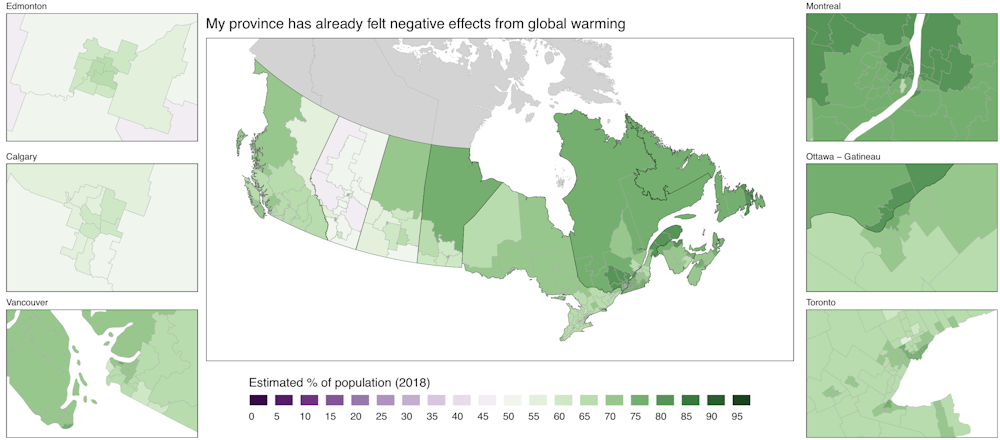
And the majority of Canadians in all but three ridings think their province has already experienced the impacts of climate change. These beliefs are particularly high in Québec, where 79% feel the impacts of climate change have already arrived. 

Canadians also want to see the government take the climate threat seriously.

Get the latest climate news and analysis, direct to your inbox.

Subscribe Today

View our latest digests

The majority of voters supports emissions trading. Carbon taxation is more divisive, yet more people support carbon taxation than don’t in 88% of Canadian ridings.

And the handful of ridings that don’t support the Trudeau government’s carbon pricing policy—Fort McMurray-Cold Lake, for example—are already in Conservative hands.

In other words, the path to a majority government—or even a minority government—goes through many ridings where Canadians are worried about climate change and want the government to take aggressive action.

Compared to the United States, the Canadian public believes climate change is happening in far higher shares. Even Canadian ridings where belief in climate change is the lowest have comparable beliefs to liberal states like Vermont and Washington. Overall Canadian support for a carbon tax is higher than support for a carbon tax in California, often thought of as the most environmentally progressive U.S. state.


Importantly, support for specific climate policies remains high in provinces that have already implemented climate laws. For instance, support for a carbon tax in British Columbia, where this policy was introduced in 2008, is the second-highest in the country at 61% (Prince Edward Island has the highest support). Similarly, support for emissions trading is second-highest in Québec, again just behind PEI, where a carbon market was implemented in 2013.

Even Conservative Ridings Want Action

We don’t find evidence of a backlash to carbon taxes or emissions trading—Canadians living in provinces with substantive climate policies continue to support them. Instead, we find substantial support for climate action in the ridings of Canadian politicians who have done the most to undermine Canada’s climate policy.

Ontario Premier Doug Ford’s provincial riding matches up with the federal riding of Etobicoke North, where 62% of the public supports emissions trading. In other words, Ford ignored the majority will of his own constituents when he acted to repeal Ontario’s policy last year.
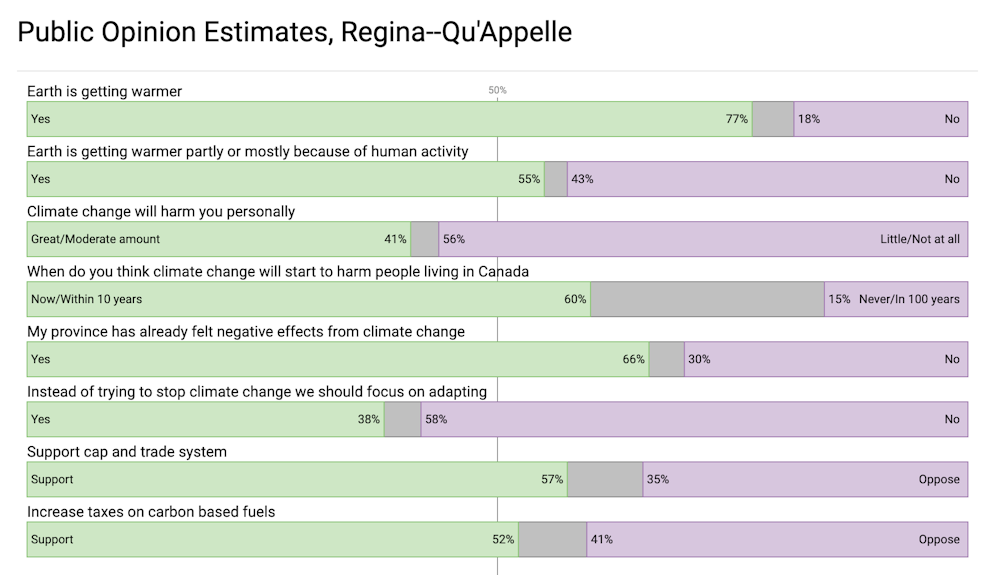


The same is true federally. In Scheer’s home riding of Regina-Qu’Appelle, support for carbon taxation is at 52%. Only 41% of Scheer’s own constituents oppose a carbon tax. He too is offside with the people he represents.

The Political Risks of Opposing Climate Reforms

Our results emphasize how the media can sometimes misinterpret electoral mandates. In Ontario, Doug Ford promised to repeal the province’s emissions trading scheme—and won. But the former Conservative leader, Patrick Brown, supported carbon pricing while enjoying a comfortable lead in the polls.

There are lots of reasons why Canadians might choose to change their government, but opposition to carbon pricing hasn’t been one of them.

Climate science is clear on the need to rapidly decrease greenhouse gas emissions to avert the most disastrous consequences of climate change. As a northern country, climate impacts in Canada are already larger than in other places. 

Our research, which the public can explore, shows that Canadians everywhere—from the most Conservative to the most Liberal ridings—are united in understanding that climate change poses a major threat to the people and places they cherish. The coming election will provide an opportunity for Canadians to have a say in the future of climate policy in their country—and all Canadian politicians should take note.

The Conversation

Matto Mildenberger is Assistant Professor of Political Science, University of California, Santa Barbara. Erick Lachapelle is Associate professor, Département de science politique, Université de Montréal. This article is republished from The Conversation</a> under a Creative Commons licence.





in Canada, Energy Politics, Media, Messaging, & Public Opinion

Trending Stories

(Mark Carney/Facebook)
Energy Efficiency

Carney Promises Heat Pump Rebate Program Coming in Early 2027

October 9, 2026
1.3k
Orin Zebest/flickr
Subsidies

$5.3B Subsidy Won’t Counter ‘Oil-Fuelled Inflation’, Critics Say, as Ottawa Extends Gas Tax Suspension

September 8, 2026
2.3k
Canadian Nuclear Laboratories/flickr
Nuclear

RIP SMRs: Is It the End of the Line for Small Modular Nuclear Reactors?

September 23, 2026
8.8k

Leave a Reply Cancel reply

Your email address will not be published. Required fields are marked *

I agree to the Terms & Conditions and Privacy Policy.

Get the latest climate news and analysis, direct to your inbox.

Subscribe Today

A Modest Proposal for a New Project of National Interest

by Aaron Cosbey
October 4, 2026

…

Follow Us

Canadians in Every Riding Support Climate Action, New Research Shows

September 8, 2019
Reading time: 7 minutes
Full Story: The Conversation @ConversationEDU
Author: Matto Mildenberger @mmildenberger and Erick Lachapelle @erickUdeM

kelly8843496 / Pixabay

kelly8843496 / Pixabay

Canada is gearing up for a big election this fall and climate policy will likely be at the centre of debate. Prime Minister Justin Trudeau’s Liberals are trumpeting their carbon pricing policy, while Andrew Scheer’s Conservatives want to get rid of it. Meanwhile, Elizabeth May and her newly relevant Greens think Canada must do more to manage the climate crisis.

But where do Canadian voters stand on this issue? Our research team, based at the Université de Montréal and the University of California Santa Barbara, has new public opinion data to answer this question. Using recent statistical and political science advances, we can estimate Canadian opinion in every single riding across the country (except for the less densely populated territories, where data collection is sparse). And we’ve released on online tool so anyone can see how their local riding compares to others across the country.

Canadians are Concerned About Climate Change

Our results reinforce what is increasingly clear: climate change is on the minds of Canadians, and not just in urban or coastal communities. The majority of Canadians in every single riding believe the climate is changing. The highest beliefs are in Halifax, where 93% of the public believe climate change is happening.


And the majority of Canadians in all but three ridings think their province has already experienced the impacts of climate change. These beliefs are particularly high in Québec, where 79% feel the impacts of climate change have already arrived. 

Canadians also want to see the government take the climate threat seriously.

Get the latest climate news and analysis, direct to your inbox.

Subscribe Today

View our latest digests

The majority of voters supports emissions trading. Carbon taxation is more divisive, yet more people support carbon taxation than don’t in 88% of Canadian ridings.

And the handful of ridings that don’t support the Trudeau government’s carbon pricing policy—Fort McMurray-Cold Lake, for example—are already in Conservative hands.

In other words, the path to a majority government—or even a minority government—goes through many ridings where Canadians are worried about climate change and want the government to take aggressive action.

Compared to the United States, the Canadian public believes climate change is happening in far higher shares. Even Canadian ridings where belief in climate change is the lowest have comparable beliefs to liberal states like Vermont and Washington. Overall Canadian support for a carbon tax is higher than support for a carbon tax in California, often thought of as the most environmentally progressive U.S. state.


Importantly, support for specific climate policies remains high in provinces that have already implemented climate laws. For instance, support for a carbon tax in British Columbia, where this policy was introduced in 2008, is the second-highest in the country at 61% (Prince Edward Island has the highest support). Similarly, support for emissions trading is second-highest in Québec, again just behind PEI, where a carbon market was implemented in 2013.

Even Conservative Ridings Want Action

We don’t find evidence of a backlash to carbon taxes or emissions trading—Canadians living in provinces with substantive climate policies continue to support them. Instead, we find substantial support for climate action in the ridings of Canadian politicians who have done the most to undermine Canada’s climate policy.

Ontario Premier Doug Ford’s provincial riding matches up with the federal riding of Etobicoke North, where 62% of the public supports emissions trading. In other words, Ford ignored the majority will of his own constituents when he acted to repeal Ontario’s policy last year.


The same is true federally. In Scheer’s home riding of Regina-Qu’Appelle, support for carbon taxation is at 52%. Only 41% of Scheer’s own constituents oppose a carbon tax. He too is offside with the people he represents.

The Political Risks of Opposing Climate Reforms

Our results emphasize how the media can sometimes misinterpret electoral mandates. In Ontario, Doug Ford promised to repeal the province’s emissions trading scheme—and won. But the former Conservative leader, Patrick Brown, supported carbon pricing while enjoying a comfortable lead in the polls.

There are lots of reasons why Canadians might choose to change their government, but opposition to carbon pricing hasn’t been one of them.

Climate science is clear on the need to rapidly decrease greenhouse gas emissions to avert the most disastrous consequences of climate change. As a northern country, climate impacts in Canada are already larger than in other places. 

Our research, which the public can explore, shows that Canadians everywhere—from the most Conservative to the most Liberal ridings—are united in understanding that climate change poses a major threat to the people and places they cherish. The coming election will provide an opportunity for Canadians to have a say in the future of climate policy in their country—and all Canadian politicians should take note.

The Conversation

Matto Mildenberger is Assistant Professor of Political Science, University of California, Santa Barbara. Erick Lachapelle is Associate professor, Département de science politique, Université de Montréal. This article is republished from The Conversation</a> under a Creative Commons licence.


in Canada, Energy Politics, Media, Messaging, & Public Opinion

Leave a Reply Cancel reply

Your email address will not be published. Required fields are marked *

I agree to the Terms & Conditions and Privacy Policy.

Trending Stories

(Mark Carney/Facebook)

Carney Promises Heat Pump Rebate Program Coming in Early 2027

October 9, 2026
1.3k
Orin Zebest/flickr

$5.3B Subsidy Won’t Counter ‘Oil-Fuelled Inflation’, Critics Say, as Ottawa Extends Gas Tax Suspension

September 8, 2026
2.3k
Canadian Nuclear Laboratories/flickr

RIP SMRs: Is It the End of the Line for Small Modular Nuclear Reactors?

September 23, 2026
8.8k

A Modest Proposal for a New Project of National Interest

by Aaron Cosbey
October 4, 2026

…

Follow Us

Copyright 2026 © Energy Mix Productions Inc. All rights reserved.

  • About
  • Contact
  • Privacy Policy and Copyright
  • Cookie Policy
No Result
View All Result
  • Topics
    • Buildings & Infrastructure
    • Climate Equity & Justice
      • Energy Poverty
      • Indigenous Rights & Reconciliation
    • Climate Finance
      • Community Climate Finance
      • Finance & Investment
      • Insurance & Liability
      • Subsidies
    • Climate Impacts & Adaptation
      • Biodiversity & Habitat
      • Drought & Wildfires
      • Forests & Deforestation
      • Health & Safety
      • Heat & Temperature
      • Ice Loss & Sea Level Rise
      • Severe Storms & Flooding
    • Emissions
      • Carbon Levels & Measurement
      • CCS & Negative Emissions
      • Methane
    • Energy
      • Renewables
      • Fossil Fuels
      • Hydrogen
      • Nuclear
      • Batteries & Storage
      • Energy Efficiency
      • Power Grids
    • Food & Agriculture
    • Industry
      • Data Centres & Tech
      • Critical Minerals & Mining
      • Petrochemicals & Plastics
    • Policy & Politics
      • Carbon Pricing
      • COP Conferences
      • Elections
      • Energy Politics
      • International Security & War
      • Legal & Regulatory
    • Research & Innovation
      • International Agencies & Studies
      • Research & Development
    • Society & Culture
      • Climate Action
      • Mis/Disinformation & Greenwashing
      • Jobs & Training
      • Leisure & Recreation
      • Media, Messaging, & Public Opinion
    • Transportation & Mobility
      • Electric Vehicles
      • Shipping & Aviation
      • Transit
      • Walking, Biking & Micromobility
  • Regions
    • Africa
    • Arctic & Antarctica
    • Asia
    • Australia
    • Canada
    • International
    • Mexico & the Caribbean
    • Middle East
    • Oceans
    • Small Island States
    • South & Central America
    • Subnational
    • United States
    • UK & Europe
  • Special Coverage
    • The Weekender
    • IEA2026
    • Canada’s Major Projects Office
    • Hidden Wonder Valley
    • COP30
    • Cities & Communities
    • Heat & Power
    • Community Climate Finance
  • More Resources
    • Climate Glossary
    • What If We Changed the Conversation on Climate Change?
    • Eco-Anxiety
  • About
  • Contact

Copyright 2025 © Smarter Shift Inc. and Energy Mix Productions Inc. All rights reserved.

Manage Cookie Consent
To provide the best experiences, we use technologies like cookies to store and/or access device information. Consenting to these technologies will allow us to process data such as browsing behaviour or unique IDs on this site. Not consenting or withdrawing consent, may adversely affect certain features and functions.
Functional Always active
The technical storage or access is strictly necessary for the legitimate purpose of enabling the use of a specific service explicitly requested by the subscriber or user, or for the sole purpose of carrying out the transmission of a communication over an electronic communications network.
Preferences
The technical storage or access is necessary for the legitimate purpose of storing preferences that are not requested by the subscriber or user.
Statistics
The technical storage or access that is used exclusively for statistical purposes. The technical storage or access that is used exclusively for anonymous statistical purposes. Without a subpoena, voluntary compliance on the part of your Internet Service Provider, or additional records from a third party, information stored or retrieved for this purpose alone cannot usually be used to identify you.
Marketing
The technical storage or access is required to create user profiles to send advertising, or to track the user on a website or across several websites for similar marketing purposes.
  • Manage options
  • Manage services
  • Manage {vendor_count} vendors
  • Read more about these purposes
View preferences
  • {title}
  • {title}
  • {title}
No Result
View All Result
  • Topics
    • Buildings & Infrastructure
    • Climate Equity & Justice
      • Energy Poverty
      • Indigenous Rights & Reconciliation
    • Climate Finance
      • Community Climate Finance
      • Finance & Investment
      • Insurance & Liability
      • Subsidies
    • Climate Impacts & Adaptation
      • Biodiversity & Habitat
      • Drought & Wildfires
      • Forests & Deforestation
      • Health & Safety
      • Heat & Temperature
      • Ice Loss & Sea Level Rise
      • Severe Storms & Flooding
    • Emissions
      • Carbon Levels & Measurement
      • CCS & Negative Emissions
      • Methane
    • Energy
      • Renewables
      • Fossil Fuels
      • Hydrogen
      • Nuclear
      • Batteries & Storage
      • Energy Efficiency
      • Power Grids
    • Food & Agriculture
    • Industry
      • Data Centres & Tech
      • Critical Minerals & Mining
      • Petrochemicals & Plastics
    • Policy & Politics
      • Carbon Pricing
      • COP Conferences
      • Elections
      • Energy Politics
      • International Security & War
      • Legal & Regulatory
    • Research & Innovation
      • International Agencies & Studies
      • Research & Development
    • Society & Culture
      • Climate Action
      • Mis/Disinformation & Greenwashing
      • Jobs & Training
      • Leisure & Recreation
      • Media, Messaging, & Public Opinion
    • Transportation & Mobility
      • Electric Vehicles
      • Shipping & Aviation
      • Transit
      • Walking, Biking & Micromobility
  • Regions
    • Africa
    • Arctic & Antarctica
    • Asia
    • Australia
    • Canada
    • International
    • Mexico & the Caribbean
    • Middle East
    • Oceans
    • Small Island States
    • South & Central America
    • Subnational
    • United States
    • UK & Europe
  • Special Coverage
    • The Weekender
    • IEA2026
    • Canada’s Major Projects Office
    • Hidden Wonder Valley
    • COP30
    • Cities & Communities
    • Heat & Power
    • Community Climate Finance
  • More Resources
    • Climate Glossary
    • What If We Changed the Conversation on Climate Change?
    • Eco-Anxiety
  • About
  • Contact

Copyright 2025 © Smarter Shift Inc. and Energy Mix Productions Inc. All rights reserved.