The Energy Mix
Subscribe
Donate
  • Topics
    • Buildings & Infrastructure
    • Climate Equity & Justice
      • Energy Poverty
      • Indigenous Rights & Reconciliation
    • Climate Finance
      • Community Climate Finance
      • Finance & Investment
      • Insurance & Liability
      • Subsidies
    • Climate Impacts & Adaptation
      • Biodiversity & Habitat
      • Drought & Wildfires
      • Forests & Deforestation
      • Health & Safety
      • Heat & Temperature
      • Ice Loss & Sea Level Rise
      • Severe Storms & Flooding
    • Emissions
      • Carbon Levels & Measurement
      • CCS & Negative Emissions
      • Methane
    • Energy
      • Renewables
      • Fossil Fuels
      • Hydrogen
      • Nuclear
      • Batteries & Storage
      • Energy Efficiency
      • Power Grids
    • Food & Agriculture
    • Industry
      • Data Centres & Tech
      • Critical Minerals & Mining
      • Petrochemicals & Plastics
    • Policy & Politics
      • Carbon Pricing
      • COP Conferences
      • Elections
      • Energy Politics
      • International Security & War
      • Legal & Regulatory
    • Research & Innovation
      • International Agencies & Studies
      • Research & Development
    • Society & Culture
      • Climate Action
      • Mis/Disinformation & Greenwashing
      • Jobs & Training
      • Leisure & Recreation
      • Media, Messaging, & Public Opinion
    • Transportation & Mobility
      • Electric Vehicles
      • Shipping & Aviation
      • Transit
      • Walking, Biking & Micromobility
  • Regions
    • Africa
    • Arctic & Antarctica
    • Asia
    • Australia
    • Canada
    • International
    • Mexico & the Caribbean
    • Middle East
    • Oceans
    • Small Island States
    • South & Central America
    • Subnational
    • United States
    • UK & Europe
  • Special Coverage
    • The Weekender
    • IEA2026
    • Canada’s Major Projects Office
    • Hidden Wonder Valley
    • COP30
    • Cities & Communities
    • Heat & Power
    • Community Climate Finance
  • More Resources
    • Climate Glossary
    • What If We Changed the Conversation on Climate Change?
    • Eco-Anxiety
  • About
  • Contact
No Result
View All Result
The Energy Mix
  • Topics
    • Buildings & Infrastructure
    • Climate Equity & Justice
      • Energy Poverty
      • Indigenous Rights & Reconciliation
    • Climate Finance
      • Community Climate Finance
      • Finance & Investment
      • Insurance & Liability
      • Subsidies
    • Climate Impacts & Adaptation
      • Biodiversity & Habitat
      • Drought & Wildfires
      • Forests & Deforestation
      • Health & Safety
      • Heat & Temperature
      • Ice Loss & Sea Level Rise
      • Severe Storms & Flooding
    • Emissions
      • Carbon Levels & Measurement
      • CCS & Negative Emissions
      • Methane
    • Energy
      • Renewables
      • Fossil Fuels
      • Hydrogen
      • Nuclear
      • Batteries & Storage
      • Energy Efficiency
      • Power Grids
    • Food & Agriculture
    • Industry
      • Data Centres & Tech
      • Critical Minerals & Mining
      • Petrochemicals & Plastics
    • Policy & Politics
      • Carbon Pricing
      • COP Conferences
      • Elections
      • Energy Politics
      • International Security & War
      • Legal & Regulatory
    • Research & Innovation
      • International Agencies & Studies
      • Research & Development
    • Society & Culture
      • Climate Action
      • Mis/Disinformation & Greenwashing
      • Jobs & Training
      • Leisure & Recreation
      • Media, Messaging, & Public Opinion
    • Transportation & Mobility
      • Electric Vehicles
      • Shipping & Aviation
      • Transit
      • Walking, Biking & Micromobility
  • Regions
    • Africa
    • Arctic & Antarctica
    • Asia
    • Australia
    • Canada
    • International
    • Mexico & the Caribbean
    • Middle East
    • Oceans
    • Small Island States
    • South & Central America
    • Subnational
    • United States
    • UK & Europe
  • Special Coverage
    • The Weekender
    • IEA2026
    • Canada’s Major Projects Office
    • Hidden Wonder Valley
    • COP30
    • Cities & Communities
    • Heat & Power
    • Community Climate Finance
  • More Resources
    • Climate Glossary
    • What If We Changed the Conversation on Climate Change?
    • Eco-Anxiety
  • About
  • Contact
Subscribe
Donate
The Energy Mix
Subscribe

As Permafrost Thaws, Some Headwaters in Canada’s North Turn Orange and Toxic: Study

May 25, 2026
Reading time: 6 minutes
Full Story: The Canadian Press
Author: Jordan Omstead

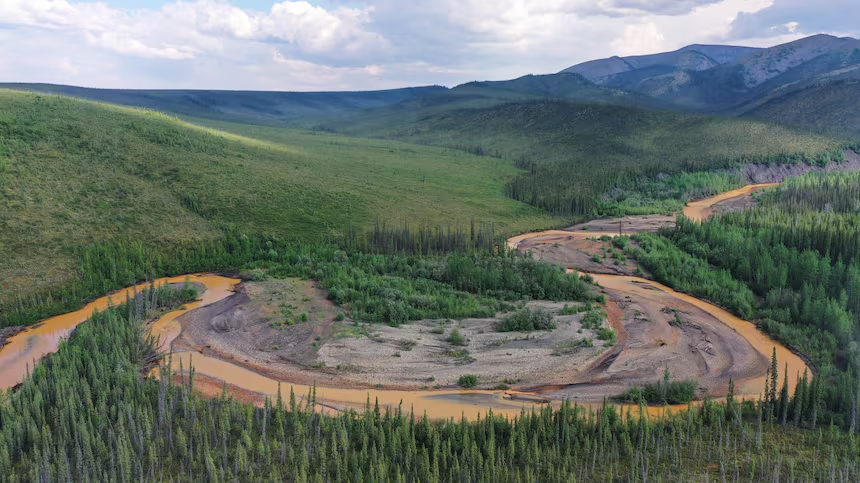
Acidic seepages linked to permafrost thaw are releasing toxic metals and turning Yukon streams a rusty orange. (Handout photo-Andras Szeitz)

Acidic seepages linked to permafrost thaw are releasing toxic metals and turning Yukon streams a rusty orange. (Handout photo-Andras Szeitz)

Ancient bedrock exposed by disappearing permafrost is releasing toxic metals into Canada’s northern rivers, a new study says, with once-pristine subarctic streams now comparable in some cases to highly acidic, contaminated mining sites.

The findings out of Yukon point to an “unfolding environmental disaster,” one co-author said, and adds to alarm over the rapid climate-fuelled changes in the North. 

“We don’t know the end point, but there’s nothing about this that gives me any feeling of like, ‘oh, we’re going to be OK’,” said co-author Sean Carey, a professor at McMaster University. 

“I’m not even a gloomy person. This looks pretty gloomy.”

Scientists over the past decade have documented a rise in what’s sometimes called rusting rivers. From Alaska to the Pyrenees, once-clear waters are turning a turbid bright orange in a process linked to thawing permafrost. 

In some of those Alaskan headwaters, scientists documented the complete loss of two fish species and a sharp drop in biodiversity. 

The paper published May 21 in a leading scientific journal gives the clearest view yet of the phenomenon in Canada’s subarctic and underlines the need to keep a closer eye on its potential impacts. The researchers looked at an area north of Dawson City straddling the Yukon and Mackenzie river basins, the largest North American subarctic rivers and major contributors to the Arctic Ocean.

The headwaters have been used by Indigenous communities and backcountry hikers for drinking water and can be critical spawning ground for fish, such as dolly varden and Arctic grayling.

“We were really shocked when we started seeing the data coming in year over year, particularly in the last two or three years, where we captured an abrupt transition,” said lead author Elliott Skierszkan, an assistant professor at Carleton University.

The study in Science used satellite imagery to pinpoint 146 visibly impacted streams. On-the-ground water quality monitoring shows some of these streams have taken an abrupt turn from pristine water to very acidic, very toxic levels of metals, especially since 2024. 

Get the latest climate news and analysis, direct to your inbox.

Subscribe Today

View our latest digests

“When we look at it on a broader landscape, this is happening not just in the few streams that we’ve been instrumenting, but in hundreds, possibly thousands of streams, particularly in the North American northwest,” he said. 

The worst case documented by the researchers was a stream feeding the Ogilvie River. Its water quality, once pristine at the beginning of the millennium, had changed dramatically by July 2025.

The water was so acidic it would be uninhabitable for most aquatic life, with sulphur concentrations on par with a mining tailings pond. Metals, such as aluminum and cadmium, were detected at levels hundreds, if not thousands of times higher than what’s considered safe for humans and wildlife. 

A plume was visible up to three kilometres downstream from where the stream met the Ogilvie River.

“We need to increase our monitoring, certainly, because there’s a mobilization of metals at toxic levels that’s happening and we need to make sure that people are aware so that they’re not at risk of consumption,” said Skierszkan.

Permafrost blanketing Canada’s North is disappearing faster than it ever has since the last ice age due to human-caused climate change driven by the burning of fossil fuels, the study says. The region, and the North broadly, is warming faster than the global average, with temperatures rising by around 2.6C since the 1960s.

Homes are being relocated and roads and airport runways are slumping as the ice-rich ground thaws and buckles in on itself or collapses into the Arctic Ocean. Methane released from decomposing soil is further heating the planet, a climate feedback loop that thaws more permafrost.

As that frozen ground thaws, ancient bedrock is also being exposed to water and oxygen. 
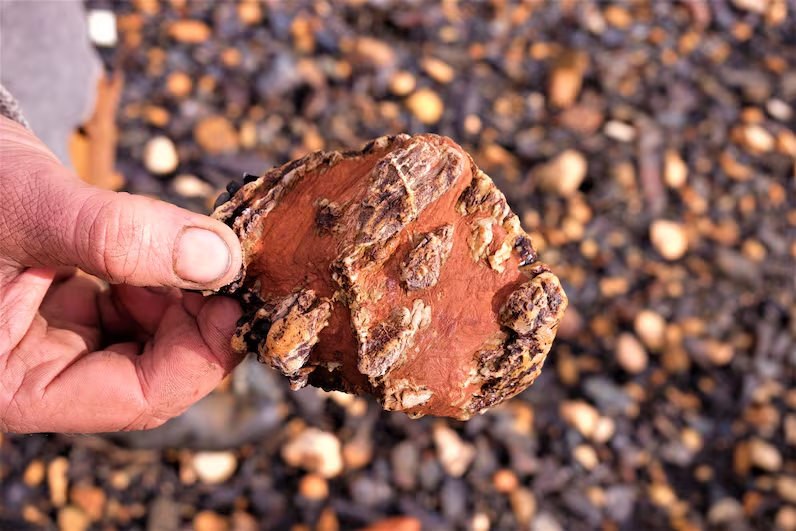
PhD candidate Andras Szeitz holds an iron-oxide rich rock. (Handout photo/Andras Szeitz)

Weathered sulphide-rich rock releases acidity and leach metals, carried by rainfall and melting snow into the streams below and degrading their water quality. It can create a visually striking barrier, with clear upstream waters suddenly turned turbid terracotta as the river meets up with a tainted stream. 

“These streams look like butter chicken,” said Carey. 

While the local impacts on a specific stream can be significant, the good news, for now, is that larger downstream rivers have not seen a concerning drop in water quality, Skierszkan said. While long-term sulphate levels are increasing, it’s not at toxic levels and metal concentrations are still stable, he said. 

As the smaller streams feed into larger rivers, the water’s pH goes back up and the dissolved metals form into microscopic particles, giving the rivers the rusty colour. 

How far downstream the water quality improves remains an open question, Skierszkan said. 

Signs of trouble are not only visible in those rusty waterways but in the pockmarked hill slopes where the acid seepage originates, the study says. Water samples taken from these areas of dead vegetation were more acidic and metal concentrated than the streams below. 

“These concentrations are comparable to those observed in effluents from some of the world’s most contaminated mine sites, surpassing acute toxicity thresholds for most terrestrial and aquatic organisms by several orders of magnitude,” the study says.

The comparison to a mining site is pointed in this region. In 2017, First Nations won a landmark legal case to protect the vast majority of the Peel watershed from mining and other industrial activities. 

The team behind the paper would later get funding to study the link between permafrost thaw and water quality.

Around that time, researchers in Alaska caused a stir when they reported some crystalline streams in the Kobuk Valley National Park had in the course of a year turned acidic and orange while two resident fish species, dolly varden and slimy sculpin, had disappeared.

Skierszkan, who had worked with Yukon First Nations before, reached out to the Trʼondëk Hwëchʼin government, who pointed him to headwater streams of high cultural significance along the Dempster highway corridor and Tombstone Park, he said.

For the research, Skierszkan partnered with Carey, who had been studying the area’s hydrology since the mid-1990s. Their co-authors on the paper are Matt Lindsay, a geochemist at the University of Saskatchewan, and McMaster PhD student Andras Szeitz. 

“We were really able to capture the water quality initially and then this really catastrophic decline—precipitous drop in pH, metals concentrations thousands of times above water quality guidelines—all happening within a two-to-three-year period,” Skierszkan said.

The team will now shift toward trying to document the impacts of this abrupt shift, they said. Their research was awarded funding from the Canada Water Agency earlier this year to support work in partnership with Trʼondëk Hwëchʼin.

Backcountry hikers will also be encouraged to report any sightings of the rusted streams as the researchers continue trying to assess the extent of the issue.

There’s “very likely” some impacts to fish who have to move through these tainted streams, Skierszkan said. Local people depend on the fisheries for sustenance and it’s a popular tourist area, he said. 

It adds another pressure on the region’s already stressed aquatic life. In 2024, Alaska and Canada put a seven-year moratorium on fishing Yukon River Chinook salmon, whose population has collapsed to less than 10 per cent of its historical average since the 1980s. 

The First Nation and the territorial government did not immediately return a request for comment from The Canadian Press about the research. 

This report by The Canadian Press was first published May 21, 2026. 


in Biodiversity & Habitat, Climate Impacts & Adaptation, Indigenous Rights & Reconciliation, Yukon

Trending Stories

Facebook
Severe Storms & Flooding

540+ Dead, Hundreds Missing as Towering Flash Flood in Nepal Points to Extreme Heat, Heavy Rainfalls

August 28, 2026
987
Sarah Yurchevich
Data Centres & Tech

Alberta Woman Maps Out the Facts About Power-Hungry Data Centres

August 25, 2026
729
picryl
Canadian Sovereignty

Trump Trade War Could Be a Catalyst to Speed Canada’s Energy Transition, Experts Say

August 25, 2026
697

Leave a Reply Cancel reply

Your email address will not be published. Required fields are marked *

I agree to the Terms & Conditions and Privacy Policy.

Get the latest climate news and analysis, direct to your inbox.

Subscribe Today

Related Articles

Solar Farms Can Be Havens for Rare Plants. Just Ask the Threecorner Milkvetch.

Solar Farms Can Be Havens for Rare Plants. Just Ask the Threecorner Milkvetch.

February 9, 2026
Axing N.L. Ocean Conservation Site a ‘Blow’ to National Goals, Say Environment Groups

Axing N.L. Ocean Conservation Site a ‘Blow’ to National Goals, Say Environment Groups

February 6, 2026
Canada’s Vast Peatlands Need Stronger Safeguards, New Strategy Concludes

Canada’s Vast Peatlands Need Stronger Safeguards, New Strategy Concludes

December 8, 2025

The End of the World vs. the End of the Week: Carney’s Pushback on Trump’s Bullying Could Point to the Next Energy Transition Moment

by Mitchell Beer
August 23, 2026

…

Follow Us

As Permafrost Thaws, Some Headwaters in Canada’s North Turn Orange and Toxic: Study

May 25, 2026
Reading time: 6 minutes
Full Story: The Canadian Press
Author: Jordan Omstead

Acidic seepages linked to permafrost thaw are releasing toxic metals and turning Yukon streams a rusty orange. (Handout photo-Andras Szeitz)

Acidic seepages linked to permafrost thaw are releasing toxic metals and turning Yukon streams a rusty orange. (Handout photo-Andras Szeitz)

Ancient bedrock exposed by disappearing permafrost is releasing toxic metals into Canada’s northern rivers, a new study says, with once-pristine subarctic streams now comparable in some cases to highly acidic, contaminated mining sites.

The findings out of Yukon point to an “unfolding environmental disaster,” one co-author said, and adds to alarm over the rapid climate-fuelled changes in the North. 

“We don’t know the end point, but there’s nothing about this that gives me any feeling of like, ‘oh, we’re going to be OK’,” said co-author Sean Carey, a professor at McMaster University. 

“I’m not even a gloomy person. This looks pretty gloomy.”

Scientists over the past decade have documented a rise in what’s sometimes called rusting rivers. From Alaska to the Pyrenees, once-clear waters are turning a turbid bright orange in a process linked to thawing permafrost. 

In some of those Alaskan headwaters, scientists documented the complete loss of two fish species and a sharp drop in biodiversity. 

The paper published May 21 in a leading scientific journal gives the clearest view yet of the phenomenon in Canada’s subarctic and underlines the need to keep a closer eye on its potential impacts. The researchers looked at an area north of Dawson City straddling the Yukon and Mackenzie river basins, the largest North American subarctic rivers and major contributors to the Arctic Ocean.

The headwaters have been used by Indigenous communities and backcountry hikers for drinking water and can be critical spawning ground for fish, such as dolly varden and Arctic grayling.

“We were really shocked when we started seeing the data coming in year over year, particularly in the last two or three years, where we captured an abrupt transition,” said lead author Elliott Skierszkan, an assistant professor at Carleton University.

The study in Science used satellite imagery to pinpoint 146 visibly impacted streams. On-the-ground water quality monitoring shows some of these streams have taken an abrupt turn from pristine water to very acidic, very toxic levels of metals, especially since 2024. 

Get the latest climate news and analysis, direct to your inbox.

Subscribe Today

View our latest digests

“When we look at it on a broader landscape, this is happening not just in the few streams that we’ve been instrumenting, but in hundreds, possibly thousands of streams, particularly in the North American northwest,” he said. 

The worst case documented by the researchers was a stream feeding the Ogilvie River. Its water quality, once pristine at the beginning of the millennium, had changed dramatically by July 2025.

The water was so acidic it would be uninhabitable for most aquatic life, with sulphur concentrations on par with a mining tailings pond. Metals, such as aluminum and cadmium, were detected at levels hundreds, if not thousands of times higher than what’s considered safe for humans and wildlife. 

A plume was visible up to three kilometres downstream from where the stream met the Ogilvie River.

“We need to increase our monitoring, certainly, because there’s a mobilization of metals at toxic levels that’s happening and we need to make sure that people are aware so that they’re not at risk of consumption,” said Skierszkan.

Permafrost blanketing Canada’s North is disappearing faster than it ever has since the last ice age due to human-caused climate change driven by the burning of fossil fuels, the study says. The region, and the North broadly, is warming faster than the global average, with temperatures rising by around 2.6C since the 1960s.

Homes are being relocated and roads and airport runways are slumping as the ice-rich ground thaws and buckles in on itself or collapses into the Arctic Ocean. Methane released from decomposing soil is further heating the planet, a climate feedback loop that thaws more permafrost.

As that frozen ground thaws, ancient bedrock is also being exposed to water and oxygen. 

PhD candidate Andras Szeitz holds an iron-oxide rich rock. (Handout photo/Andras Szeitz)

Weathered sulphide-rich rock releases acidity and leach metals, carried by rainfall and melting snow into the streams below and degrading their water quality. It can create a visually striking barrier, with clear upstream waters suddenly turned turbid terracotta as the river meets up with a tainted stream. 

“These streams look like butter chicken,” said Carey. 

While the local impacts on a specific stream can be significant, the good news, for now, is that larger downstream rivers have not seen a concerning drop in water quality, Skierszkan said. While long-term sulphate levels are increasing, it’s not at toxic levels and metal concentrations are still stable, he said. 

As the smaller streams feed into larger rivers, the water’s pH goes back up and the dissolved metals form into microscopic particles, giving the rivers the rusty colour. 

How far downstream the water quality improves remains an open question, Skierszkan said. 

Signs of trouble are not only visible in those rusty waterways but in the pockmarked hill slopes where the acid seepage originates, the study says. Water samples taken from these areas of dead vegetation were more acidic and metal concentrated than the streams below. 

“These concentrations are comparable to those observed in effluents from some of the world’s most contaminated mine sites, surpassing acute toxicity thresholds for most terrestrial and aquatic organisms by several orders of magnitude,” the study says.

The comparison to a mining site is pointed in this region. In 2017, First Nations won a landmark legal case to protect the vast majority of the Peel watershed from mining and other industrial activities. 

The team behind the paper would later get funding to study the link between permafrost thaw and water quality.

Around that time, researchers in Alaska caused a stir when they reported some crystalline streams in the Kobuk Valley National Park had in the course of a year turned acidic and orange while two resident fish species, dolly varden and slimy sculpin, had disappeared.

Skierszkan, who had worked with Yukon First Nations before, reached out to the Trʼondëk Hwëchʼin government, who pointed him to headwater streams of high cultural significance along the Dempster highway corridor and Tombstone Park, he said.

For the research, Skierszkan partnered with Carey, who had been studying the area’s hydrology since the mid-1990s. Their co-authors on the paper are Matt Lindsay, a geochemist at the University of Saskatchewan, and McMaster PhD student Andras Szeitz. 

“We were really able to capture the water quality initially and then this really catastrophic decline—precipitous drop in pH, metals concentrations thousands of times above water quality guidelines—all happening within a two-to-three-year period,” Skierszkan said.

The team will now shift toward trying to document the impacts of this abrupt shift, they said. Their research was awarded funding from the Canada Water Agency earlier this year to support work in partnership with Trʼondëk Hwëchʼin.

Backcountry hikers will also be encouraged to report any sightings of the rusted streams as the researchers continue trying to assess the extent of the issue.

There’s “very likely” some impacts to fish who have to move through these tainted streams, Skierszkan said. Local people depend on the fisheries for sustenance and it’s a popular tourist area, he said. 

It adds another pressure on the region’s already stressed aquatic life. In 2024, Alaska and Canada put a seven-year moratorium on fishing Yukon River Chinook salmon, whose population has collapsed to less than 10 per cent of its historical average since the 1980s. 

The First Nation and the territorial government did not immediately return a request for comment from The Canadian Press about the research. 

This report by The Canadian Press was first published May 21, 2026. 


in Biodiversity & Habitat, Climate Impacts & Adaptation, Indigenous Rights & Reconciliation, Yukon

Leave a Reply Cancel reply

Your email address will not be published. Required fields are marked *

I agree to the Terms & Conditions and Privacy Policy.

Related Articles

Solar Farms Can Be Havens for Rare Plants. Just Ask the Threecorner Milkvetch.

Solar Farms Can Be Havens for Rare Plants. Just Ask the Threecorner Milkvetch.

February 9, 2026
Axing N.L. Ocean Conservation Site a ‘Blow’ to National Goals, Say Environment Groups

Axing N.L. Ocean Conservation Site a ‘Blow’ to National Goals, Say Environment Groups

February 6, 2026
Canada’s Vast Peatlands Need Stronger Safeguards, New Strategy Concludes

Canada’s Vast Peatlands Need Stronger Safeguards, New Strategy Concludes

December 8, 2025

Trending Stories

Facebook

540+ Dead, Hundreds Missing as Towering Flash Flood in Nepal Points to Extreme Heat, Heavy Rainfalls

August 28, 2026
987
Sarah Yurchevich

Alberta Woman Maps Out the Facts About Power-Hungry Data Centres

August 25, 2026
729
picryl

Trump Trade War Could Be a Catalyst to Speed Canada’s Energy Transition, Experts Say

August 25, 2026
697

The End of the World vs. the End of the Week: Carney’s Pushback on Trump’s Bullying Could Point to the Next Energy Transition Moment

by Mitchell Beer
August 23, 2026

…

Follow Us

Copyright 2026 © Energy Mix Productions Inc. All rights reserved.

  • About
  • Contact
  • Privacy Policy and Copyright
  • Cookie Policy
No Result
View All Result
  • Topics
    • Buildings & Infrastructure
    • Climate Equity & Justice
      • Energy Poverty
      • Indigenous Rights & Reconciliation
    • Climate Finance
      • Community Climate Finance
      • Finance & Investment
      • Insurance & Liability
      • Subsidies
    • Climate Impacts & Adaptation
      • Biodiversity & Habitat
      • Drought & Wildfires
      • Forests & Deforestation
      • Health & Safety
      • Heat & Temperature
      • Ice Loss & Sea Level Rise
      • Severe Storms & Flooding
    • Emissions
      • Carbon Levels & Measurement
      • CCS & Negative Emissions
      • Methane
    • Energy
      • Renewables
      • Fossil Fuels
      • Hydrogen
      • Nuclear
      • Batteries & Storage
      • Energy Efficiency
      • Power Grids
    • Food & Agriculture
    • Industry
      • Data Centres & Tech
      • Critical Minerals & Mining
      • Petrochemicals & Plastics
    • Policy & Politics
      • Carbon Pricing
      • COP Conferences
      • Elections
      • Energy Politics
      • International Security & War
      • Legal & Regulatory
    • Research & Innovation
      • International Agencies & Studies
      • Research & Development
    • Society & Culture
      • Climate Action
      • Mis/Disinformation & Greenwashing
      • Jobs & Training
      • Leisure & Recreation
      • Media, Messaging, & Public Opinion
    • Transportation & Mobility
      • Electric Vehicles
      • Shipping & Aviation
      • Transit
      • Walking, Biking & Micromobility
  • Regions
    • Africa
    • Arctic & Antarctica
    • Asia
    • Australia
    • Canada
    • International
    • Mexico & the Caribbean
    • Middle East
    • Oceans
    • Small Island States
    • South & Central America
    • Subnational
    • United States
    • UK & Europe
  • Special Coverage
    • The Weekender
    • IEA2026
    • Canada’s Major Projects Office
    • Hidden Wonder Valley
    • COP30
    • Cities & Communities
    • Heat & Power
    • Community Climate Finance
  • More Resources
    • Climate Glossary
    • What If We Changed the Conversation on Climate Change?
    • Eco-Anxiety
  • About
  • Contact

Copyright 2025 © Smarter Shift Inc. and Energy Mix Productions Inc. All rights reserved.

Manage Cookie Consent
To provide the best experiences, we use technologies like cookies to store and/or access device information. Consenting to these technologies will allow us to process data such as browsing behaviour or unique IDs on this site. Not consenting or withdrawing consent, may adversely affect certain features and functions.
Functional Always active
The technical storage or access is strictly necessary for the legitimate purpose of enabling the use of a specific service explicitly requested by the subscriber or user, or for the sole purpose of carrying out the transmission of a communication over an electronic communications network.
Preferences
The technical storage or access is necessary for the legitimate purpose of storing preferences that are not requested by the subscriber or user.
Statistics
The technical storage or access that is used exclusively for statistical purposes. The technical storage or access that is used exclusively for anonymous statistical purposes. Without a subpoena, voluntary compliance on the part of your Internet Service Provider, or additional records from a third party, information stored or retrieved for this purpose alone cannot usually be used to identify you.
Marketing
The technical storage or access is required to create user profiles to send advertising, or to track the user on a website or across several websites for similar marketing purposes.
  • Manage options
  • Manage services
  • Manage {vendor_count} vendors
  • Read more about these purposes
View preferences
  • {title}
  • {title}
  • {title}
No Result
View All Result
  • Topics
    • Buildings & Infrastructure
    • Climate Equity & Justice
      • Energy Poverty
      • Indigenous Rights & Reconciliation
    • Climate Finance
      • Community Climate Finance
      • Finance & Investment
      • Insurance & Liability
      • Subsidies
    • Climate Impacts & Adaptation
      • Biodiversity & Habitat
      • Drought & Wildfires
      • Forests & Deforestation
      • Health & Safety
      • Heat & Temperature
      • Ice Loss & Sea Level Rise
      • Severe Storms & Flooding
    • Emissions
      • Carbon Levels & Measurement
      • CCS & Negative Emissions
      • Methane
    • Energy
      • Renewables
      • Fossil Fuels
      • Hydrogen
      • Nuclear
      • Batteries & Storage
      • Energy Efficiency
      • Power Grids
    • Food & Agriculture
    • Industry
      • Data Centres & Tech
      • Critical Minerals & Mining
      • Petrochemicals & Plastics
    • Policy & Politics
      • Carbon Pricing
      • COP Conferences
      • Elections
      • Energy Politics
      • International Security & War
      • Legal & Regulatory
    • Research & Innovation
      • International Agencies & Studies
      • Research & Development
    • Society & Culture
      • Climate Action
      • Mis/Disinformation & Greenwashing
      • Jobs & Training
      • Leisure & Recreation
      • Media, Messaging, & Public Opinion
    • Transportation & Mobility
      • Electric Vehicles
      • Shipping & Aviation
      • Transit
      • Walking, Biking & Micromobility
  • Regions
    • Africa
    • Arctic & Antarctica
    • Asia
    • Australia
    • Canada
    • International
    • Mexico & the Caribbean
    • Middle East
    • Oceans
    • Small Island States
    • South & Central America
    • Subnational
    • United States
    • UK & Europe
  • Special Coverage
    • The Weekender
    • IEA2026
    • Canada’s Major Projects Office
    • Hidden Wonder Valley
    • COP30
    • Cities & Communities
    • Heat & Power
    • Community Climate Finance
  • More Resources
    • Climate Glossary
    • What If We Changed the Conversation on Climate Change?
    • Eco-Anxiety
  • About
  • Contact

Copyright 2025 © Smarter Shift Inc. and Energy Mix Productions Inc. All rights reserved.