The Energy Mix
Subscribe
Donate
  • Topics
    • Buildings & Infrastructure
    • Climate Equity & Justice
      • Energy Poverty
      • Indigenous Rights & Reconciliation
    • Climate Finance
      • Community Climate Finance
      • Finance & Investment
      • Insurance & Liability
      • Subsidies
    • Climate Impacts & Adaptation
      • Biodiversity & Habitat
      • Drought & Wildfires
      • Forests & Deforestation
      • Health & Safety
      • Heat & Temperature
      • Ice Loss & Sea Level Rise
      • Severe Storms & Flooding
    • Emissions
      • Carbon Levels & Measurement
      • CCS & Negative Emissions
      • Methane
    • Energy
      • Renewables
      • Fossil Fuels
      • Hydrogen
      • Nuclear
      • Batteries & Storage
      • Energy Efficiency
      • Power Grids
    • Food & Agriculture
    • Industry
      • Data Centres & Tech
      • Critical Minerals & Mining
      • Petrochemicals & Plastics
    • Policy & Politics
      • Carbon Pricing
      • COP Conferences
      • Elections
      • Energy Politics
      • International Security & War
      • Legal & Regulatory
    • Research & Innovation
      • International Agencies & Studies
      • Research & Development
    • Society & Culture
      • Climate Action
      • Mis/Disinformation & Greenwashing
      • Jobs & Training
      • Leisure & Recreation
      • Media, Messaging, & Public Opinion
    • Transportation & Mobility
      • Electric Vehicles
      • Shipping & Aviation
      • Transit
      • Walking, Biking & Micromobility
  • Regions
    • Africa
    • Arctic & Antarctica
    • Asia
    • Australia
    • Canada
    • International
    • Mexico & the Caribbean
    • Middle East
    • Oceans
    • Small Island States
    • South & Central America
    • Subnational
    • United States
    • UK & Europe
  • Special Coverage
    • The Weekender
    • IEA2026
    • Canada’s Major Projects Office
    • Hidden Wonder Valley
    • COP30
    • Cities & Communities
    • Heat & Power
    • Community Climate Finance
  • More Resources
    • Climate Glossary
    • What If We Changed the Conversation on Climate Change?
    • Eco-Anxiety
  • About
  • Contact
No Result
View All Result
The Energy Mix
  • Topics
    • Buildings & Infrastructure
    • Climate Equity & Justice
      • Energy Poverty
      • Indigenous Rights & Reconciliation
    • Climate Finance
      • Community Climate Finance
      • Finance & Investment
      • Insurance & Liability
      • Subsidies
    • Climate Impacts & Adaptation
      • Biodiversity & Habitat
      • Drought & Wildfires
      • Forests & Deforestation
      • Health & Safety
      • Heat & Temperature
      • Ice Loss & Sea Level Rise
      • Severe Storms & Flooding
    • Emissions
      • Carbon Levels & Measurement
      • CCS & Negative Emissions
      • Methane
    • Energy
      • Renewables
      • Fossil Fuels
      • Hydrogen
      • Nuclear
      • Batteries & Storage
      • Energy Efficiency
      • Power Grids
    • Food & Agriculture
    • Industry
      • Data Centres & Tech
      • Critical Minerals & Mining
      • Petrochemicals & Plastics
    • Policy & Politics
      • Carbon Pricing
      • COP Conferences
      • Elections
      • Energy Politics
      • International Security & War
      • Legal & Regulatory
    • Research & Innovation
      • International Agencies & Studies
      • Research & Development
    • Society & Culture
      • Climate Action
      • Mis/Disinformation & Greenwashing
      • Jobs & Training
      • Leisure & Recreation
      • Media, Messaging, & Public Opinion
    • Transportation & Mobility
      • Electric Vehicles
      • Shipping & Aviation
      • Transit
      • Walking, Biking & Micromobility
  • Regions
    • Africa
    • Arctic & Antarctica
    • Asia
    • Australia
    • Canada
    • International
    • Mexico & the Caribbean
    • Middle East
    • Oceans
    • Small Island States
    • South & Central America
    • Subnational
    • United States
    • UK & Europe
  • Special Coverage
    • The Weekender
    • IEA2026
    • Canada’s Major Projects Office
    • Hidden Wonder Valley
    • COP30
    • Cities & Communities
    • Heat & Power
    • Community Climate Finance
  • More Resources
    • Climate Glossary
    • What If We Changed the Conversation on Climate Change?
    • Eco-Anxiety
  • About
  • Contact
Subscribe
Donate
The Energy Mix
Subscribe
Opinion & Analysis

B.C. And Alberta Fall Behind on Fracking Safety Distances for Residents

July 2, 2026
Reading time: 6 minutes
Full Story: The Conversation
Author: Margaret McGregor, Deborah Curran, Élyse Caron-Beaudoin, Kevin Berk, Tim K. Takaro

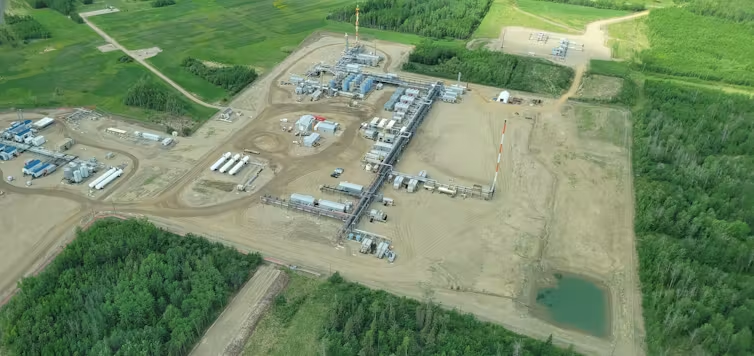
A drill pad seen from above. The evidence base for health harms associated with living close to active oil and gas wells emerged long after B.C.’s setback regulations were created in 2010. (Tim Takaro/ CC BY)

A drill pad seen from above. The evidence base for health harms associated with living close to active oil and gas wells emerged long after B.C.’s setback regulations were created in 2010. (Tim Takaro/ CC BY)

In May, Prime Minister Mark Carney announced plans to double the capacity of Canada’s electricity grid by 2050, using natural gas in the name of “powering Canada strong.” Almost all Canadian gas these days is derived from hydraulic fracturing—known as fracking—an industrial process involving large amounts of water laced with chemicals pumped long distances underground.

Many of the chemicals used in fracking are harmful to humans and include carcinogens such as PFAS (commonly referred to as “forever chemicals”) and endocrine disruptors.

These chemicals can leak into the environment through spills, pipes that eventually erode and crack, and evaporation into the air when stored in open wastewater ponds. The toxicity of this chemical mix is further exacerbated by naturally occurring radioactive materials and heavy metals unearthed from deep underground during the fracking process.

Another source of health harms from residential proximity to this industry is air pollution from diesel traffic, compressor stations and the venting and flaring of methane and other volatile organic gases—all of which are integral to shale gas extraction.

Residential Setback Regulations

Jurisdictions where fracking takes place acknowledge the potential harms from living nearby active wells through a key regulation termed a “residential setback”—defined as the minimum allowable distance between where a person lives and the construction of an active well.

As part of an ongoing study, we recently examined setback distances in two Canadian provinces, British Columbia and Alberta, and four American states—California, Colorado, Pennsylvania and Texas—with major shale gas industries.

It turns out that B.C. and Alberta have the shortest and least protective residential setback regulations compared to their major U.S. counterparts. This distance—a mere 100 metres—is significantly shorter than California’s and Colorado’s default setback distances at 975 metres and 610 metres respectively.

Get the latest climate news and analysis, direct to your inbox.

Subscribe Today

View our latest digests

California’s 975-metre regulated setback distance not only applies to private residences but also covers other “sensitive receptors,” defined as education resources, community resource centres, health-care facilities, live-in housing or any business open to the public. There is no mention in B.C.’s regulations of other “sensitive receptors” except a non-binding policy to disallow gas wells within 1,000 metres (one kilometre) of a school.

Impact on Health

Researchers have used residential setbacks as a way to measure individuals’ exposure to fracking activity and its association with a variety of health outcomes. Several studies have demonstrated that mothers living closer to active gas wells are at greater risk of having smaller babies. This can lead to significant developmental and other health challenges later in life.

The farthest distance within which impaired fetal growth was observed in these studies was 10 kilometres—a distance 1,000 times greater than B.C. and Alberta’s currently regulated 100-metre setback distance.

Other studies report higher rates of congenital birth defects among infants born to mothers living within 10 kilometres of an active well compared to mothers living farther away.

A shorter distance to the nearest well has been linked to more self-reported symptoms in several studies. In one community-based survey in Pennsylvania, a significantly higher proportion of survey respondents living within 457 metres of a gas well reported symptoms than those living beyond that distance.

The researchers further reported that when a gas well, compressor station or impoundment pit was 457 to 1,219 metres away, 27% of participants reported throat irritation. This increased to 63% at 152 to 457 metres, and to 74% at less than 152 metres. This pattern was similar for sinus problems and headaches.

California researchers found that people living less than 200 metres from oil wells had significantly poorer lung function test results compared to those living beyond that distance.

Other health harms using setbacks to measure exposure reported greater risk of gestational hypertension within one kilometre of an active well and adverse mental health among a group of American and Canadian women attempting to conceive within two kilometres of an active well.

All these studies report health harms occurring at distances far greater than B.C.’s currently regulated 100-metre setback.

Other studies, deploying exposure measures that combine residential proximity and density of wells, found a wide range of human health harms. These include higher rates of childhood leukemia and other cancers, heart and lung diseases and overall mortality within perimeter distances greater than 100 metres.

Vulnerable Populations

Environmental exposures are also not equally distributed across and within populations. B.C.’s shale gas industry is located in the northeast area of the province. This is a rural and remote part of B.C. that’s the traditional territory of Treaty 8 First Nations who rely on the land for food, water sources, ceremonial practices and cultural identity.

One study set in northeast B.C. reported that areas with high proportions of Indigenous people experienced more air pollution compared to areas with a low proportions of Indigenous people. The study reported a similar pattern and even larger disparity in areas with high versus low socio-economic vulnerability.

Rural B.C.’s northeast is experiencing a massive expansion in the number of active wells to meet the increasing demand from B.C.s new liquefied natural gas (LNG) industry. The harms from these wells are minimally regulated at best and not subject to cumulative environmental assessments.

The evidence base for health harms associated with living close to active oil and gas wells emerged long after B.C.’s setback regulations were created in 2010. The burden of these health harms are likely to worsen with the current fracking boom.

Setback regulations remain the only lever that affords some protection to those bearing the greatest health risks from shale gas development. Provincial and federal governments have made the unfortunate decision to go “full-bore” on expanding fracking. There is an urgent need to align regulatory setbacks with environmental health evidence and best practices to protect peoples’ health.

Canadian Association of Physicians for the Environment (CAPE) member Margaret McGregor is a clinical associate professor in the UBC Dept. of Family Practice, Faculty of Medicine, University of British Columbia. Deborah Curran is a professor at the Faculty of Law and School of Environmental Studies and executive director of the Environmental Law Centre, University of Victoria. Élyse Caron-Beaudoin is an assistant professor of environmental health, Department of Health and Society, University of Toronto. Kevin Berk is a PhD candidate at the Schulich School of Law, Dalhousie University and a former articling student at the Environmental Law Centre, and Tim K. Takaro is professor emeritus, Faculty of Health Sciences, Simon Fraser University, and also a CAPE member.

This article is republished from The Conversation under a Creative Commons license.


in Alberta, British Columbia, Fracking & LNG, Opinion & Analysis

Trending Stories

Facebook
Severe Storms & Flooding

540+ Dead, Hundreds Missing as Towering Flash Flood in Nepal Points to Extreme Heat, Heavy Rainfalls

August 28, 2026
975
Sarah Yurchevich
Data Centres & Tech

Alberta Woman Maps Out the Facts About Power-Hungry Data Centres

August 25, 2026
707
picryl
Canadian Sovereignty

Trump Trade War Could Be a Catalyst to Speed Canada’s Energy Transition, Experts Say

August 25, 2026
672

Leave a Reply Cancel reply

Your email address will not be published. Required fields are marked *

I agree to the Terms & Conditions and Privacy Policy.

Get the latest climate news and analysis, direct to your inbox.

Subscribe Today

Related Articles

Local Economies Pushed Aside as Newfoundland LNG Megaproject Presses Ahead

Local Economies Pushed Aside as Newfoundland LNG Megaproject Presses Ahead

February 6, 2026
Fermeuse LNG Receives Boost in MOU with South Korea’s Hanwha Industrial Conglomerate

Fermeuse LNG Receives Boost in MOU with South Korea’s Hanwha Industrial Conglomerate

January 29, 2026
LNG Glut Hits on Schedule as Shell, Mitsubishi Try to Withdraw from B.C. Megaproject

LNG Glut Hits on Schedule as Shell, Mitsubishi Try to Withdraw from B.C. Megaproject

January 19, 2026

The End of the World vs. the End of the Week: Carney’s Pushback on Trump’s Bullying Could Point to the Next Energy Transition Moment

by Mitchell Beer
August 23, 2026

…

Follow Us

Opinion & Analysis

B.C. And Alberta Fall Behind on Fracking Safety Distances for Residents

July 2, 2026
Reading time: 6 minutes
Full Story: The Conversation
Author: Margaret McGregor, Deborah Curran, Élyse Caron-Beaudoin, Kevin Berk, Tim K. Takaro

A drill pad seen from above. The evidence base for health harms associated with living close to active oil and gas wells emerged long after B.C.’s setback regulations were created in 2010. (Tim Takaro/ CC BY)

A drill pad seen from above. The evidence base for health harms associated with living close to active oil and gas wells emerged long after B.C.’s setback regulations were created in 2010. (Tim Takaro/ CC BY)

In May, Prime Minister Mark Carney announced plans to double the capacity of Canada’s electricity grid by 2050, using natural gas in the name of “powering Canada strong.” Almost all Canadian gas these days is derived from hydraulic fracturing—known as fracking—an industrial process involving large amounts of water laced with chemicals pumped long distances underground.

Many of the chemicals used in fracking are harmful to humans and include carcinogens such as PFAS (commonly referred to as “forever chemicals”) and endocrine disruptors.

These chemicals can leak into the environment through spills, pipes that eventually erode and crack, and evaporation into the air when stored in open wastewater ponds. The toxicity of this chemical mix is further exacerbated by naturally occurring radioactive materials and heavy metals unearthed from deep underground during the fracking process.

Another source of health harms from residential proximity to this industry is air pollution from diesel traffic, compressor stations and the venting and flaring of methane and other volatile organic gases—all of which are integral to shale gas extraction.

Residential Setback Regulations

Jurisdictions where fracking takes place acknowledge the potential harms from living nearby active wells through a key regulation termed a “residential setback”—defined as the minimum allowable distance between where a person lives and the construction of an active well.

As part of an ongoing study, we recently examined setback distances in two Canadian provinces, British Columbia and Alberta, and four American states—California, Colorado, Pennsylvania and Texas—with major shale gas industries.

It turns out that B.C. and Alberta have the shortest and least protective residential setback regulations compared to their major U.S. counterparts. This distance—a mere 100 metres—is significantly shorter than California’s and Colorado’s default setback distances at 975 metres and 610 metres respectively.

Get the latest climate news and analysis, direct to your inbox.

Subscribe Today

View our latest digests

California’s 975-metre regulated setback distance not only applies to private residences but also covers other “sensitive receptors,” defined as education resources, community resource centres, health-care facilities, live-in housing or any business open to the public. There is no mention in B.C.’s regulations of other “sensitive receptors” except a non-binding policy to disallow gas wells within 1,000 metres (one kilometre) of a school.

Impact on Health

Researchers have used residential setbacks as a way to measure individuals’ exposure to fracking activity and its association with a variety of health outcomes. Several studies have demonstrated that mothers living closer to active gas wells are at greater risk of having smaller babies. This can lead to significant developmental and other health challenges later in life.

The farthest distance within which impaired fetal growth was observed in these studies was 10 kilometres—a distance 1,000 times greater than B.C. and Alberta’s currently regulated 100-metre setback distance.

Other studies report higher rates of congenital birth defects among infants born to mothers living within 10 kilometres of an active well compared to mothers living farther away.

A shorter distance to the nearest well has been linked to more self-reported symptoms in several studies. In one community-based survey in Pennsylvania, a significantly higher proportion of survey respondents living within 457 metres of a gas well reported symptoms than those living beyond that distance.

The researchers further reported that when a gas well, compressor station or impoundment pit was 457 to 1,219 metres away, 27% of participants reported throat irritation. This increased to 63% at 152 to 457 metres, and to 74% at less than 152 metres. This pattern was similar for sinus problems and headaches.

California researchers found that people living less than 200 metres from oil wells had significantly poorer lung function test results compared to those living beyond that distance.

Other health harms using setbacks to measure exposure reported greater risk of gestational hypertension within one kilometre of an active well and adverse mental health among a group of American and Canadian women attempting to conceive within two kilometres of an active well.

All these studies report health harms occurring at distances far greater than B.C.’s currently regulated 100-metre setback.

Other studies, deploying exposure measures that combine residential proximity and density of wells, found a wide range of human health harms. These include higher rates of childhood leukemia and other cancers, heart and lung diseases and overall mortality within perimeter distances greater than 100 metres.

Vulnerable Populations

Environmental exposures are also not equally distributed across and within populations. B.C.’s shale gas industry is located in the northeast area of the province. This is a rural and remote part of B.C. that’s the traditional territory of Treaty 8 First Nations who rely on the land for food, water sources, ceremonial practices and cultural identity.

One study set in northeast B.C. reported that areas with high proportions of Indigenous people experienced more air pollution compared to areas with a low proportions of Indigenous people. The study reported a similar pattern and even larger disparity in areas with high versus low socio-economic vulnerability.

Rural B.C.’s northeast is experiencing a massive expansion in the number of active wells to meet the increasing demand from B.C.s new liquefied natural gas (LNG) industry. The harms from these wells are minimally regulated at best and not subject to cumulative environmental assessments.

The evidence base for health harms associated with living close to active oil and gas wells emerged long after B.C.’s setback regulations were created in 2010. The burden of these health harms are likely to worsen with the current fracking boom.

Setback regulations remain the only lever that affords some protection to those bearing the greatest health risks from shale gas development. Provincial and federal governments have made the unfortunate decision to go “full-bore” on expanding fracking. There is an urgent need to align regulatory setbacks with environmental health evidence and best practices to protect peoples’ health.

Canadian Association of Physicians for the Environment (CAPE) member Margaret McGregor is a clinical associate professor in the UBC Dept. of Family Practice, Faculty of Medicine, University of British Columbia. Deborah Curran is a professor at the Faculty of Law and School of Environmental Studies and executive director of the Environmental Law Centre, University of Victoria. Élyse Caron-Beaudoin is an assistant professor of environmental health, Department of Health and Society, University of Toronto. Kevin Berk is a PhD candidate at the Schulich School of Law, Dalhousie University and a former articling student at the Environmental Law Centre, and Tim K. Takaro is professor emeritus, Faculty of Health Sciences, Simon Fraser University, and also a CAPE member.

This article is republished from The Conversation under a Creative Commons license.


in Alberta, British Columbia, Fracking & LNG, Opinion & Analysis

Leave a Reply Cancel reply

Your email address will not be published. Required fields are marked *

I agree to the Terms & Conditions and Privacy Policy.

Related Articles

Local Economies Pushed Aside as Newfoundland LNG Megaproject Presses Ahead

Local Economies Pushed Aside as Newfoundland LNG Megaproject Presses Ahead

February 6, 2026
Fermeuse LNG Receives Boost in MOU with South Korea’s Hanwha Industrial Conglomerate

Fermeuse LNG Receives Boost in MOU with South Korea’s Hanwha Industrial Conglomerate

January 29, 2026
LNG Glut Hits on Schedule as Shell, Mitsubishi Try to Withdraw from B.C. Megaproject

LNG Glut Hits on Schedule as Shell, Mitsubishi Try to Withdraw from B.C. Megaproject

January 19, 2026

Trending Stories

Facebook

540+ Dead, Hundreds Missing as Towering Flash Flood in Nepal Points to Extreme Heat, Heavy Rainfalls

August 28, 2026
975
Sarah Yurchevich

Alberta Woman Maps Out the Facts About Power-Hungry Data Centres

August 25, 2026
707
picryl

Trump Trade War Could Be a Catalyst to Speed Canada’s Energy Transition, Experts Say

August 25, 2026
672

The End of the World vs. the End of the Week: Carney’s Pushback on Trump’s Bullying Could Point to the Next Energy Transition Moment

by Mitchell Beer
August 23, 2026

…

Follow Us

Copyright 2026 © Energy Mix Productions Inc. All rights reserved.

  • About
  • Contact
  • Privacy Policy and Copyright
  • Cookie Policy
No Result
View All Result
  • Topics
    • Buildings & Infrastructure
    • Climate Equity & Justice
      • Energy Poverty
      • Indigenous Rights & Reconciliation
    • Climate Finance
      • Community Climate Finance
      • Finance & Investment
      • Insurance & Liability
      • Subsidies
    • Climate Impacts & Adaptation
      • Biodiversity & Habitat
      • Drought & Wildfires
      • Forests & Deforestation
      • Health & Safety
      • Heat & Temperature
      • Ice Loss & Sea Level Rise
      • Severe Storms & Flooding
    • Emissions
      • Carbon Levels & Measurement
      • CCS & Negative Emissions
      • Methane
    • Energy
      • Renewables
      • Fossil Fuels
      • Hydrogen
      • Nuclear
      • Batteries & Storage
      • Energy Efficiency
      • Power Grids
    • Food & Agriculture
    • Industry
      • Data Centres & Tech
      • Critical Minerals & Mining
      • Petrochemicals & Plastics
    • Policy & Politics
      • Carbon Pricing
      • COP Conferences
      • Elections
      • Energy Politics
      • International Security & War
      • Legal & Regulatory
    • Research & Innovation
      • International Agencies & Studies
      • Research & Development
    • Society & Culture
      • Climate Action
      • Mis/Disinformation & Greenwashing
      • Jobs & Training
      • Leisure & Recreation
      • Media, Messaging, & Public Opinion
    • Transportation & Mobility
      • Electric Vehicles
      • Shipping & Aviation
      • Transit
      • Walking, Biking & Micromobility
  • Regions
    • Africa
    • Arctic & Antarctica
    • Asia
    • Australia
    • Canada
    • International
    • Mexico & the Caribbean
    • Middle East
    • Oceans
    • Small Island States
    • South & Central America
    • Subnational
    • United States
    • UK & Europe
  • Special Coverage
    • The Weekender
    • IEA2026
    • Canada’s Major Projects Office
    • Hidden Wonder Valley
    • COP30
    • Cities & Communities
    • Heat & Power
    • Community Climate Finance
  • More Resources
    • Climate Glossary
    • What If We Changed the Conversation on Climate Change?
    • Eco-Anxiety
  • About
  • Contact

Copyright 2025 © Smarter Shift Inc. and Energy Mix Productions Inc. All rights reserved.

Manage Cookie Consent
To provide the best experiences, we use technologies like cookies to store and/or access device information. Consenting to these technologies will allow us to process data such as browsing behaviour or unique IDs on this site. Not consenting or withdrawing consent, may adversely affect certain features and functions.
Functional Always active
The technical storage or access is strictly necessary for the legitimate purpose of enabling the use of a specific service explicitly requested by the subscriber or user, or for the sole purpose of carrying out the transmission of a communication over an electronic communications network.
Preferences
The technical storage or access is necessary for the legitimate purpose of storing preferences that are not requested by the subscriber or user.
Statistics
The technical storage or access that is used exclusively for statistical purposes. The technical storage or access that is used exclusively for anonymous statistical purposes. Without a subpoena, voluntary compliance on the part of your Internet Service Provider, or additional records from a third party, information stored or retrieved for this purpose alone cannot usually be used to identify you.
Marketing
The technical storage or access is required to create user profiles to send advertising, or to track the user on a website or across several websites for similar marketing purposes.
  • Manage options
  • Manage services
  • Manage {vendor_count} vendors
  • Read more about these purposes
View preferences
  • {title}
  • {title}
  • {title}
No Result
View All Result
  • Topics
    • Buildings & Infrastructure
    • Climate Equity & Justice
      • Energy Poverty
      • Indigenous Rights & Reconciliation
    • Climate Finance
      • Community Climate Finance
      • Finance & Investment
      • Insurance & Liability
      • Subsidies
    • Climate Impacts & Adaptation
      • Biodiversity & Habitat
      • Drought & Wildfires
      • Forests & Deforestation
      • Health & Safety
      • Heat & Temperature
      • Ice Loss & Sea Level Rise
      • Severe Storms & Flooding
    • Emissions
      • Carbon Levels & Measurement
      • CCS & Negative Emissions
      • Methane
    • Energy
      • Renewables
      • Fossil Fuels
      • Hydrogen
      • Nuclear
      • Batteries & Storage
      • Energy Efficiency
      • Power Grids
    • Food & Agriculture
    • Industry
      • Data Centres & Tech
      • Critical Minerals & Mining
      • Petrochemicals & Plastics
    • Policy & Politics
      • Carbon Pricing
      • COP Conferences
      • Elections
      • Energy Politics
      • International Security & War
      • Legal & Regulatory
    • Research & Innovation
      • International Agencies & Studies
      • Research & Development
    • Society & Culture
      • Climate Action
      • Mis/Disinformation & Greenwashing
      • Jobs & Training
      • Leisure & Recreation
      • Media, Messaging, & Public Opinion
    • Transportation & Mobility
      • Electric Vehicles
      • Shipping & Aviation
      • Transit
      • Walking, Biking & Micromobility
  • Regions
    • Africa
    • Arctic & Antarctica
    • Asia
    • Australia
    • Canada
    • International
    • Mexico & the Caribbean
    • Middle East
    • Oceans
    • Small Island States
    • South & Central America
    • Subnational
    • United States
    • UK & Europe
  • Special Coverage
    • The Weekender
    • IEA2026
    • Canada’s Major Projects Office
    • Hidden Wonder Valley
    • COP30
    • Cities & Communities
    • Heat & Power
    • Community Climate Finance
  • More Resources
    • Climate Glossary
    • What If We Changed the Conversation on Climate Change?
    • Eco-Anxiety
  • About
  • Contact

Copyright 2025 © Smarter Shift Inc. and Energy Mix Productions Inc. All rights reserved.